
"Blue Onion" plate by Ernst Teichert, hand-painted porcelain with floral-vegetal decoration, circa early 20th century
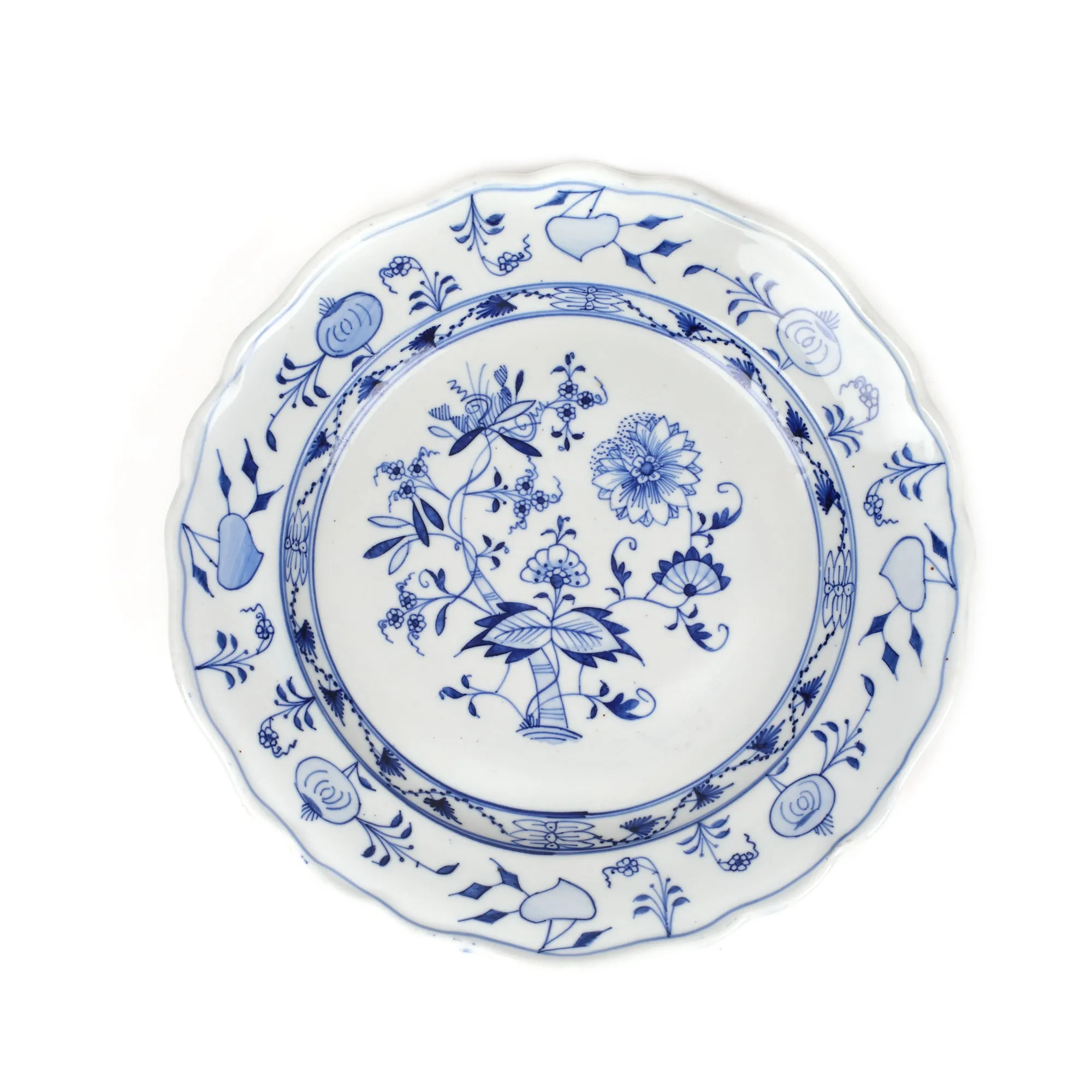
"Blue Onion" plate by Ernst Teichert, hand-painted porcelain with floral-vegetal decoration, circa early 20th century
Description
The "onion" model, initially called the "bulb" model, is inspired by Asian motifs of pomegranates, peaches, bamboo, lotus flowers, and chrysanthemums. Since pomegranates were not a common fruit in Germany, Meissen painters created hybrids resembling flora more familiar to Europeans. Johann Friedrich Ernst Teichert initially worked as a master in his brother Johann Friedrich Carl Teichert's ceramic factory. In 1869, he established his own factory, Produktionsstätte für Ofen- und Schamottewaren. The factory's name was changed in 1872 to Aktiengesellschaft Sächsische Ofen- und Schamottewaren Fabrik. By the second half of the 1870s, distribution was limited to the German market due to very high import taxes. In 1884, Ernst Teichert opened a porcelain factory, Ernst Teichert Cölln-Meißen, which was taken over in 1886 after his death by his son Christian. On July 27, 1901, the company became Ernst Teichert GmbH, producing colored tiles, ornamental ceramics, and tableware. In 1930, Meißner Ofen- und Porzellanfabrik (the former Carl Teichert Meißen), Ernst Teichert GmbH
Sizing
Sizing info d=24 cm
Signature
marked at the base with the mark of Ernst Teichert "Meissen"
Medium
hand-painted porcelain
Location
Artmark românia