
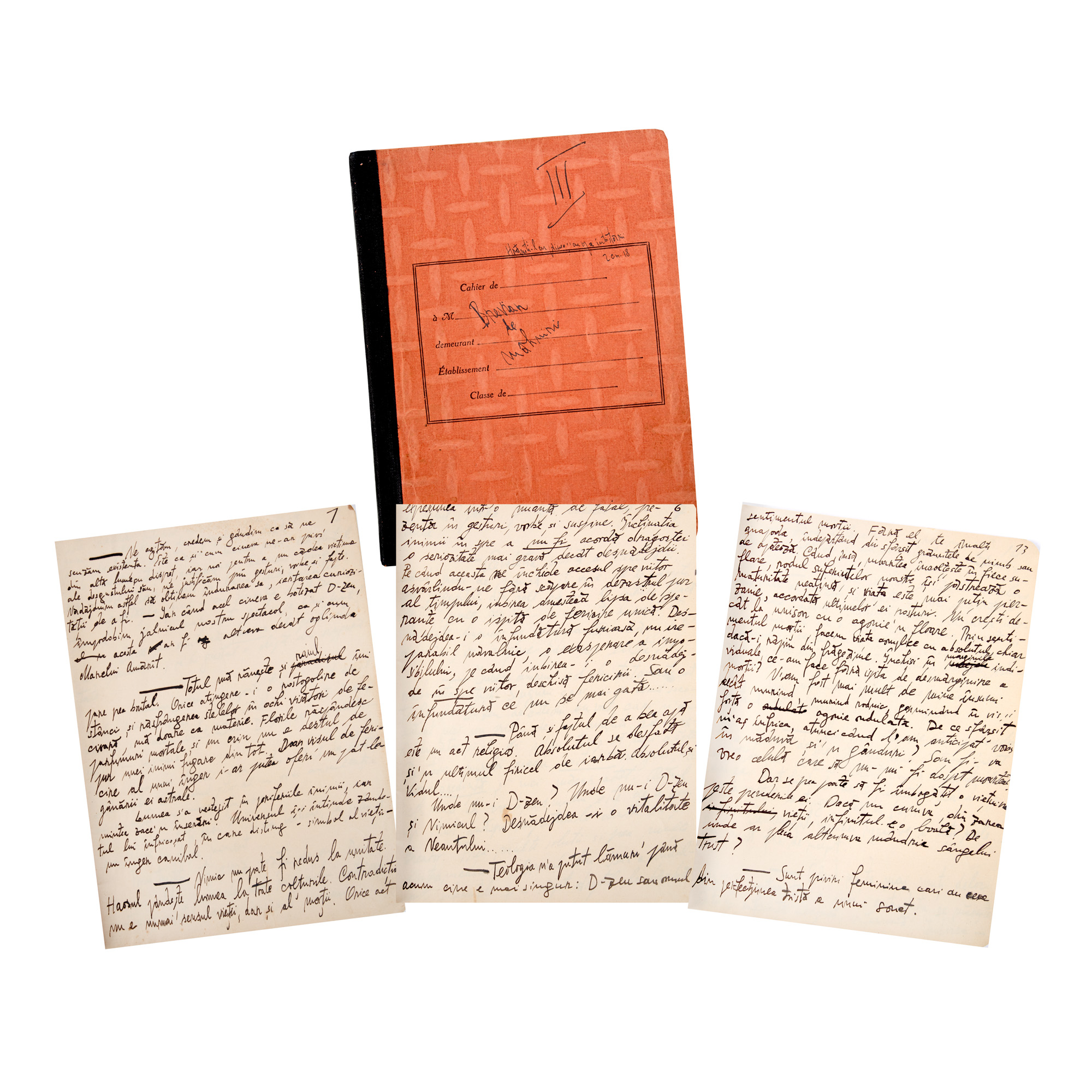
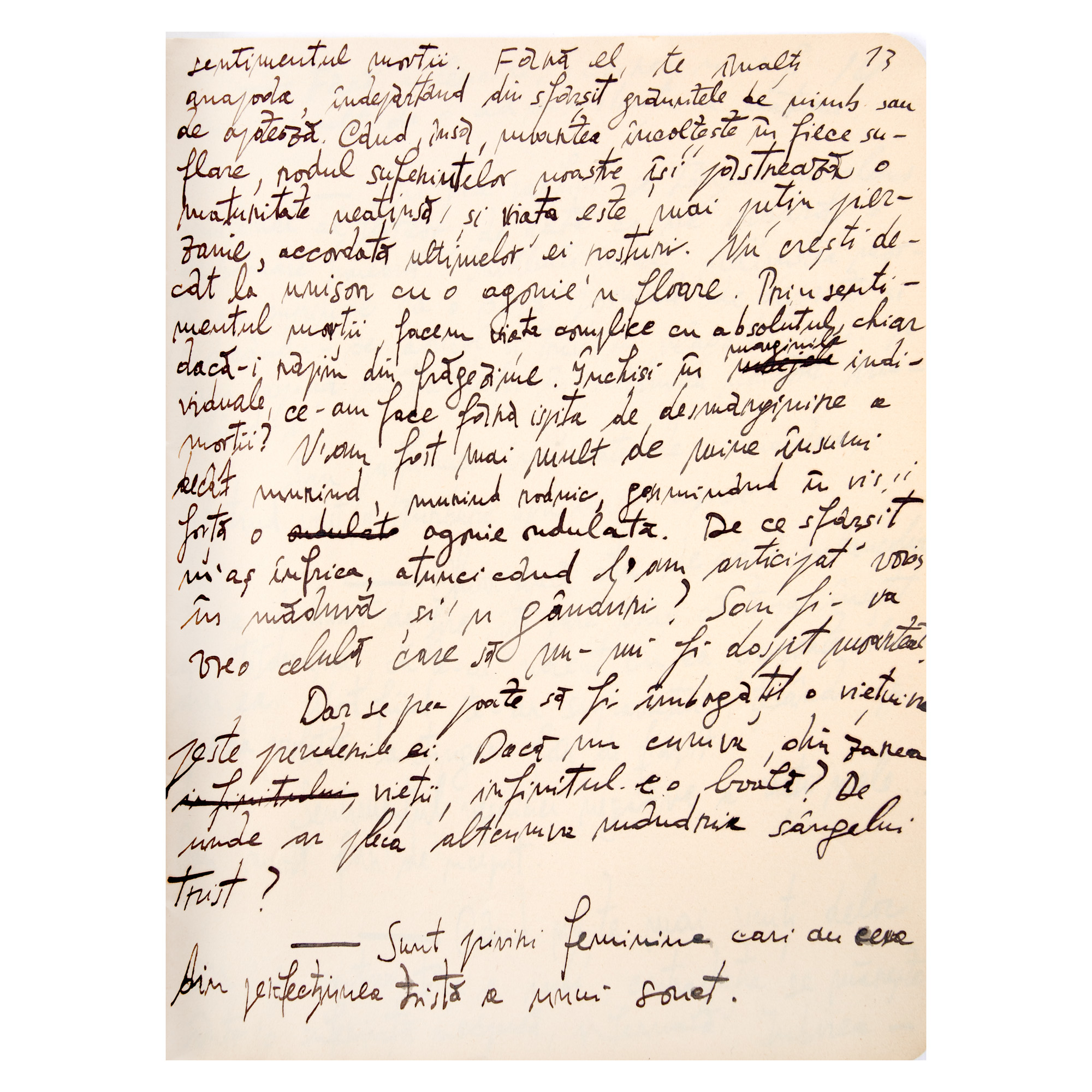
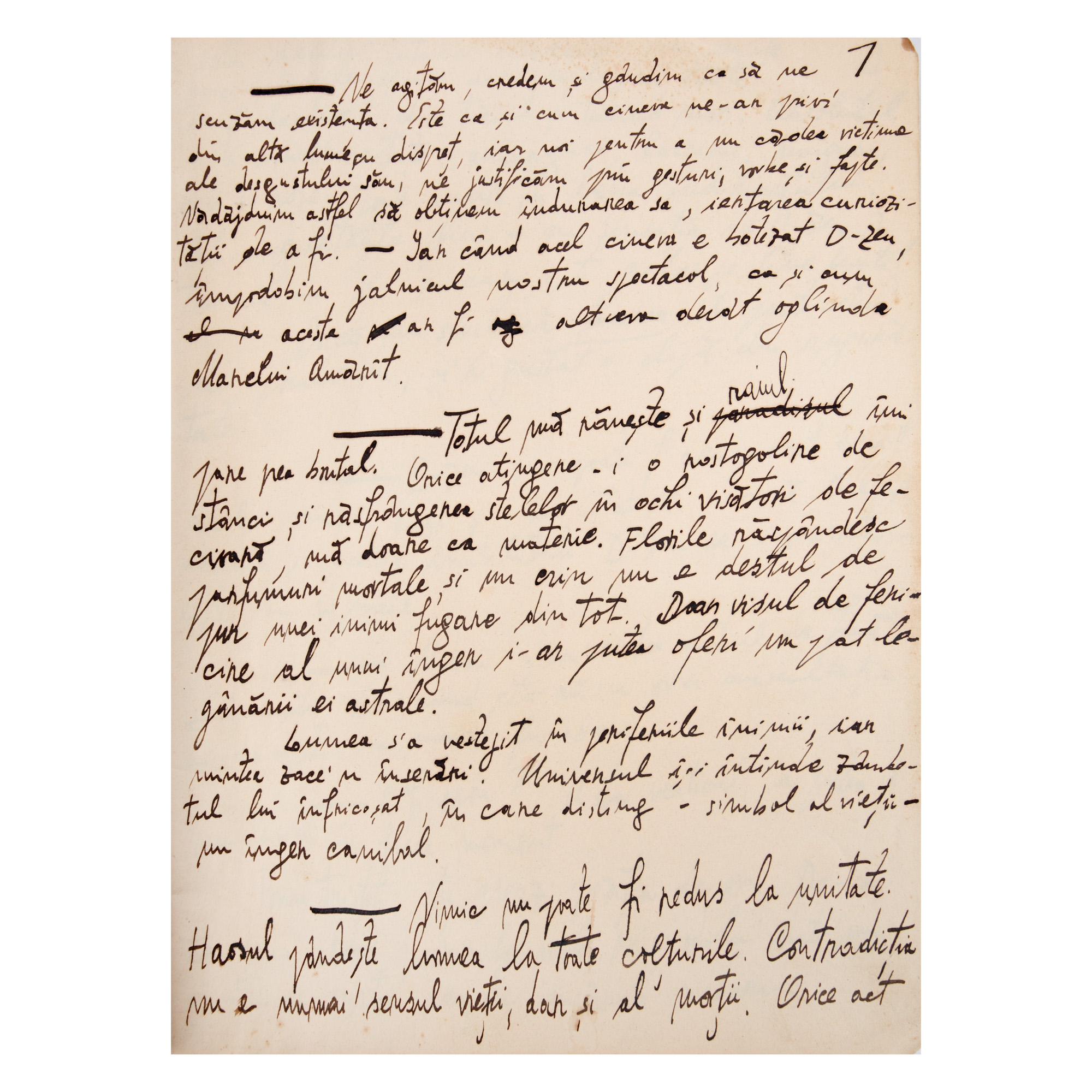
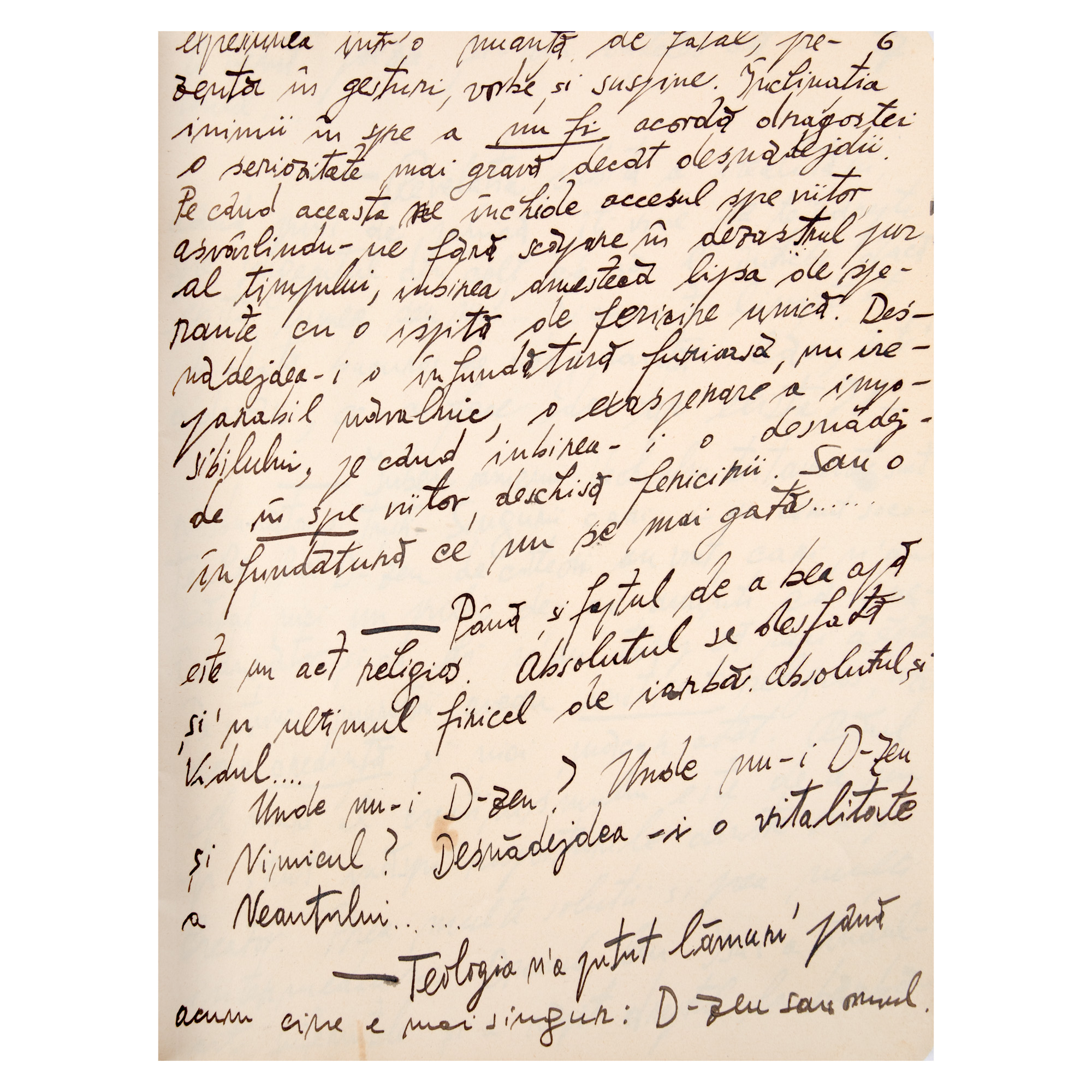
95. Emil Cioran notebook, containing the manuscript of a part of the "Amurgul Gândurilor" ("The Twilight of Thinking") ("Feed him with the bread and water of sorrow ..."), ca. 1940, absolute rarity, collectible piece (50 pages)
The photos of the lot are informative and indicative, and cannot provide a highly detailed view of the object from all angles. We recommend a careful physical inspection of the lot before bidding.
95. Emil Cioran notebook, containing the manuscript of a part of the "Amurgul Gândurilor" ("The Twilight of Thinking") ("Feed him with the bread and water of sorrow ..."), ca. 1940, absolute rarity, collectible piece (50 pages)
22.5 x 17 cm
Research information
"The Twilight of Thinking" is the last book published in the country by Emil Cioran, in 1940, after "Pe culmile disperÄrii" ("On the Heights of Despair") (1934), "Cartea amagirilor" ("The Book of Delusions") (1936), "Schimbarea la faÈÄ a României" ("The Transfiguration of Romania") (1936), "Lacrimi Èi sfinÈi" ("Tears and Saints") (1937). These volumes, to which one can add "Ãndreptar patimaÈ" ("The Passionate Handbook"), remained undisclosed until 1991, already represent a creation with distinct features in the landscape of the era, when brilliant individual voices were imposed, shaping the profile of the great generation of the 30s: Mircea Eliade, Eugen Ionesco, Constantin Noica, Mircea VulcÄnescu. The unprecedented spiritual effervescence, centred on the fundamental themes of the crisis of the modern world and our psychological and historical status, seemed to contain a foreshadowing of the ungenerous period of the totalitarian years. Some ideas were exiled with their authors altogether, entering the European heritage, becoming classics. That is how it happened with the scholarly works of Mircea Eliade, with Ionescoâs theatre, with Cioranâs fragmentary philosophy. The latter became the stylistic standard of the French language, dominating, despite its austere existence, the Parisian literary scene. Cioran fascinated from the beginning, due to his heretical ideation evincing a sealed pessimism, to which he associated a striking aphoristic rhetoric in "Amurgul gândurilor" ("The Twilight of Thinking"), deepening the twilight sensitivity chosen from the very beginning, and at the same time it anticipated the evolution in French of remarkable consistency in terms of attitude. The dark register of the prophecy always raises the Hamletian issues of the Life-Nothingness dialectic. The obsessive oscillation "To be or not to be?" is given a definitive answer by the thinker, in numerous nuances: neither one nor the other. There is no escape from decadence, decay, which, paradoxically, is an occasion for jubilation in despair â this is the leitmotif of the volume bearing an agonic, Wagnerian name. In fact, the German composer seems to play Cioranâs seductive twilight melancholy: "â¦in the Wagnerian delight, distant and dusky waves roar around tired temples or overturn sleeping remedies of dream and doom." The phrase is filled with keywords, which have the capacity to define a vivid but abused sensibility, which praises extinction, but longing for extasy, at the same time.
For clarifications regarding the bidding procedure, hammer price costs, guarantee, payment, and collection terms for the winning lot, we recommend carefully reading/re-reading the Bidding Regulations.
For additional information regarding the lot and the auction, please contact the Art Consultants Department.
Similar lots