The photos of the lot are informative and indicative, and cannot provide a highly detailed view of the object from all angles. We recommend a careful physical inspection of the lot before bidding.
Eduard Andrei, "Ștefan Luchian și Georges de Feure. Noutăți despre original, replică, interpretare în creația Art Nouveau", in Antichități România, no. 45-46 (3-4), 20011, pp. 40-43 (see also academia.edu/34877075/Ștefan_Luchian_si_Georges_de_Feure._notedii_despre__original_replica_interpretare_in_creatia_Art_Nouveau).
Petru Comarnescu, Luchian, 2nd edition, revised, Tineretului Publishing House, Bucharest, 1965, p. 172-173, 177-179, reproductions.
Paul Constantin, Arta 1900 in Romania, Meridiane, Bucharest, 1972, pp. 137-138 Publishing House of the Academy of the R.S.R., Bucharest, 1972, pp. 137-138, reproduction.
Monica Enache, "Interferențe plastice: Ștefan Luchian (1868-1916) și Georges de Feure (1868-1943)", in Astra, no. 3-4/2011.
Theodor Enescu, Luchian Exhibition, The R.P.R. Museum of Art, Bucharest, 1957.
Theodor Enescu, "Simbolismul și pictura. Un capitol din evoluția picturii și a gustului artistic la sfârșitul secolului al XIX-lea și începutul secolului al XX-lea", in Pagini de artă românească modernă, Academiei Publishing House, Bucharest, 1974, p.7-57 and reproductions.
Theodor Enescu, Ștefan Luchian. Painting, pastel, watercolour, drawing, Romanian Cultural Institute, Bucharest, 2007.
Theodor Enescu, Luchian and the origins of the modern spirit in Romanian painting, translated by Ioana Vlasiu, Official Journal, Bucharest, 2015.
Marin Mihalache, Testimonies about Luchian, Meridiane Publishing House, Bucharest, 1966.
Ian Millman, Georges de Feure. Maître du Symbolisme et de l’Art Nouveau, A.C.R. Edition Internationale, Courbevoie (Paris), 1992, pp. 8-9.
Elena Olaru, Ștefan Luchian, the master of Romanian graphic art, [exhibition catalogue], The National Museum of Art of Romania Publishing House, Bucharest, 2018, bilingual Romanian-English edition.
Geogeta Peleanu, Petre Oprea, Doina Schobel, Exhibition Flowers in the work of the painter Ștefan Luchian, The R.S.R. Museum of Art, Bucharest, 1966. (cat.74, p. 80, with the reproduction of the preparatory watercolour for the Autumn panel).
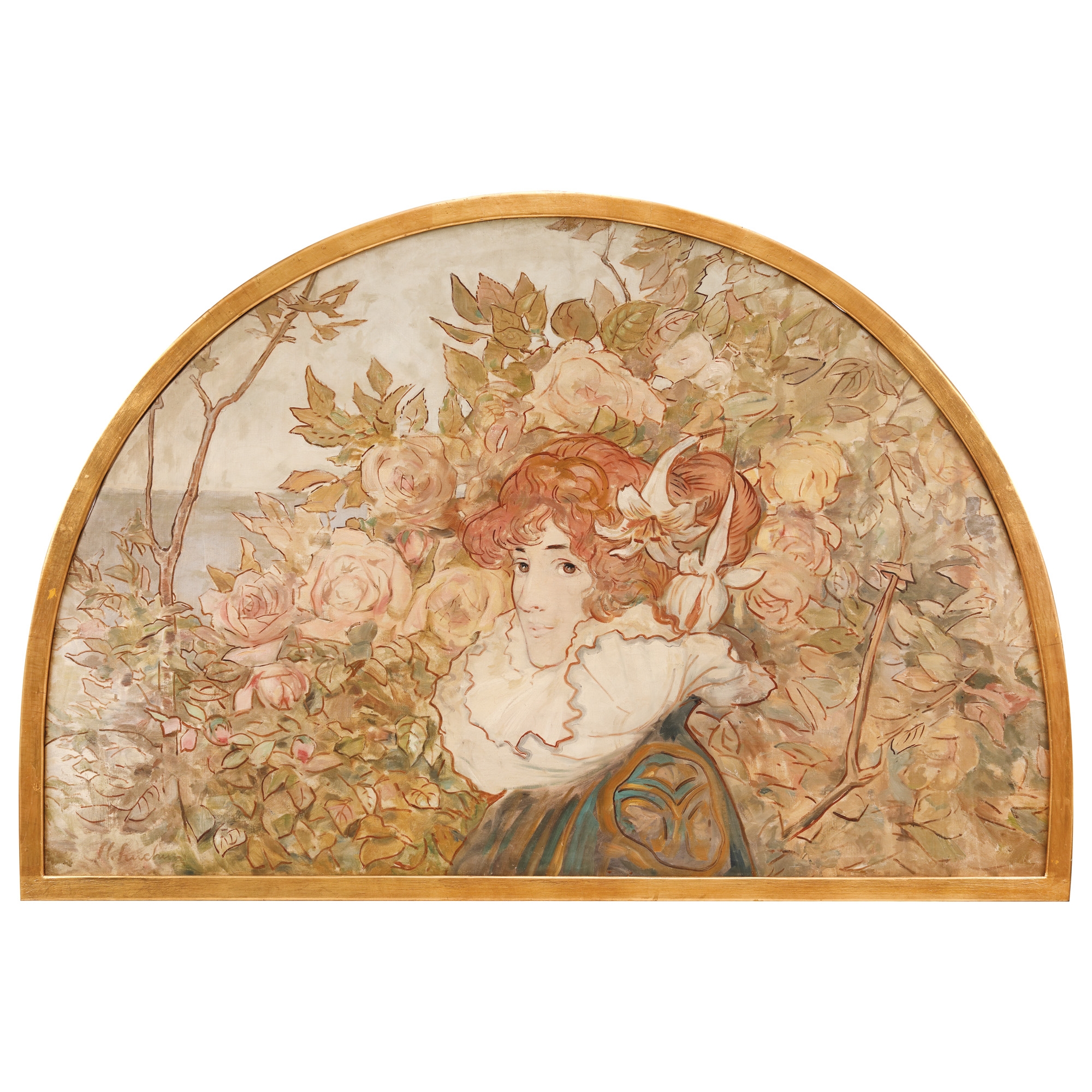
oil on canvas, 95 x 143 cm, 95 Ã 143 cm, signed bottom left, with brown, "Șt. Luchian"
Research information
The artwork is reproduced în "Scrieri despre artÄ. Ètefan Luchian Èi spiritul modern în pictura româneascÄ", Theodor Enescu, Meridiane Publishing House, Bucharest, 2000 cat. 75, under the title "Panou decorativ". The artwork is reproduced in the monography "Luchian", Petru Comarnescu, Tineretului Publishing House, Bucharest, 1965 under the title "Panou decorativ". The artwork is reproduced în "Arta 1900 în România", Paul Constantin. Meridiane Publishing House, Bucharest, 1972, p. 138. A study of the artwork is reproduced in "Arta 1900 în România", Paul Constantin. Meridiane Publishing House, Bucharest, 1972, p. 138.
PROVENANCE
the historical collection of the diplomat Victor Antonescu (1871-1947); "Autumn" is part of a set of four allegorical oils commissioned by Victor Antonescu in 1901, when he was completing the work on his residence in Bucharest on ColÈei Boulevard.
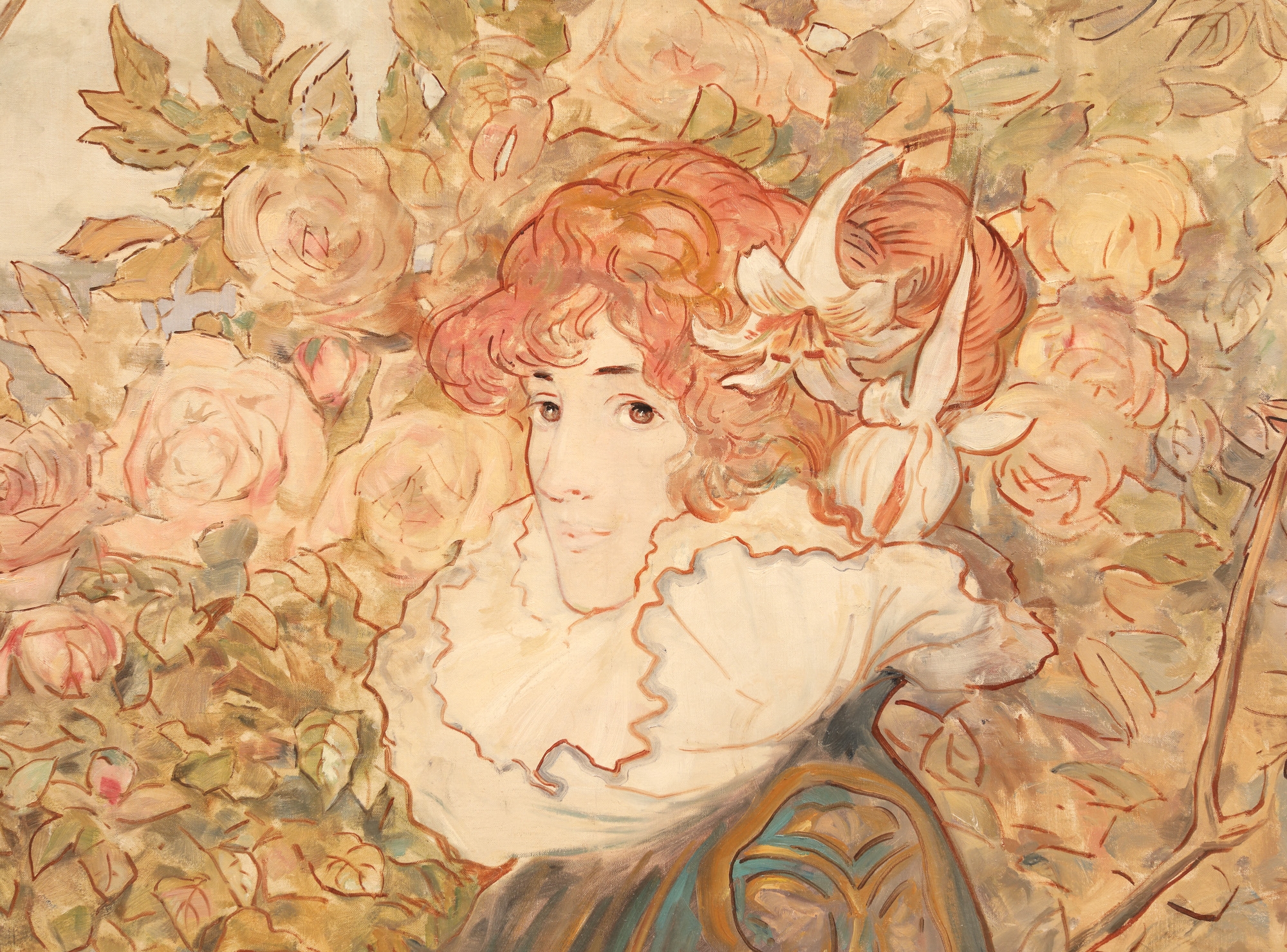
The elegant trajectory of the sinuous lines, just like the crowning of the assembly using the arch of a circle, impregnates an essential decorative effect to the current work. In the centre of the composition, looking towards us, a gracious feminine figure emerges from the folds of an elegant white silk collar, integrated, just like a floral element, to the mass of vegetation flooding the image. The character's generously moulded hairstyle becomes a decorative motif in itself, both thanks to the line's direction, as well as to the symbolic presence of the two white lilies. All these aspects exuding class and elegance converge, offering the current work features typical for Art Nouveau, a style which had emerged towards the end of the 19th Century, descending from Symbolist sensitivity. Marking plastic and decorative arts worldwide (furniture, ceramic, glass, etc.) around 1900, the Art Nouveau style, also known under various denominations - Art 1900, Modern Style, Jugendstil, Lo Stile Floreale - represented at that time the new artistic lexicon, the original formula, highly awaited when stepping into the 20th Century.
The current commissioned work, conceived and executed by Luchian in 1901, is part of a suite of four or perhaps more decorative panels1, representing feminine allegories (presumably the four seasons) - - seemingly aimed at decorating the home of lawyer and politician Victor Antonescu, in Strada Colței nr. 56 (1871, Antonești, Teleorman - 1947, Bucharest)2.
The comment by art historian Theodor Enescu regarding these panels (including the one offered to the public in this moment) emphasises Luchian's skillfulness as far as the decorative conception of the surfaces is concerned: "his knowledge of composing in gracious decorative assemblies, the delicate feminine figures typical for the end of the century - with their sophisticated hairstyles, their abundantly laced costumes, their sashes, their jewels and their floral adornments, their conventional demure gestures - on a background of leafy bushes, with luxuriant flowers and a scenographical combination of mysterious Medieval architecture styles."3
Two of the panels in question are property of the Romanian National Art Museum, the one by the title Primăvara (Spring) (inv.10577/104185) being part of the current permanent exhibition of the National Gallery and representing nowadays the hallmark of noblesse of the country's first art museum.4
For his definite works, Luchian elaborated preparatory versions 5, water colour drawings (some of them on paper, one of them on silk), which remind of the sophistication of the Far-Eastern graphics, executed with a high finesse of the line trajectory and transparency of the water colours. From these sketches, the water colour on silk (213 x 292 mm., Romanian Academy Library, inv. 3486) is the preparatory step for our panel, very close to the work Toamna (Autumn).
The actual Art Nouveau works are not numerous in Romanian art and architecture, but the echoes of this vision are often encountered around 1900, especially in graphic arts, in painting, interwoven with the state of mind generated by symbolist art (it also occurs in the case of the texts and illustrations of the Ileana magazine, for which Ștefan Luchian was one of the founders and collaborators). Re-emerged in the Western public conscience towards 1960-1970, after having been overlooked for a long time, art lovers' appreciation and art historians' interest towards Art Nouveau and symbolism is reborn starting from 1960-1970. The Romanian bibliography related to Luchian's work marks these changes of register, caused both by alterations of taste, as well as by the ideological perspective (Comarnescu, 1955; Enescu, 1974).
Given the short existence of the Art Nouveau stylistic movement in Luchian's work in relation with the post-impressionistic work defining him, we could ask ourselves whether the initial aesthetic option belonged to Luchian or Victor Antonescu, when the source of inspiration for the panels was chosen in the form of the Art Nouveau graphic by French-Dutch symbolist artist Georges de Feure (1868-1943), Luchian's contemporary, a renowned and appreciated poster author and decorator in the late 19th Century Paris. Flagged by Paul Constantin (1972), remembered by Theodor Enescu (1974), this closeness was analysed by young art historians Monica Enache (2011) and Eduard Andrei (2011), through detailed comparisons between similar works by Luchian and de Feure.
Reproductions of Georges de Feure's works can be found during the aforementioned years in various magazines from Paris, such as Le Figaro Illustré. According to Eduard Andrei (2011), "the painting Primăvara (Spring) as well as the sketches of the other "seasons" are almost faithful duplicates of a series of four gouache works executed in 1899 by Georges de Feure […]. Print engraved in 1900 at the Goupil studio in Paris, they were reproduced in the month of February of the same year - under the generic title 'Figură de femeie între flori' ('Feminine Figure among Flowers') - in the Le Figaro Illustré magazine." 6
Certainly, both the artist and the commissioner were touched by this choice of vision, dominating the last decade of the 19th Century, when both of them were in Paris and the images bearing Georges de Feure's signature circulated everywhere, becoming a true hallmark of the era. Besides, the French publications (current newspapers and art and decoration magazines) were imported and read regularly by the Bucharest high society.
As far as these panels' theme is concerned, one should emphasize the opinion of Monica Enache, who questions the "Anotimpuri" ("Seasons") title, using as a departure point Georges de Feure's works in the already quoted issue of Le Figaro Illustré ( nr.119). The researcher flags the images accompanying the article "La femme par le Feure", which bring into focus, using their typically symbolist titles, "the dual nature of the feminine personality": Experience, Vice versus Innocence, Virtue, Contemplation.
The decorative panel by the name of "Toamna" ("Autumn"), presented to the public today, remains one of Luchian's well-established works, an expression of the artist's craftsmanship in decorative composition, in drawing, and in the full command of painting techniques. Purchased from its last owner towards 1965, with the aid of painter Eugen Ispir, the current work originated, at that time, from C. Papahagi's collection, or the one of Dr. N. Cornățeanu - according to Theodor Enescu, Luchian Retrospective Exhibition Catalogue 1957, page 83.
Having been almost forgotten, its present appearance in Bucharest's artistic life contributes, just like a recovery process, to the completion of the cycle of panels mentioned by the bibliography, shedding more light over Luchian's work.
(Ioana Beldiman)
1 The definite panels and the preparatory water colour drawings are commented upon and reproduced in: Theodor Enescu, "Simbolismul și pictura I", in Pagini de artă modernă românească, Editura Academiei, 1974, p. 41-42. This study is the only publication containing reproductions of all known works belonging to the cycle in question. We draw the attention to the fact that under the image of the panel "Toamna", due to an inaccuracy, The Art Museum of RSR National Gallery is mentioned as an owner, instead of the correct version, Private collection, Bucharest.
2 Being a Professor of the Faculty of Law and Liberal Deputy at that date, Antonescu would later on become Director of the National Bank, a Minister and a Diplomat. For Victor Antonescu, see Monica Enache, "Interferențe plastice: Ștefan Luchian (1868-1916) și Georges de Feure (1868-1943)”, in Astra, issue 3-4/2011
3 Enescu, quoted work, p. 41
4 See Eduard Andrei, in "Ștefan Luchian și Georges de Feure. Noutăți despre original, replică, interpretare în creația Art Nouveau”, in Antichități - România, issue 45-46, 2011, p.40.
5 Two of them are in possession of the Romanian Academy Library, Stamps and Drawings Cabinet (inv. 3487 și 3486). A drawing in water colours is preserved in MNAR, Drawings and Engravings Cabinet, inv. 29038/4441.
6 Andrei, quoted work, p. 40-41.
For clarifications regarding the bidding procedure, hammer price costs, guarantee, payment, and collection terms for the winning lot, we recommend carefully reading/re-reading the Bidding Regulations.
For additional information regarding the lot and the auction, please contact the Art Consultants Department.