The photos of the lot are informative and indicative, and cannot provide a highly detailed view of the object from all angles. We recommend a careful physical inspection of the lot before bidding.
VLASIU, Ioana, "Nicolae Grigorescu and Modernity", Domino, 2008
OPRESCU, George, "Nicolae Grigorescu", Meridiane Publishing, 1963
STEGEREAN, Călin-Alexiu, POPOIU, Paula, "Nicolae Grigorescu. Painter of the Romanian ethos", National Museum of Art of Romania Publishing, 2023
CEBUC, Alexandru, "Grigorescu", Autonomous Administration "Official Monitor", 2007
MACOVEI, Cătălina, "Nicolae Grigorescu", Parkstone Press, 1999
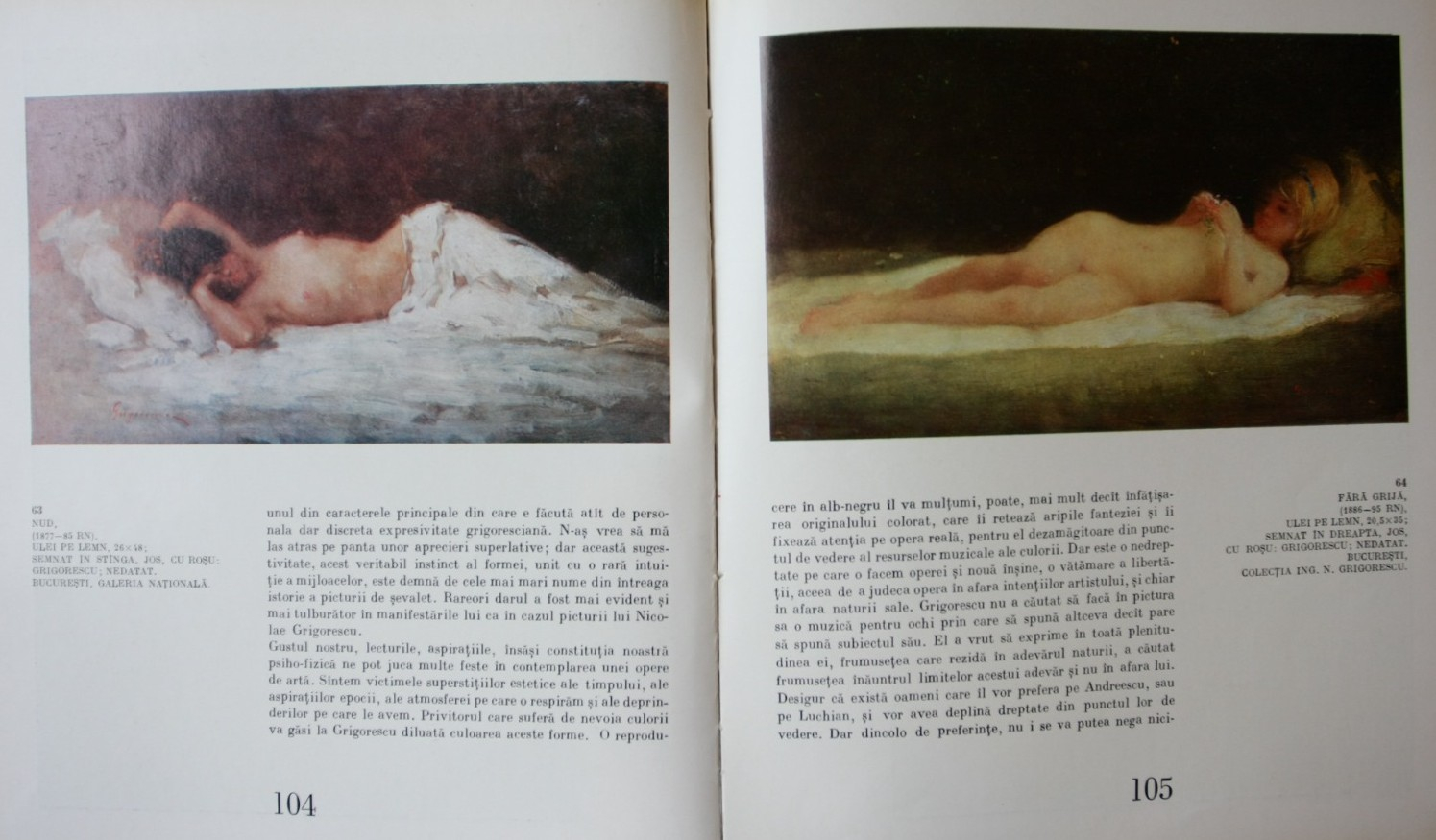
DEAC, Mircea, "The Nude in Romanian painting", Autonomous Administration "Official Monitor", 2010
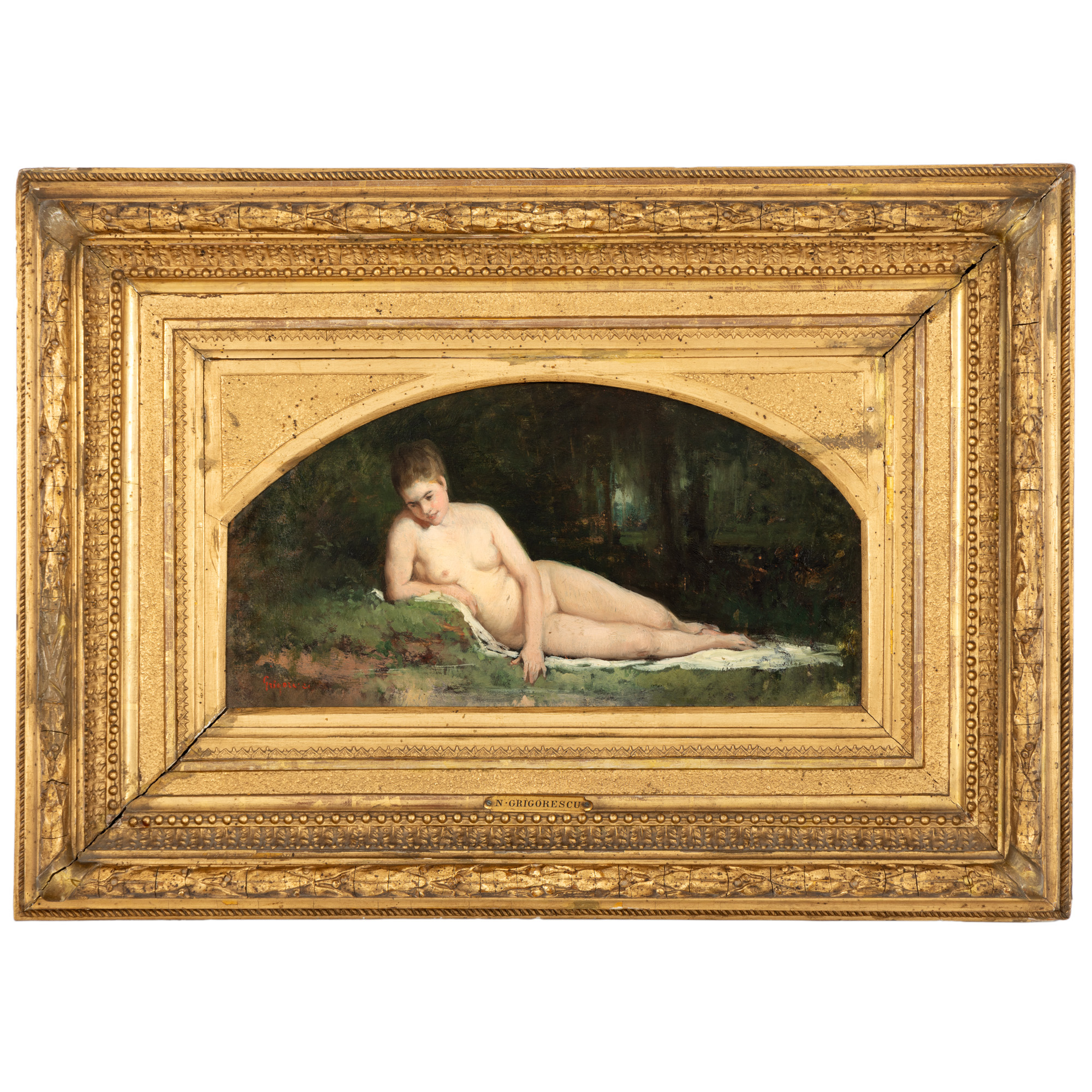
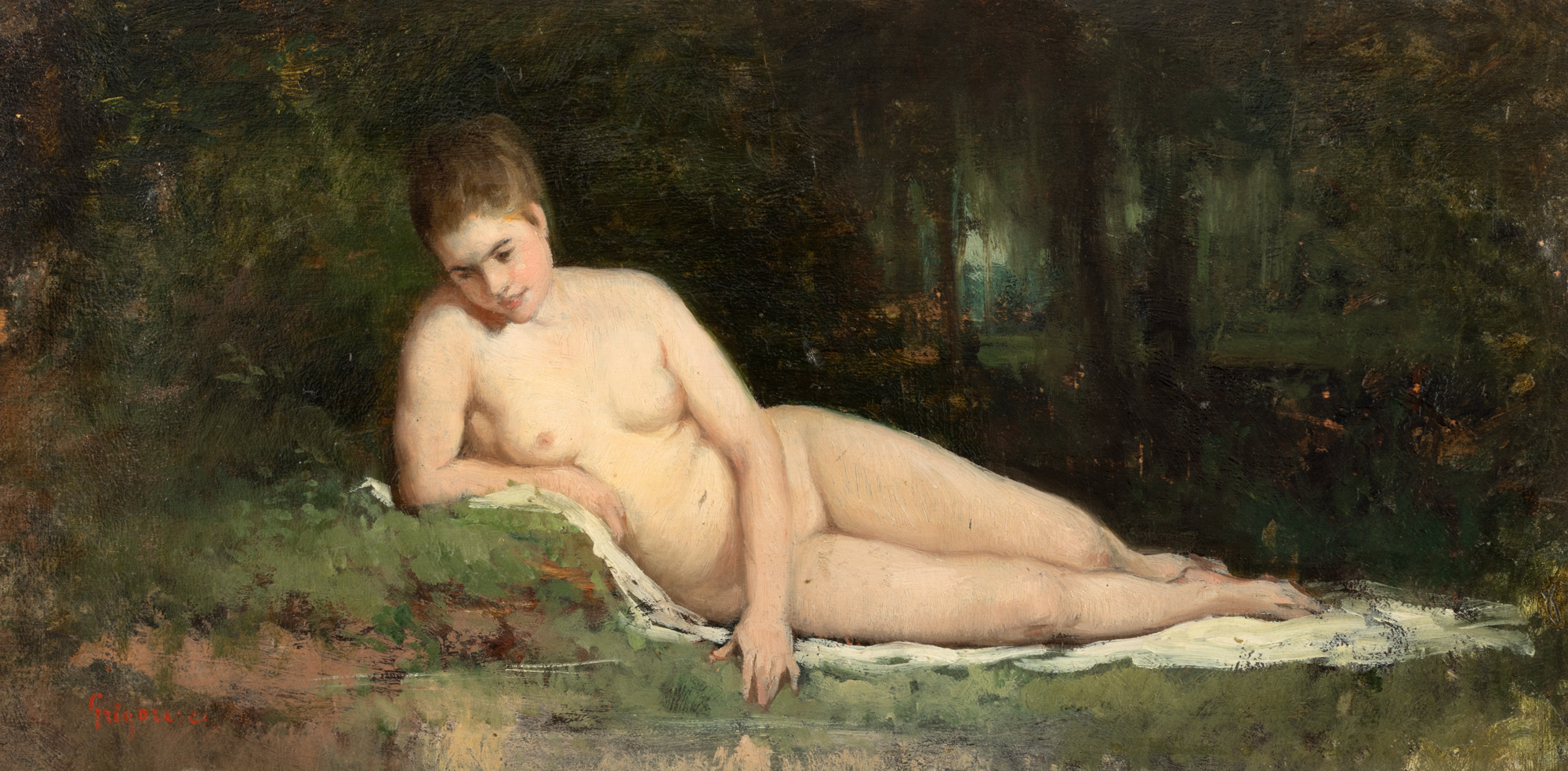
oil on wood, 18 x 35.5 cm, signed lower left, in red, "Grigorescu"
Research information
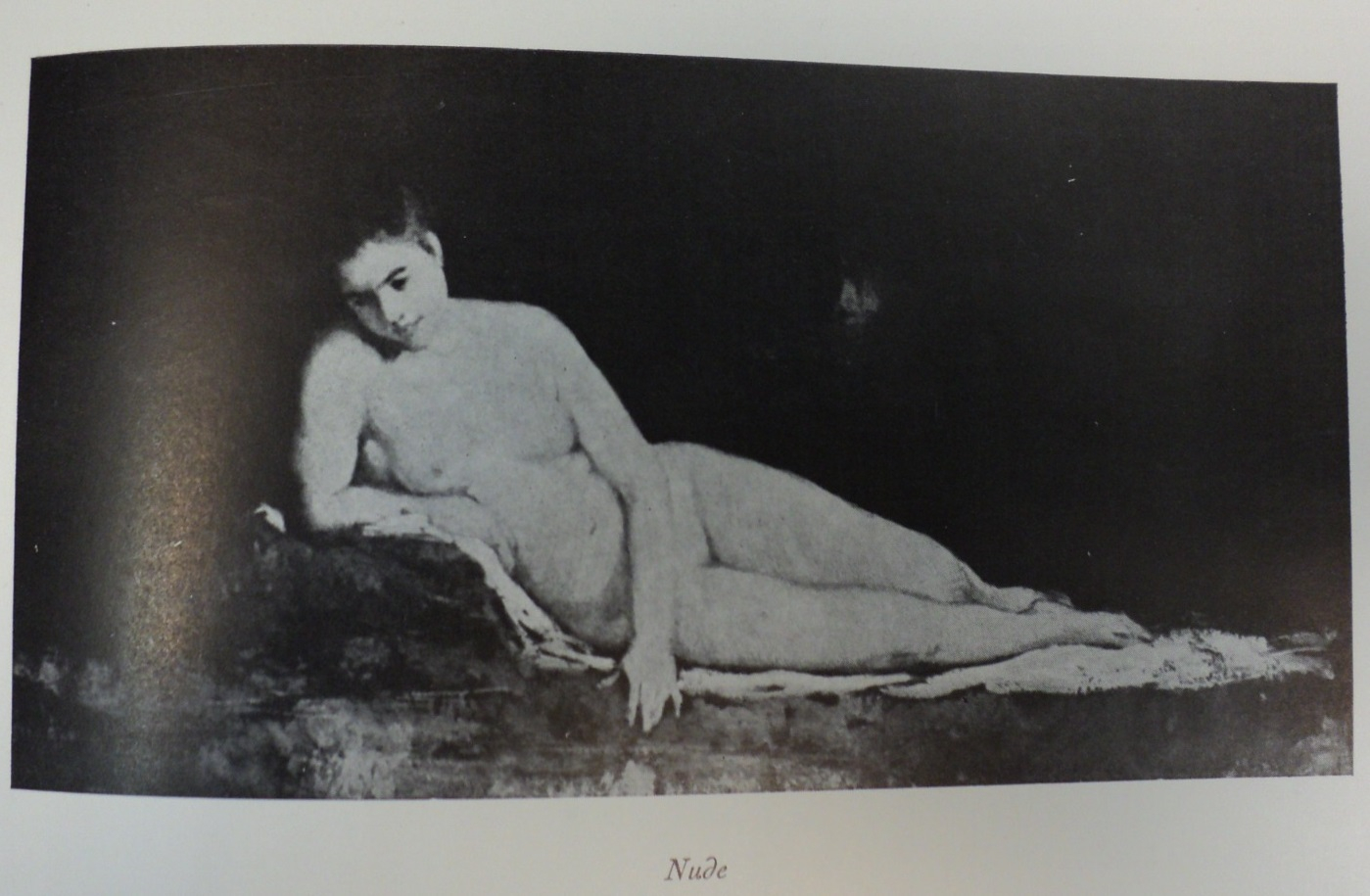
The artwork is reproduced in the catalog "Grigoresco", by Ionel Jianu, 1956, on page 79.
The artwork participated in the exhibition "Nicolae Grigorescu. Anniversary exhibition", Art Museum Arad, partner Art Safari, 2024.
The artwork participated in the exhibition "Ioan Andreescu. Truth and imagination", Art Safari Bucharest, 2025 and is reproduced in the exhibition catalog.
Considered one of the founders of modern Romanian painting, Nicolae Grigorescu combined the academic tradition with a realistic and lyrical sensitivity, breathing fresh direction into Romanian art. His humble origins and creative training make this artistic rise all the more remarkable. He managed to impress Mihail Kogălniceanu after he saw the artist in full creative process at Agapia, and, sensing his talent, encouraged him by offering him a scholarship to Paris in the fall of 1861.
In France, in 1862, Grigorescu came into contact with the modern artistic environment of the time. He learned of the Barbizon group and gradually gave up his scholarship duties, being attracted by their artistic approaches. The painters of the Barbizon School were particularly interested in the direct representation of nature and rural life, working en plein air to capture the reality as faithfully as possible. They preferred to emphasize the harmonious and balanced character of the rural environment, despite the harsh aspects of peasant life.
Grigorescu's time at Barbizon mainly took place between 1866 and 1869. The School's influence on the artist is one of the essential components of his creative vision formation. In his art, the painter assimilates techniques and means of expression from French masters - light filtered through foliage, color vibration, spontaneity of the pictorial gesture - adapting them to his own sensibilities. In works from that period, such as "Entry into the Forest at Fontainebleau", "Sunset at Barbizon", "Fisherwoman at Granville" or "Elderly Woman at Brolle", we notice a personal synthesis between the lyricism of nature and the clarity of direct observation.
More precisely, among the artists associated with the Barbizon School, Grigorescu is inspired by the work of Gustave Courbet, from whom he takes a more robust painting, with dense texture, dominated by browns and luminous accents that shape the forms in a serious and direct note. At the same time, we can identify in some works affinities with Jean-Baptiste-Camille Corot, especially in the way of using light and in more lyrical compositions, although Grigorescu's approach remains more balanced and less idealized. Thus, the present work is one of the most solid demonstrations of his academic training, complemented by French influences assimilated during the artist's period at Barbizon.
"La izvor" ("At the spring") presents the reclining female nude, seen from the front, shining in a warm light, surrounded by the dense vegetation of a forest foliage, rendered in chiaroscuro. Grigorescu achieves harmonious proportions, although it is difficult to say whether the work was designed after a hired model, in the studio, or if "At the spring" is the result of an anatomical construction dictated by imagination and cultural experience. We note the Venus pudica posture, which has become canonical in the representation of the female nude and a standard of studio compositions. This representation allows the study of proportions and is taught in art schools as a model of harmony and balance of the body. For Grigorescu, however, the position is not treated in a strict academic style, but is adapted to his pictorial sensitivity, as a starting point for studying the nude.
The model in the present work appears with her head tilted lazily to one side, and with one hand supported, and the other extended towards the water. The figure is built with particular certainty, having one shoulder raised and the other lowered, which gives naturalness and spontaneity. The same nonchalance is given by the dreamy look of the subject, who seems to contemplate her own face in the reflection from the spring. The way in which Grigorescu depicts the nude here takes on nostalgic, romantic features.
The artist outlines the body using light, which starts from one side, with strong accents and fine transitions into shadow. The confrontation created by the dialogue between the human body imbued with light and the penumbra zone confirms a young artist, still sensitive to the lesson of contrasts of the Barbizon School. Considering the group's ascendance over Grigorescu's work, we can assume that the present work falls within the period of beginnings, between 1866 and 1869.
Through the brushing with soft lines as well as through the vibration of light emitted, Grigorescu skillfully constructs volumes and models the nude. Especially to achieve the body as a central figure, the artist applies small and precious brushstrokes. In contrast, the background is painted freely, in broad, luminous green strokes, in dialogue with the streak of green and the white one under the elongated body. Through the elegance of the anatomical proportions and the sensuality of the pictorial texture, the work presents a summum of a stage in which the artist's deepest aspirations were fulfilled. (L.M.)
For clarifications regarding the bidding procedure, hammer price costs, guarantee, payment, and collection terms for the winning lot, we recommend carefully reading/re-reading the Bidding Regulations.
For additional information regarding the lot and the auction, please contact the Art Consultants Department.