The photos of the lot are informative and indicative, and cannot provide a highly detailed view of the object from all angles. We recommend a careful physical inspection of the lot before bidding.
STUHMER, Marcelino, "Corneliu Baba: Penetrating into the Mad World of the Late Opera", Artmark Galleries, 2018
SUSARA, Pavel, "Corneliu Baba", Parkstone - D.O.R, 2001
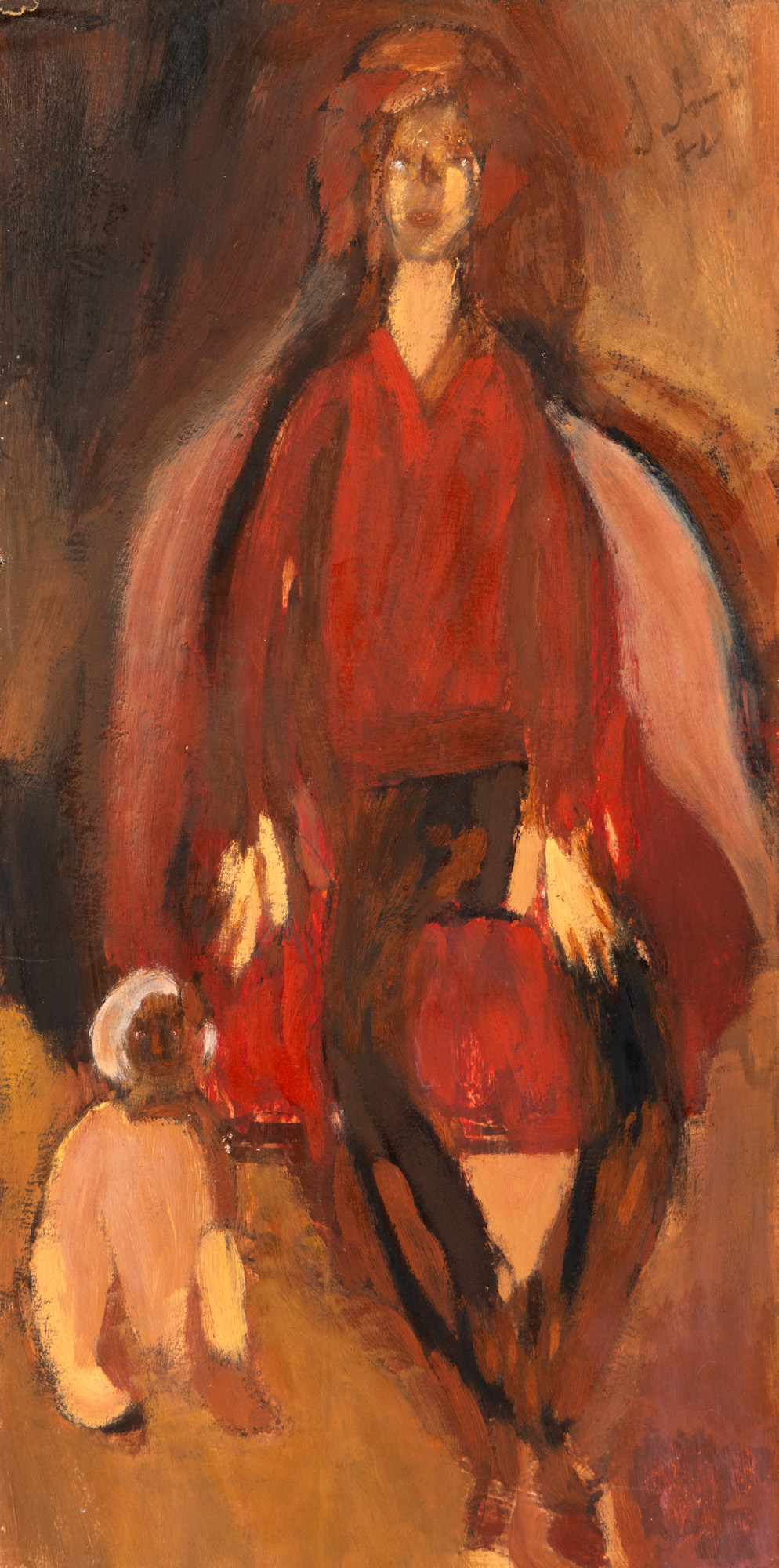
oil on canvas glued on cardboard, 40.5 x 20 cm, signed and dated upper right, in brown, "Baba, (19)72"
Corneliu Baba was an "aristocrat of culture", as Ștefan Câlția called him, and consistently cultivated the genre of the portrait, exploring it not only as physical representation but mainly as an expression of the subject's inner experiences and human condition. Throughout his career, Baba enriched his style with expressionist and symbolist influences, transforming reality into a plastic meditation on truth and suffering.
The '70s marked the artist's entry into his last and perhaps most intense creative phase, characterized by an obsessive exploration of human archetypes. Baba went through a period of reflection and distance from the official cultural system. In his diary, he noted the idea of distancing himself in "a sort of internal exile...". This awareness of the internal exile led him towards art increasingly focused on human suffering, loneliness, and fear. In this stage, his portraits no longer seek to idealize the human, but to capture vulnerability and inner tension.
His declared influences are El Greco, Rembrandt, and Goya - painters of human drama, chiaroscuro, and psychological depth. In the later cycles of his work, we notice a strong analogy with Goya's later period and German expressionism - the same gravity and the same investigation of inner unrest visually expressed through images taken from nightmares dominated by monsters. This phase is marked by sober expressionism, oppressive symbolism, and deep meditation on the human condition.
The present work falls within this phase of symbolic search and pictorial refinement. The painting presents a full-length portrait of an uncertain figure, perhaps a girl. The subject's rigid posture and uncertain gaze are matched by the presence of a monkey. We might interpret its presence as a symbol of imitation, of instinctual nature, or perhaps, an ironic mirror of the human condition. The same association is found in the artist's later work, "Harlequin with Monkey", from 1974.
The background on which these figures stand out is neutral, focusing the gaze on the physical presence of the character. The chromatics of the work, built on a limited but expressive range of faded colors (brown, ochre - specific to the artist's later period) amplify the somber image and contribute to an atmosphere of melancholy and alienation. In this context, we look at the central figures of the composition, the girl accompanied by a monkey, Baba highlighting the existential isolation of the subject. The artist skilfully uses red as a vibrant accent on the model's costume, breaking the monotony of the earth tones.
In conclusion, the work synthesizes the essence of Baba's art after the '70s: a profound realism that transcends simple mimicry, a robust pictorial technique anchored in the tradition of the great masters, a grave chromatic palette, and a philosophical vision of the human condition marked by inner tension. (L.M.)
For clarifications regarding the bidding procedure, hammer price costs, guarantee, payment, and collection terms for the winning lot, we recommend carefully reading/re-reading the Bidding Regulations.
For additional information regarding the lot and the auction, please contact the Art Consultants Department.
By choosing "Accept all cookies" you agree to the use of cookies to help us provide you with a better user experience and to analyse website usage. By clicking "Adjust your preferences" you can choose which cookies to allow. Only the essential cookies are necessary for the proper functioning of our website and cannot be refused
Cookie settings
Our website stores four types of cookies. At any time you can choose which cookies you accept and which you refuse. You can read more about what cookies are and what types of cookies we store in our Confidentiality Policy.
are necessary for technical reasons. Without them, this website may not function properly.
are necessary for specific functionality on the website. Without them, some features may be disabled.
allow us to analyse website use and to improve the visitor's experience.
allow us to personalise your experience and to send you relevant content and offers, on this website and other websites.