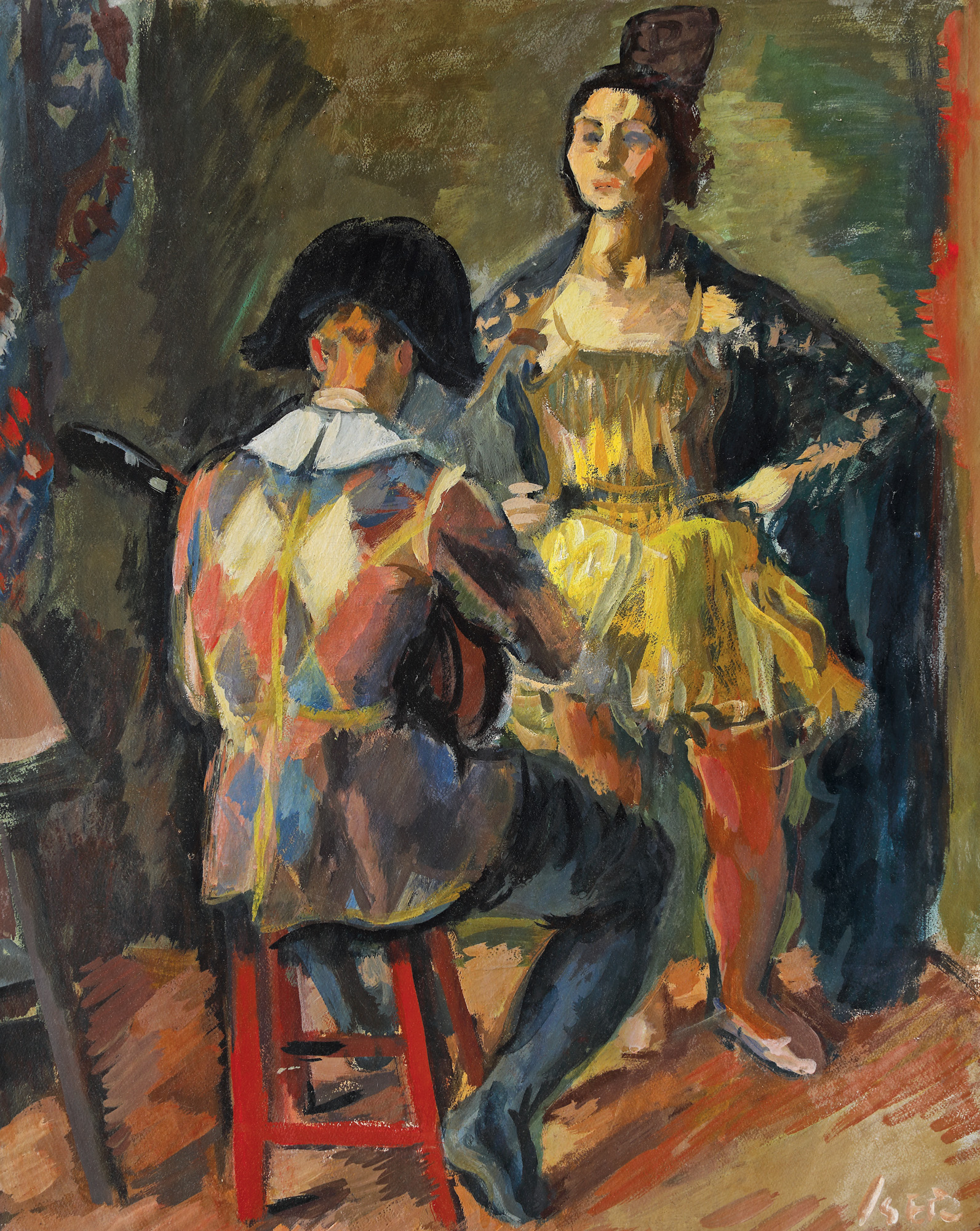
34. Pierrot and Colombina [the second half of the 1930s]
The photos of the lot are informative and indicative, and cannot provide a highly detailed view of the object from all angles. We recommend a careful physical inspection of the lot before bidding.
34. Pierrot and Colombina [the second half of the 1930s]
gouache and oil on cardboard, 60.5 x 48.5 cm, signed bottom right, in white, "Iser"
PROVENANCE
Corneliu Vadim Tudor collection.
Commedia dell’Arte, such an inexhaustible source in imitative arts history, also influenced 20th century painting, in Symbolist poetry or in Modernist painting, particularly in the avant-garde. The motif of the harlequin and of the dancer caught Iser’s attention as soon as his contact with French culture materialized, after his first trips to Paris. His fascination with the Expressionism, as aesthetic engine of the entire imitative approach, proved to be what pushed Iser towards psychological painting, the most inclined towards understanding and rendering the feelings of his models. It was also validated by the spirit of the age, for which the representation of the harlequin had become a genuine discourse on the dualism of life and, consequently, of figurative art. Picasso, Juan Gris, André Derain, Emil Nolde, or Amedeo Modigliani are only a few of the names from the first decades of the 20th century who restructured and recovered the iconic, but apathetic image of the well-known characters of the human comedy. Seduced by the animation of Emile Reynauld in France, "Pauvre Pierrot", an experiment of the optical theatre, preceding the cinema, which cad caused great stir at the time, Iser created early on several works illustrating the unfulfilled love of Pierrot the harlequin for Columbina, the ballet dancer. A first take on the theme, under the direct influence of the classical triangle - harlequin, Colombina, and Pierrot - was seen at Iser in 1912, when, upon Dimitrie Burileanu’s order (distinguished politician and diplomat), the artist decorated his mansion from Turnu Severin with such a composition. Several years later, in the late 30s, the National Bank would purchase the celebrated "Harlequin and Dancer" (National Museum of Art of Romania, inv. 3238), at the recommendation of the same Dimitrie Burileanu, the Governor at the time. These reference points help us understand the fact that the central motif was a genuine visual stronghold for the Iserian aesthetics. We can easily note the new meanings attained by the Harlequinades of the fourth and fifth decades in this gouache where, using the relations between volumes, movement, and colour-light, Iser reaffirms the notorious theme. The composition is essentialized, given the technique, as well, it has a theatrical ait, and it vibrates precisely because of the gouache spread over the surface of the painting. The visual decoupage, the schematic nature of the drawing, and the quick stroke are specific for the Modernist language which Iser had mastered as early as in the first decade of the 20th century, in the years when he was fully integrated in the Paris creative mood. (I.P.)
For clarifications regarding the bidding procedure, hammer price costs, guarantee, payment, and collection terms for the winning lot, we recommend carefully reading/re-reading the Bidding Regulations.
For additional information regarding the lot and the auction, please contact the Art Consultants Department.
By choosing "Accept all cookies" you agree to the use of cookies to help us provide you with a better user experience and to analyse website usage. By clicking "Adjust your preferences" you can choose which cookies to allow. Only the essential cookies are necessary for the proper functioning of our website and cannot be refused
Cookie settings
Our website stores four types of cookies. At any time you can choose which cookies you accept and which you refuse. You can read more about what cookies are and what types of cookies we store in our Confidentiality Policy.
are necessary for technical reasons. Without them, this website may not function properly.
are necessary for specific functionality on the website. Without them, some features may be disabled.
allow us to analyse website use and to improve the visitor's experience.
allow us to personalise your experience and to send you relevant content and offers, on this website and other websites.