
48. Spring [1924-1925]

1886, Bârlad - 1940, Bucureşti

Estimate

EUR 30.000 - 50.000

Sold

EUR 40.000

Session

Tue, 6 February 2018 19:30

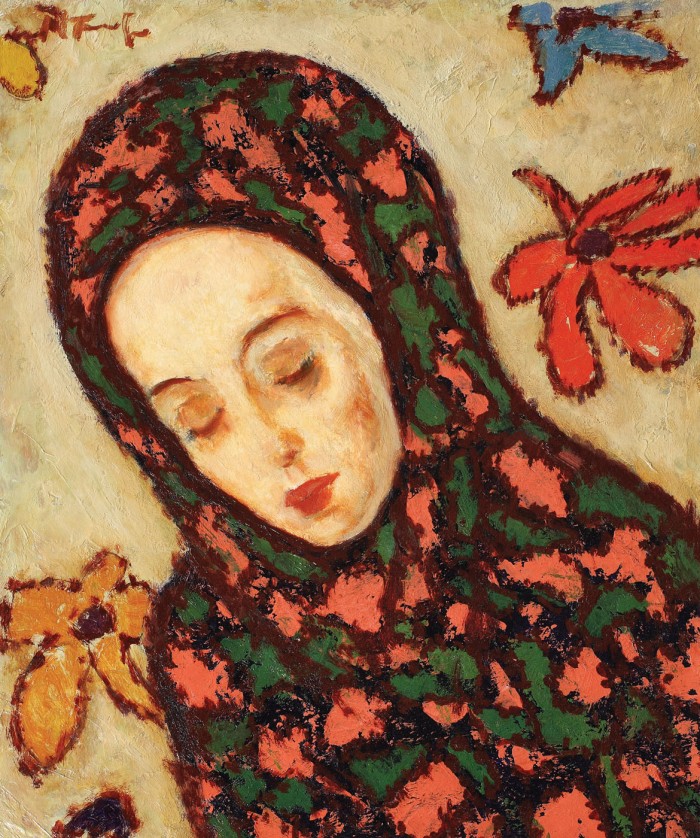
"The portrait, practiced since Nicolae Tonitza was a student of the Iași School of Fine Arts, was perhaps one of the most applauded pictorial categories that the artist has dared attempt. Documentary resources show us a relative image of the works made at the end of the first decade of the 20th century until the period after his discovery of Balchik, towards the end of his life. A few portraits of old men made in Munich, during his Bavarian period, and perhaps the oldest portrait we know today, that of his master’s mother, Baroness von Habermann, are clear data of an obvious tendency to scrutinise human nature. For an artist like Tonitza, the appearance of such a genre is clearly regulated by psychological aspirations occurring in the soul of a true researcher of life, even more so as today we know he did not make a living out of selling portraits, so he was not a cold commission taker. A first self-portrait, dated 1911, along with the drawing of his wife Ecaterina’s figure, in 1913, show us for the first time the intimate universe that he presented with such strength during the next decade, by painting his children. World War I, his spell in prison and then the difficulties of a poor life definitively transformed Tonitza’s perception of man, and while he indulged in debates on the human condition until that time, the period following the war reveals a bitter critic of the Romanian society. His painting chose simple men at the time – the horrors of war, life in a camp or the poverty of a nation being just some of the themes he approached most. But faces do not disappear; instead, they are essentialised and submitted to the central motif, and the succession of widows’ faces at the cemetery or faded faces in the crowd standing in line to buy bread is eventually rendered concrete and absolute by painting the man of a new world, Gala Galaction, in 1920. This entire stage gives portraits their necessary expressive qualities for the social manifestation preached by the satiric Tonitza. Later on, after the Vălenii de Munte stage, the painter’s portraits are imbued with the revelation of serene, playful faces. First his children, then those of his friends will give balance to the entire expressionist register of his portraits, to fill canvases with colour, decorations and a much more relaxed feel. The decorative element inspired by Luchian’s creation and perhaps Tonitza’s art direction preferences introduced the floral register that defined his creation of 1923-1927. The clothes are also connected to another decorative element, and even if the faces of the painted ones remain enshrined in expressionism, the entire composition ‘relaxes’ under the chromatic, decorative or Japanising empire that the painter easily reaches. Deeply expressionist, the creation that most defined the post-World War I stage becomes the most relevant artistic product of Nicolae Tonitza in the period 1920-1925. From his very first exhibitions, Tonitza manifested in his works a propensity for themes inspired ‘by the world of the humble’, with his family easily included in this generous thematic. The novel aspect of this composition is defined by the visual mix: the model’s face used in a painting dedicated to the expressionist universe, yet put in a painting defined by the colourful clothes and the floral background. In ‘Behind the Procession’, Tonitza introduced the figures of mourning women, typical elements for the period 1919-1924. In this painting, Tonitza reinterprets the grieving face in a novel manner in his entire creation. Reusing the character in a new pictorial complex, defined by decorations and colours, undoubtedly gives rise to an exceptional craft, so telling of Tonitza’s character."

References

BREZIANU, Barbu,”Nicolae Tonitza”, Ed. Arta Grafică, București, 1967 BREZIANU, Barbu, “Nicoale Tonitza”, Ed. Meridiane, București, 1986 CIUCĂ, Valentin, “Pe urmele lui Nicolae Tonitza”, Ed. Sport-Turism, București, 1984 COMARNESCU, Petru,”N.N.Tonitza”, Ed. Tineretului, București, 1962 PĂULEANU, Doina, „Grupul celor Patru”, Monitorul Oficial, 2012

Dimensions

width 32.5 cm, height 38.5 cm, custom 32,5x38,5

Description

oil on cardboard, signed upper left, in brown, "N. Tonitza"

Research information

Opera reproduce chipul unuia dintre personajele din "În urma convoiului", tablou realizat în cursul anului 1924.

Dating

1924-1925

PROVENANCE

colecția magistratului Lazăr Munteanu (1869-1951) - nepot (de mamă) al colecționarului Iancu Kalinderu, magistratul Lazăr Munteanu a fost unul dintre cei mai însemnați colecționari ai perioadei dintre cele două războaie mondiale, regăsindu-se în suita reprezentativă a colecționismului românesc interbelic, alături de Krikor Zambaccian sau dr. Iosif Dona. A fost președinte al tribunalului Constanța, secretar general al Departamentului Justiției și judecător la Curtea de Casație, poziții care i-au oferit confortul financiar să devină unul dintre cei mai avizați cunoscători ai artei românești moderne.

ADDITIONAL INFORMATION

For clarifications regarding the bidding procedure, hammer price costs, guarantee, payment, and collection terms for the winning lot, we recommend carefully reading/re-reading the Bidding Regulations.

For additional information regarding the lot and the auction, please contact the Art Consultants Department.

Similar lots