

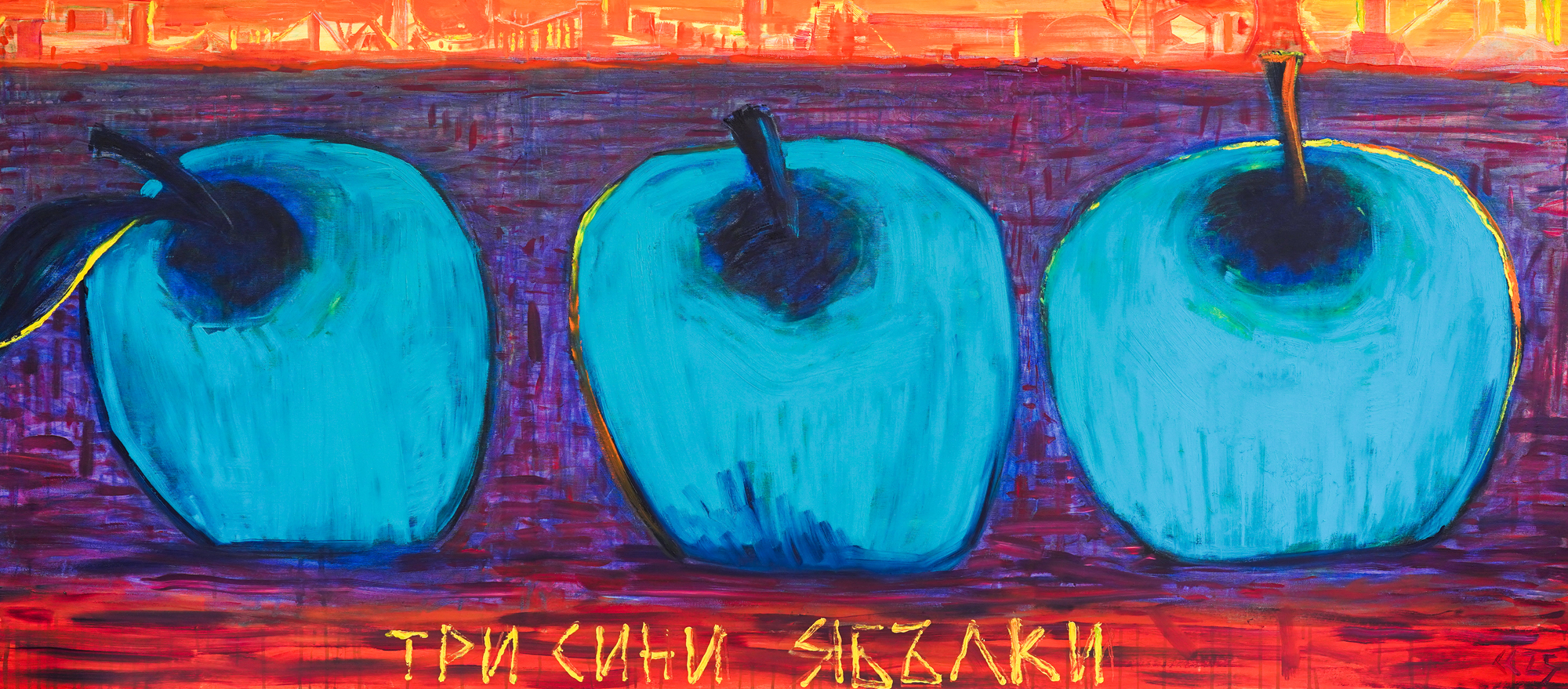
71. Three blue apples [2025]
The photos of the lot are informative and indicative, and cannot provide a highly detailed view of the object from all angles. We recommend a careful physical inspection of the lot before bidding.
71. Three blue apples [2025]
1966, Sofia
Estimate:
EUR 2.000 - 3.000
Sold
EUR 3.800
oil on canvas, 90 x 205 cm, 90 Ã 205 cm, signed and dated bottom right, in red, "СС, (20)25"
Notes
signed and dated on the back, in red, âSvilen Stefanov, 2025â
After periods of intense transformation in the field of nonconventional art forms, Svilen Stefanov returned to painting in the late 1990s. He is one of the most provocative and radical conceptual artists in Bulgaria. Svilen Stefanov creates a cold conceptual painting that uses expressionist means in a secondary way. His approach is both conceptual and classically painterly, because conceptualism is, above all, a way of thinking.
Svilen Stefanov is a distinguished art historian and artist. He is well acquainted with the global history of art and strives to create a new kind of objectness connected to neo-expressionism—one that is neither avant-garde nor typically Bulgarian. This is a different type of alternative painting that emerged in the 1990s, developing in parallel with conceptual strategies and forming part of them. It is not a rejection of conceptualism but rather its continuation. The artist creates conceptual painting with classical means, since conceptualism is a rational form of art, yet the sensuousness of the painterly surface reminds us of its material nature—and it is precisely this materiality that lies at the center of his interest. In contemporary art, the goal is not to discover something great, but to show how you interpret it.
Svilen Stefanov is known for using conceptual strategies in painting—such as incorporating text into the image. This is not about giving the work a literary basis, but rather about introducing an idea. At first glance, the large, colorful inscriptions—often humorous, such as “I Love Capital,” “The Wolves Cross the Danube Ice,” or “Lesson in Geometric Abstraction”—are actually connected with cinema, art history, and music. The images accompanying the texts are not illustrations but rather a synthesis between image and text, with alternating dominance. In short—the texts do not explain the images, and the images are not illustrations of the texts. Everything is interwoven with irony, and it is difficult to find a direct, unambiguous meaning. The hidden meanings can be interpreted differently by each of us.
In Stefanov’s canvases, reverse perspective becomes the correct way of seeing things. This inversion of focus gives a surreal psychological quality to inanimate objects—but not to people. Apples and watermelons become central subjects, charged with emotion and psychology. The tension within the stillness of the objects arises from the strong color values in some works. Stefanov builds his paintings through rich imprimaturas and velaturas, slowly and skillfully layering thin, transparent tones like translucent veils. The “oily” effect of oil paint is absent—only the inscriptions feature thick, pastose application.
In some works, wide panoramic landscapes host numerous small, faceless figures engaged in absurd processions, funerals, hangings, or the welcoming of aliens. Svilen Stefanov achieves absurdism in painting through conceptual means such as shifting emphasis from people to objects, elevating materiality to primary meaning, and “portraying” objects—like a large leek, two watermelons, or bananas. His painting is marked by intelligence, humor, and a total lack of pretension. He possesses the ability to turn great themes into everyday ones, and vice versa—but always with a smile.
His characteristic elongated formats encourage horizontal development, while compositions built from two objects imply symmetry. Svilen Stefanov steps beyond the academic reflex to seek the golden ratio, a central axis, or the classic three-object composition. He is unafraid of mirror symmetry and works between the beats. Mastering large formats is not an easy task for every painter, but for Stefanov, it is routine. The absence of a frame is a conceptual choice—the framing of an artwork in a golden border separating it from the world holds no interest for him. The lack of a frame and the use of large formats recall American art of the 20th century.
(S.N.)
For clarifications regarding the bidding procedure, hammer price costs, guarantee, payment, and collection terms for the winning lot, we recommend carefully reading/re-reading the Bidding Regulations.
For additional information regarding the lot and the auction, please contact the Art Consultants Department.
SESSION
Brought to you by
Similar lots