


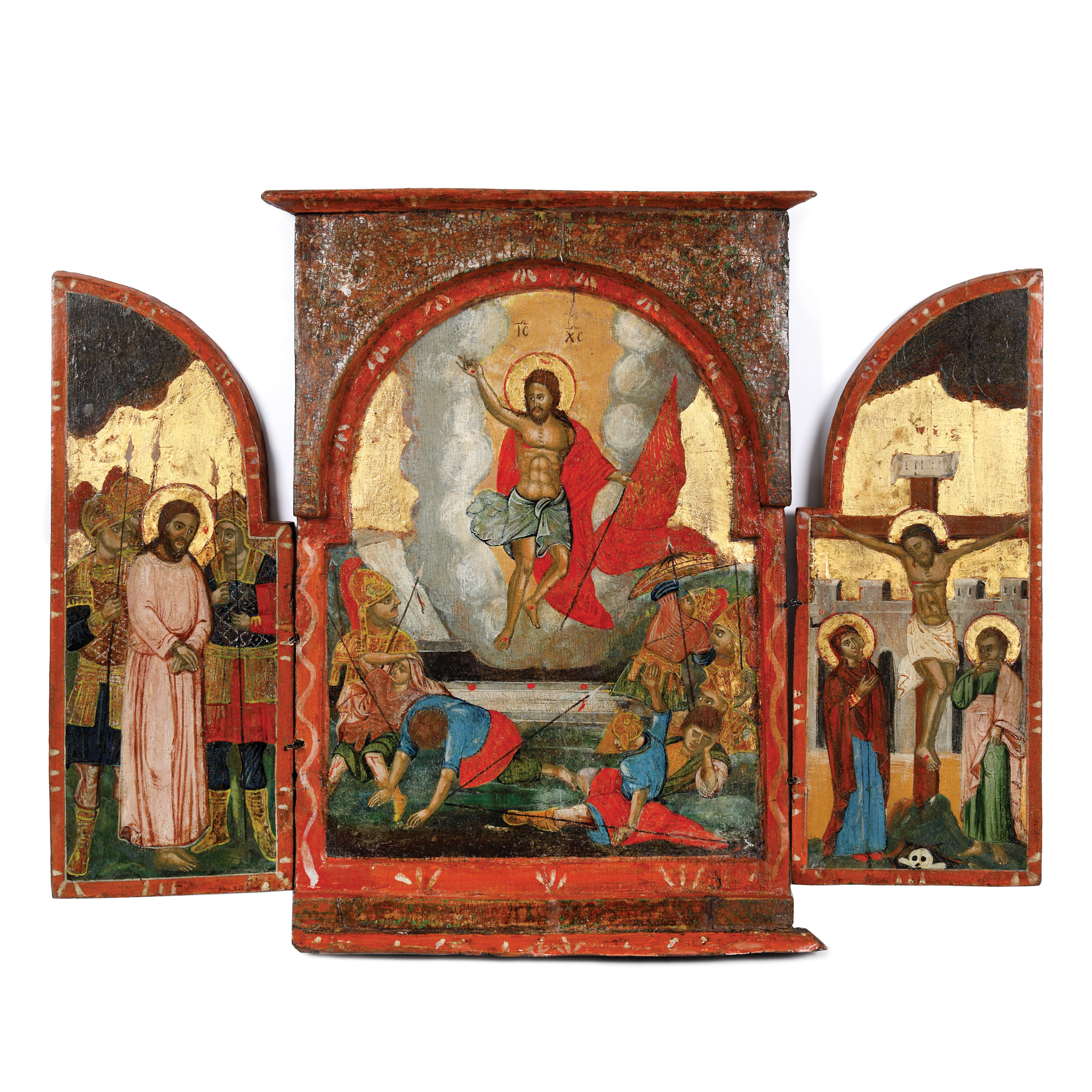
83. "The Resurrection Of The Lord, Ecce Homo and The Crucifixion of The Lord", Veneto-Cretan triptych, first half of the 17th century, rare collector's item
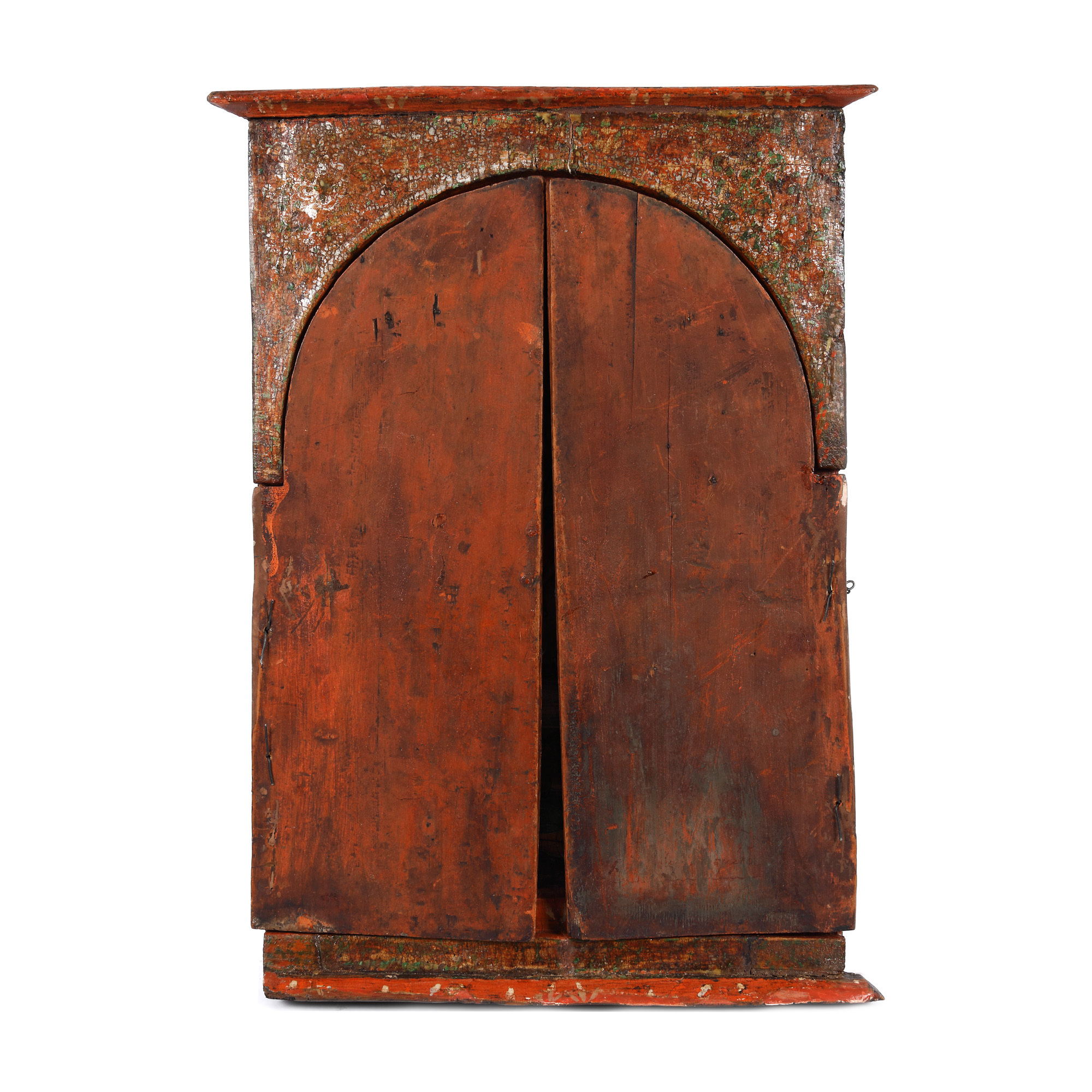
The photos of the lot are informative and indicative, and cannot provide a highly detailed view of the object from all angles. We recommend a careful physical inspection of the lot before bidding.
83. "The Resurrection Of The Lord, Ecce Homo and The Crucifixion of The Lord", Veneto-Cretan triptych, first half of the 17th century, rare collector's item
Starting price:
EUR 3.000
Not sold
tempera and gold foil on wood, 50 x 66 cm, 50 Ã 66 cm
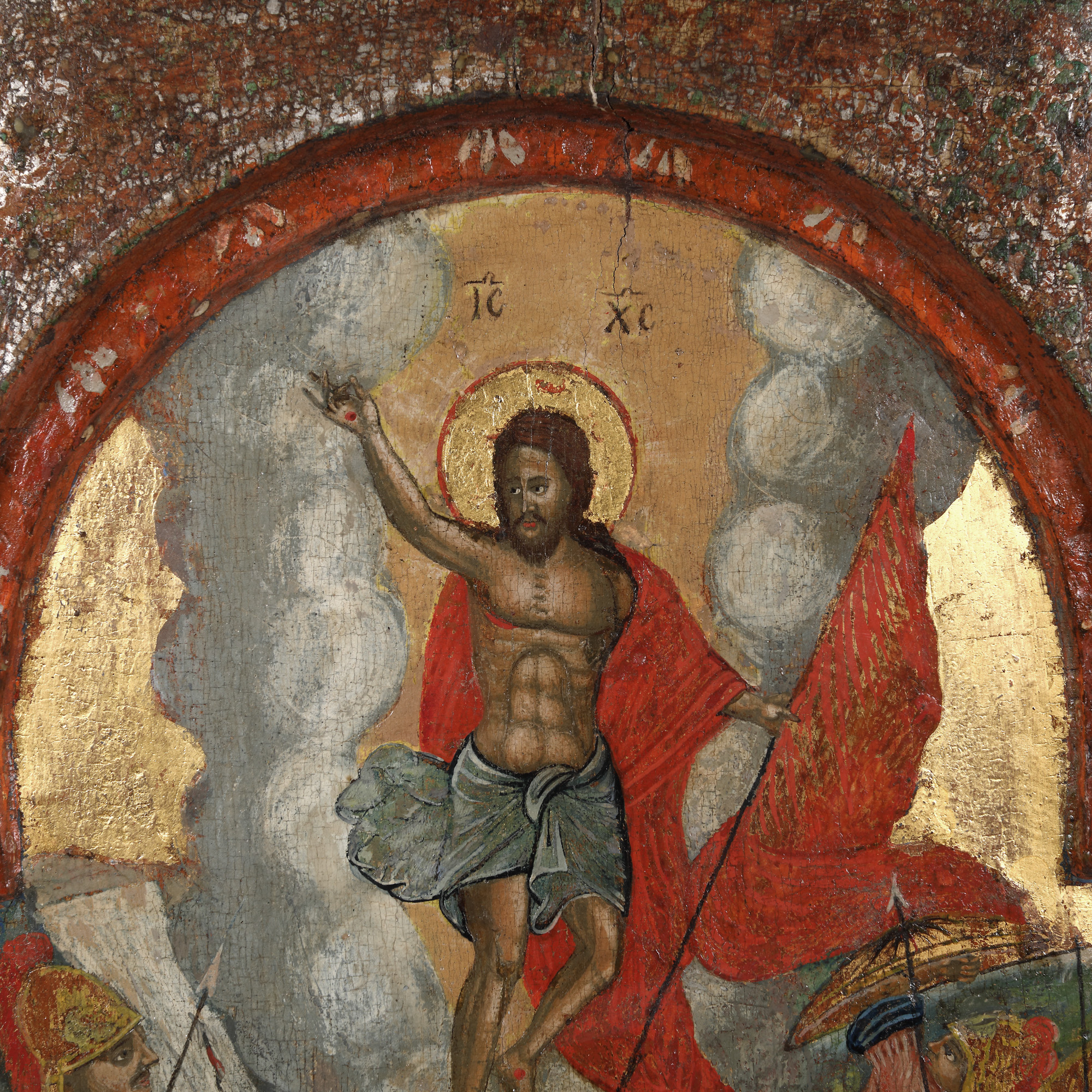
After the fall of Constantinople in 1453 under Turkish occupation, many painters of the former Byzantium took refuge on the island of Crete, continuing to paint in the tradition of the Constantinople school. At the same time, a large part of the inhabitants of Constantinople, and not only, took refuge in Venice where they founded a distinct community grouped around the church called "del Greci". The style of Cretan icons painted in the Byzantine tradition, survived until the end of the 16th century. Due to the influences of artistic trends in Italy, the painting of icons of Byzantine tradition will gradually assimilate some elements of style and design, the Greek icons painted during this period being generically called Venetian-Cretan, Venice, as an artistic center, having a decisive role in this process. The triptych painting depicts three moments in the Passion of Jesus Christ: Judgment, Crucifixion, and Resurrection. The central panel of the triptych rests on a pedestal currently painted in red and reddish brown. The upper part ends with a pediment, originally painted with vegetal motifs, almost completely destroyed. Under an arch in full center, on a gold background is painted the scene of the Resurrection of the Lord of Catholic writing, different from the Orthodox Resurrection, rendered in the form of the Descent of Jesus into Hell and the resurrection of Adam and Eve. Thus, at the bottom of the stage is painted the empty tomb, above which Jesus Christ, overcoming death rose in glory, surrounded by clouds like an almond tree, blessing with the right and left holding the flag of his victory. Around the empty tomb, the soldiers guarding it are returned to their natural positions: some are still asleep, one scared is trying to defend himself with his shield, another is amazed by what he sees, he doesn't know what to believe. His naked body has a pagnus around his hips and over his shoulder, a long, red cape, which, fluttering, emphasizes his outstretched movement. The face of Jesus Christ is painted in the tradition of Greek painting imposed by Erminie, the model of the face being made by overlapping ocher, from light ocher, for the illuminated parts, to ocher-brown and brown-green, for shadows, the light accents being put with ocher-white. The body of Jesus Christ is also modeled, as are the somewhat stereotypical faces of the soldiers guarding the tomb. Instead, the specific clothing of the Roman soldiers, with gold plates and helmets with red feathers, which are more freely treated, as well as the natural attitudes in which they were painted, are elements of influence of Western painting on traditional Greek painting. To this is added a more vivid chromatic that shines on the gold background of the panel. But the draping of the garments, made in angular folds, still belongs to the old tradition; the background of the icon and the golden halos are also according to the painting tradition of the previous century. On the left panel is the Judgment of Jesus. He is depicted standing barefoot with his hands tied, brought by soldiers with spears, before Pilate's trial. It is worth to note the simplicity of the garments of Jesus, a tunic painted light purple, with more freely treated folds, which contrasts with the bright clothes of the soldiers, with a predominance of red, green and gold plates and helmets. The golden background, the typology and the model of the faces, are identical to those of the characters on the central panel and still belong to the old traditional painting. The volley on the right shows the scene of the Crucifixion of the Lord, the theme being treated by a simplified formula, reduced to the essential elements, a formula appropriate to the ancient school of Greek painting. Against a golden background, with the walls of Jerusalem painted in gray, the Cross with the Crucified Jesus forms the axis of symmetry of the scene. At the base of the cross, the tomb of Adam illustrated by a skull, signifies the meaning of Jesus' Sacrifice on the Cross: by His death, He washed away the original sin of mankind and resurrected them to eternal life. The image of the dead Jesus on the cross expresses the peace and calmness given by the fulfillment of his mission on earth, thus emphasizing His divine side. His death on the cross is mourned by his mother, the Virgin Mary, standing on the left side of the cross, in an attitude of controlled pain. Similarly, on the right side of the cross, standing, in the same attitude of pain, is painted St. John the Theologian. Their faces are similarly treated to those of the characters analyzed above. Also, their clothes are treated according to the typical, as well as their chromatic, less the chiton St. John the Theologian, painted light purple. On the lower side of the icon, on a green background, it is difficult to decipher a dedication inscription of the donor of the triptych, written in Greek, in italics, painted in black. Transcription with Latin characters: "Deisis tou doulou tou THEOU tou Gheorghiou" in translation: "The prayer of the servant of God, of George".
For clarifications regarding the bidding procedure, hammer price costs, guarantee, payment, and collection terms for the winning lot, we recommend carefully reading/re-reading the Bidding Regulations.
For additional information regarding the lot and the auction, please contact the Art Consultants Department.
SESSION
Brought to you by
Similar lots
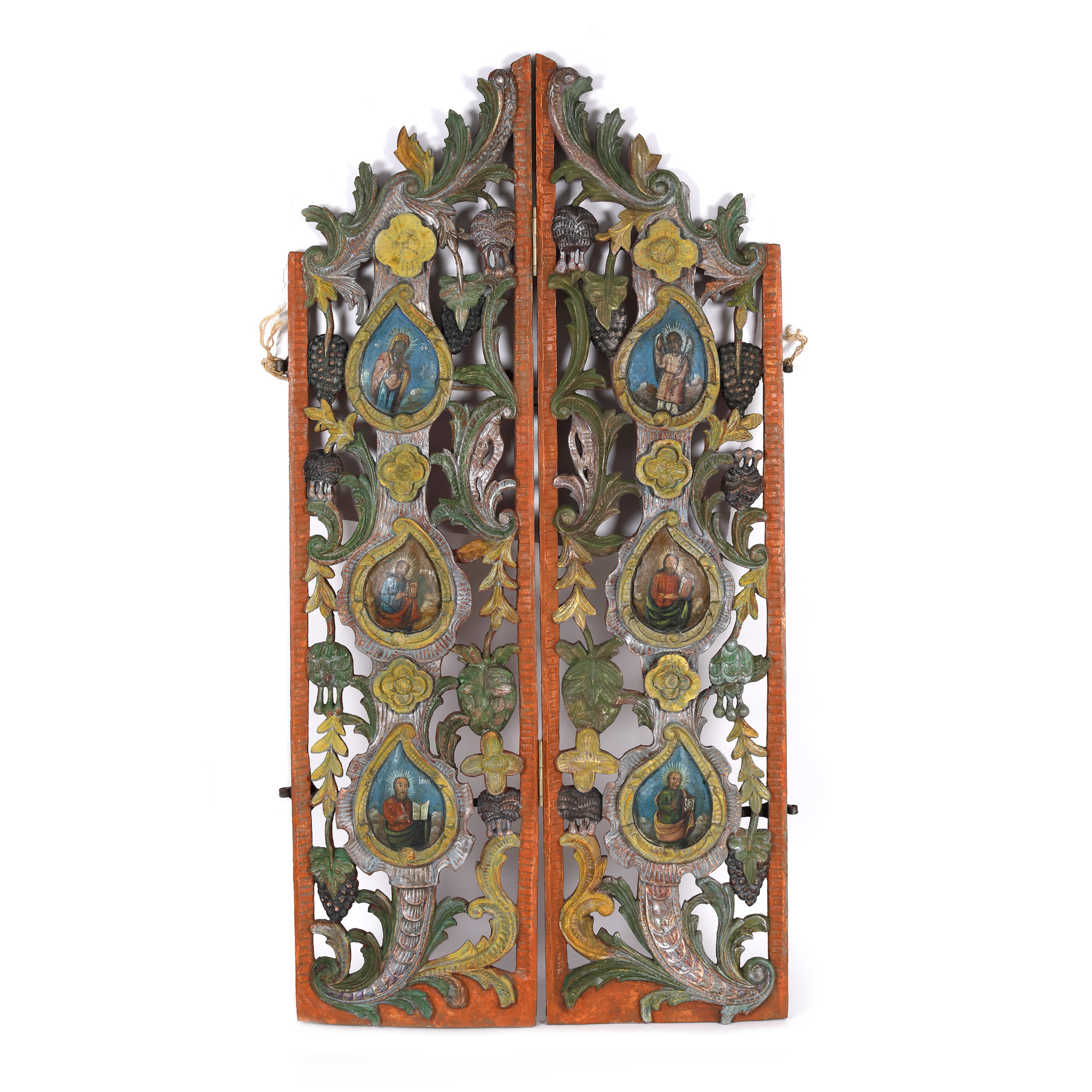
64. "The Annunciation and The Holy Evangelists Matthew, Mark, Luke and John", royal doors, Transylvanian school, early 19th century, collector's item
Starting price:
EUR 1.800
Sold
EUR 2.750
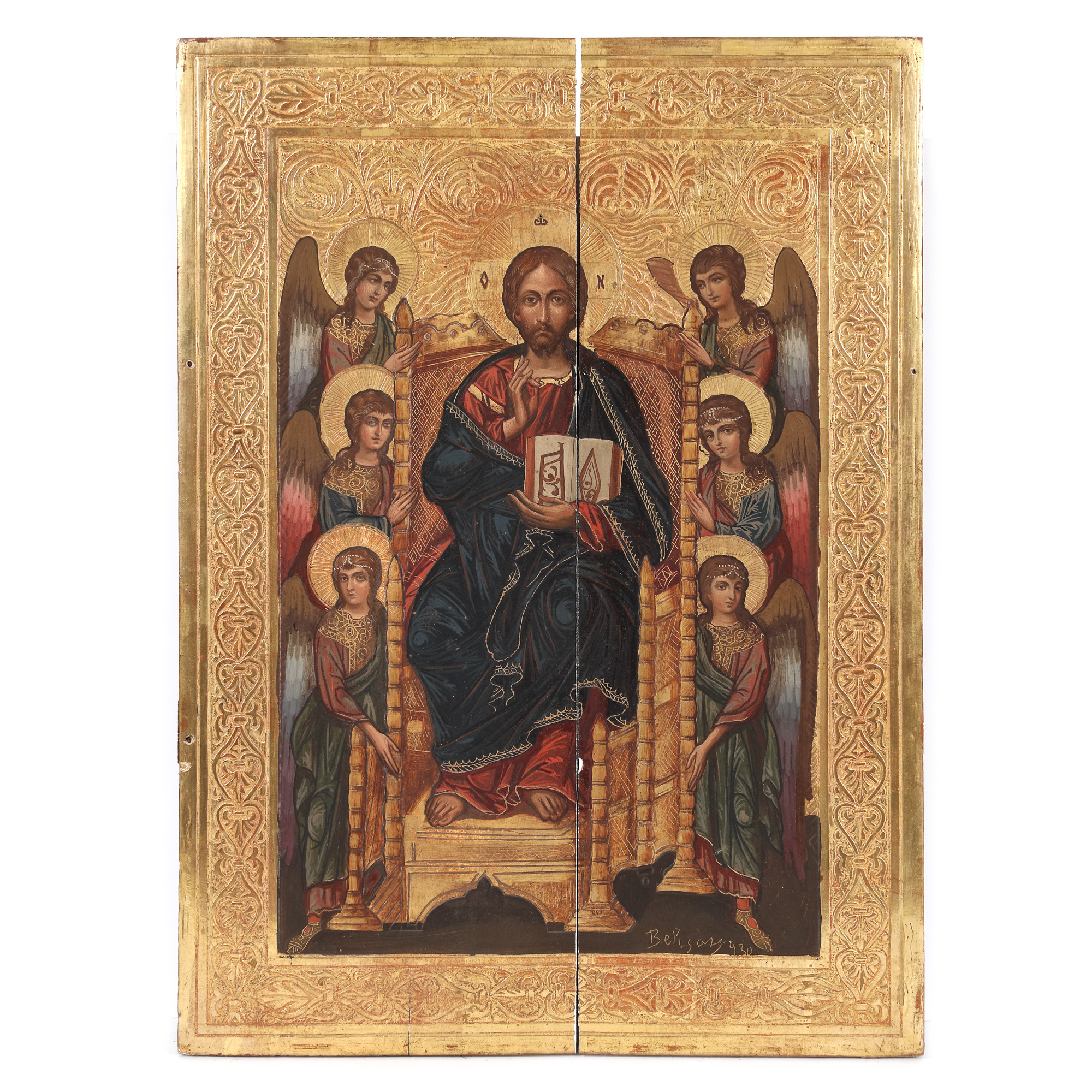
56. "Jesus Christ Emperor and High Priest", icon on wood, painter Belizarie, 1930
Starting price:
EUR 600
Sold
EUR 1.800
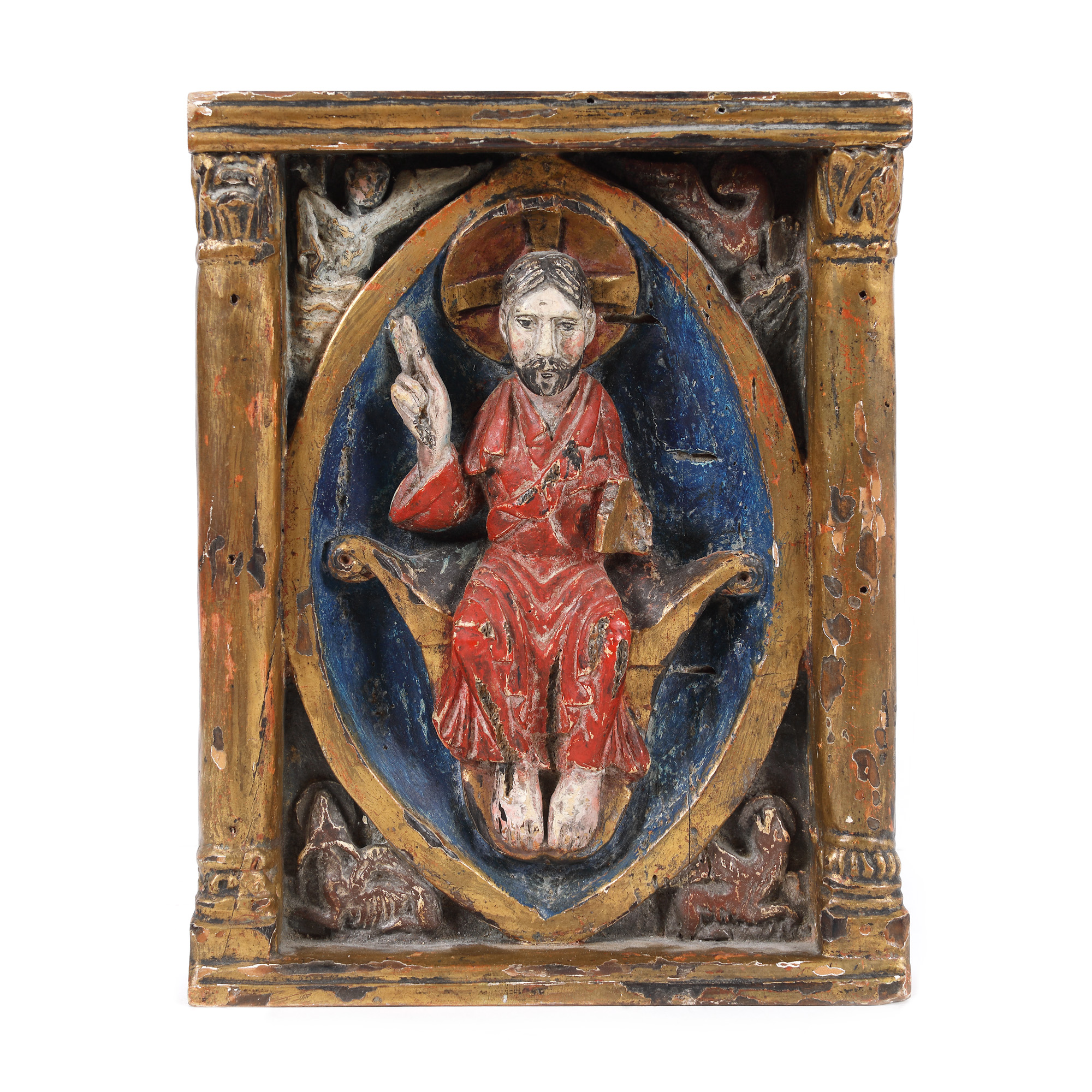
33. "Jesus Christ", icon on carved wood, Transylvanian workshop, 19th century
Starting price:
EUR 500
Sold
EUR 900