The photos of the lot are informative and indicative, and cannot provide a highly detailed view of the object from all angles. We recommend a careful physical inspection of the lot before bidding.
ANDREESCU, Viorica, "Samuel Mutzner", Meridiane Publishing House, 1974
ANDREESCU, Viorica, "Pictorul Samuel Mutzner în Japonia și America" ("The painter Samuel Mutzner in Japan and America") in "Studii și cercetări de istoria artei" ("Art History Studies and Research"), tome 19, no. 1, p. 67-82, 1972, Bucharest
MARIAN, Rodica, "Samuel Mützner", Antet, Bucharest, 2005
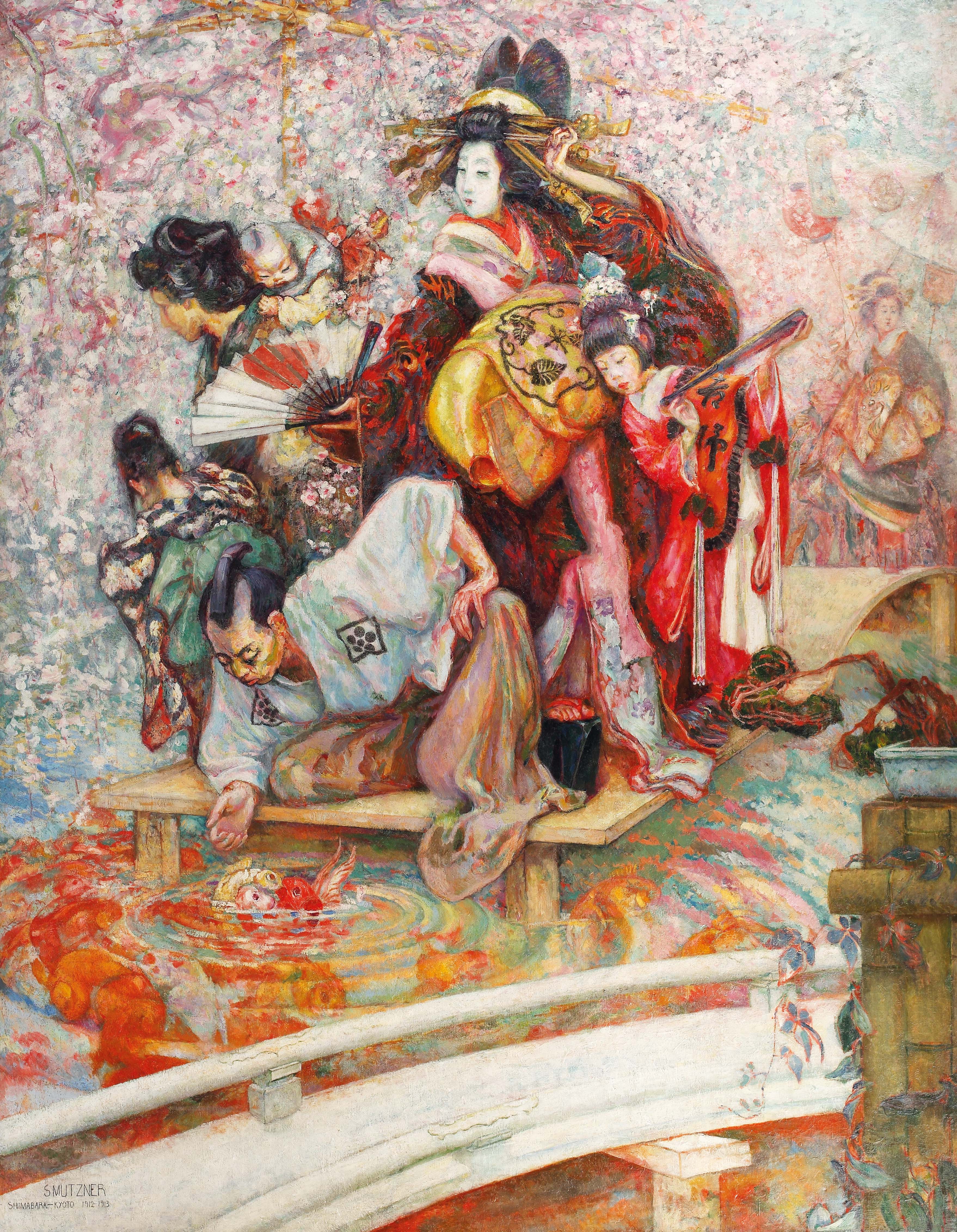
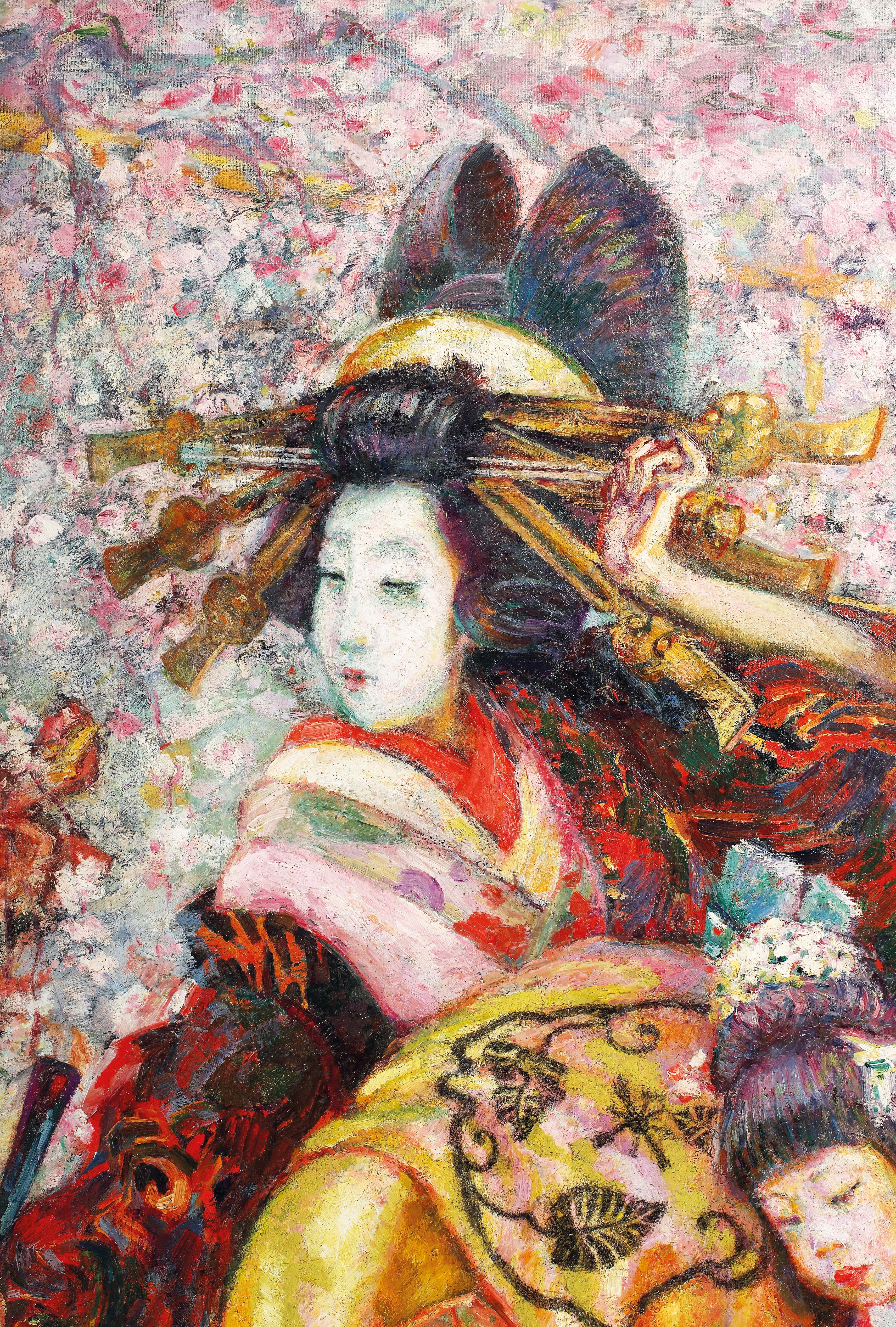
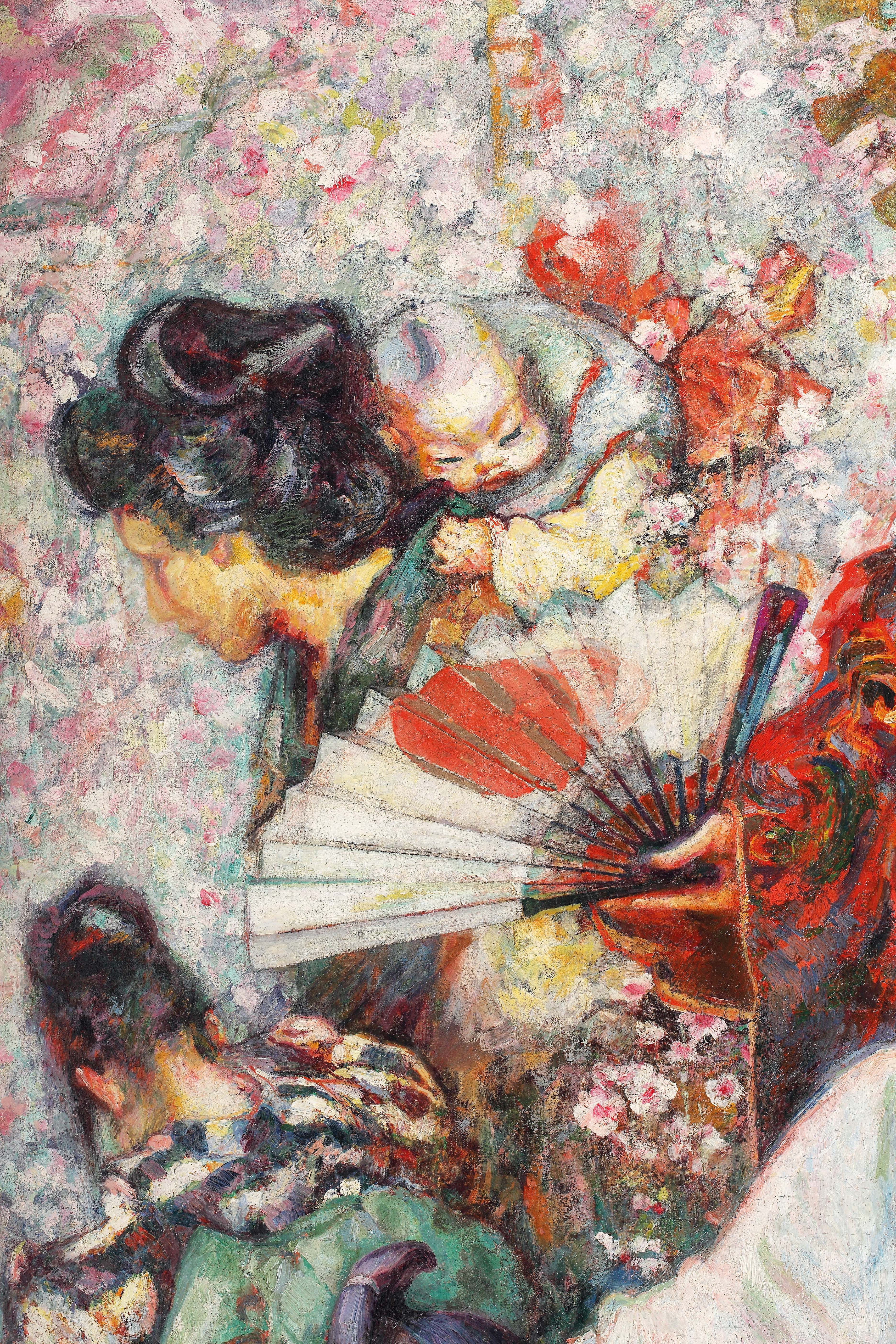
oil on canvas, 228 x 176.5 cm, 228 Ã 176,5 cm, signed, dated and located bottom left, with black, "S. MUTZNER, SHIMABARA-KYOTO, 1912-1913"
Research information
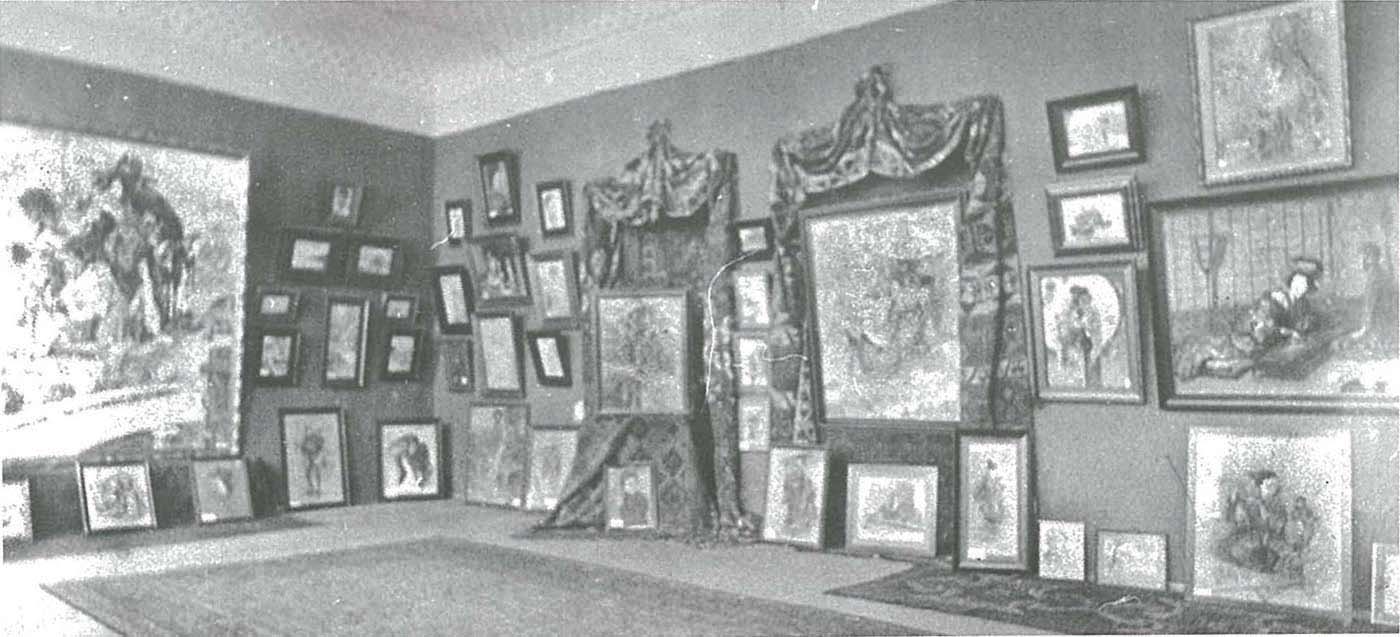
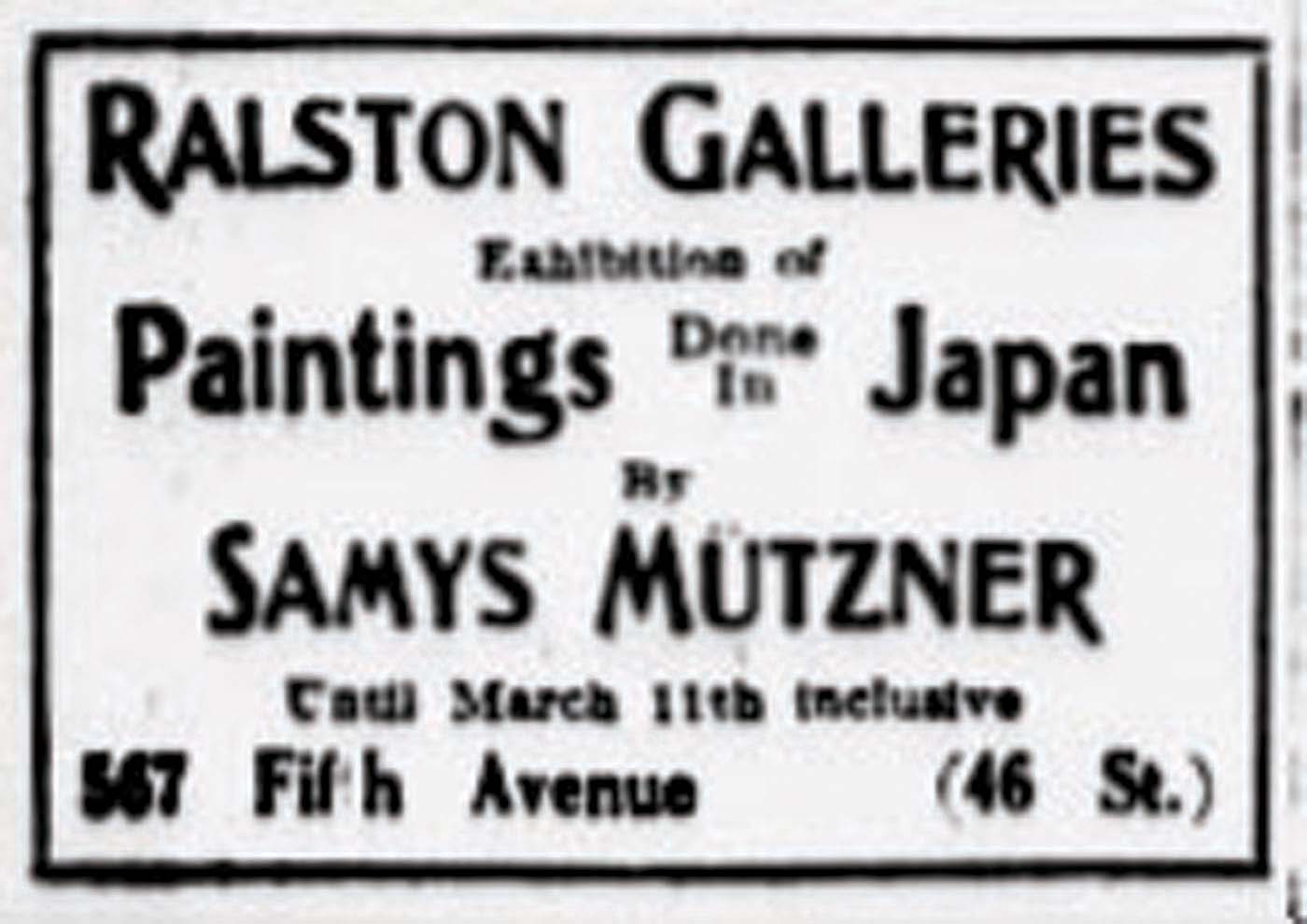
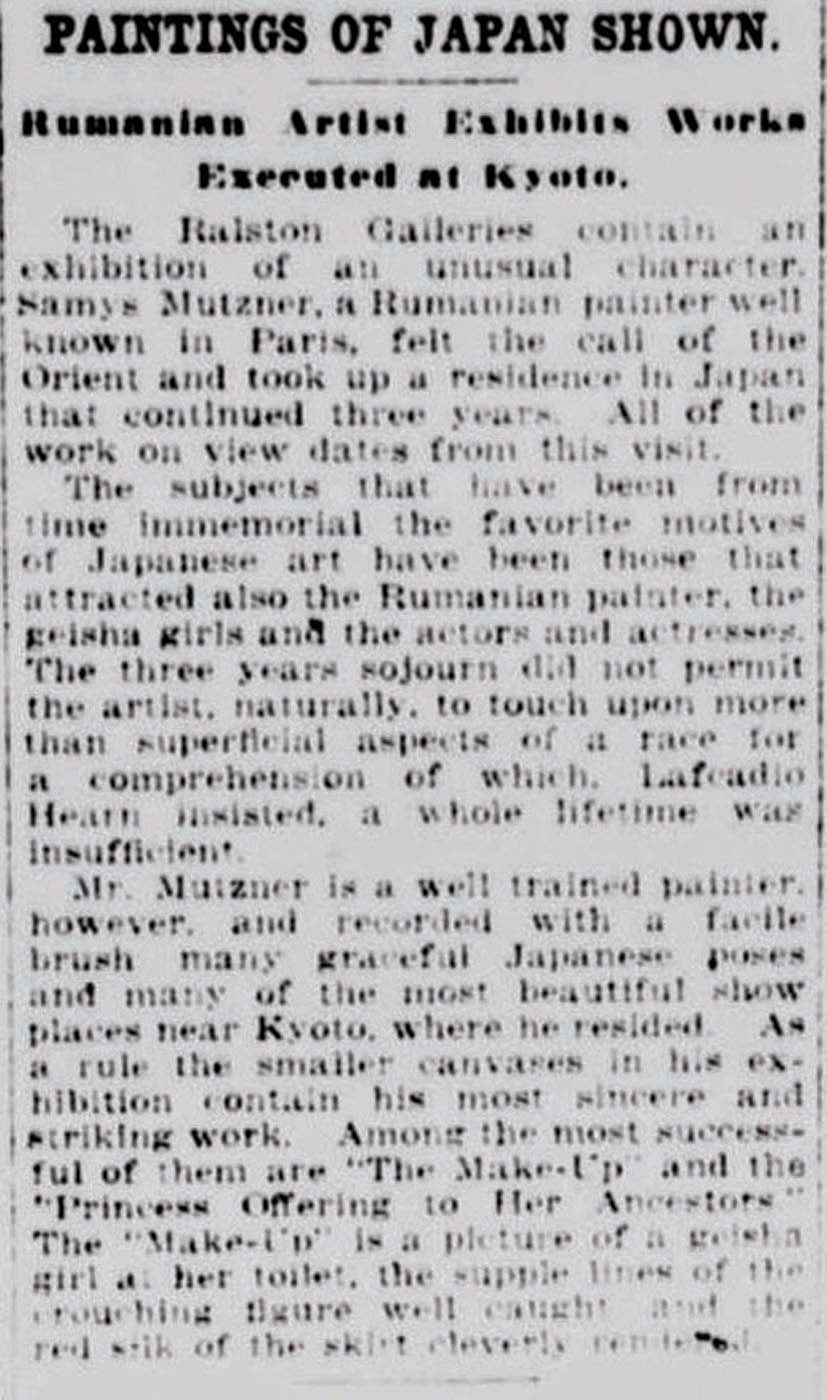
The artwork was part of the solo exhibition "Le Jepon", 88 Calea Victoriei, opposite the Kretzulescu Church, January 17 - February 28, 1916, Bucharest. The artwork is mentioned in the exhibition catalogue at cat. 67 under the title "Tayou-San dans un jardin de Shimabara." The artwork was part of the solo exhibition Mützner, Ralston Galleries, New York, 567 Fifth Avenue, January 28 - March 11, 1916. The artwork is reproduced in "Pictorul Samuel Mützner în Japonia Èi America" ("The painter Samuel Mutzner in Japan and America") by Viorica Andreescu, in "Studii Èi cercetÄri de istoria artei" ("Art History Studies and Research"), tome 19, no. 1, p. 67-82, 1972, Bucharest. The artwork is reproduced in "Samuel Mützner", Viorica Andreescu, Meridiane Publishing House, 1974. The Le Japon exhibition presented to the public in Bucharest and New York was exceptionally well received by the critics of the time, being praised in the "New York-Herald", "Evening World", "The Sun", "American Art News" or "The Globe", "AdevÄrul" or "Noua RevistÄ RomânÄ". The artwork was part of the exhibition "Samuel Mützner. Pe urmele lui Claude Monet" ("Samuel Mützner. In the footsteps of Claude Monet"), Art Safari, Bucharest, 2021.
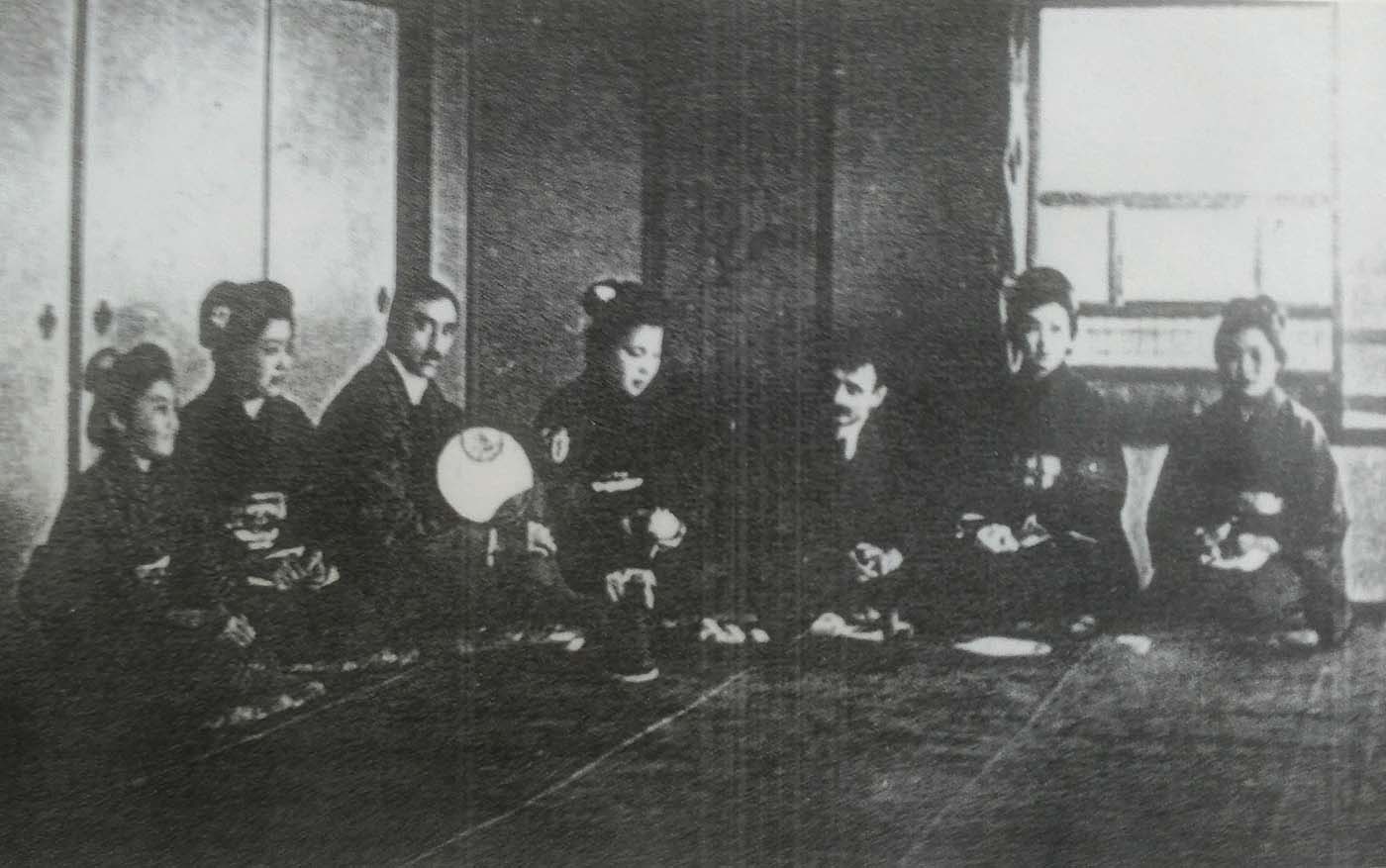
In the summer of 1912, on 28 July, Samuel Mützner arrived on Japanese shores, disembarking from the Tenyo Maru (one of the first commercial turbine-powered transpacifics, equipped with the most important equipment of the time) which brought him from Honolulu to the port of Yokohama. The end of a journey that took him from Bucharest, through Berlin, Paris, Le Havre, New York, San Francisco and Honolulu to Japan, was the fulfilment of a dream that had been growing in the young artist's soul since the end of the first decade of the 20th century. The Far East and its artistic "wonders" had experienced a new infusion into Western cultures, especially following the Russian-Japanese War (1904-1905), which resulted in the revival of that "Japanizing" taste. Naturally, young Mützner, eager to experiment and innovate, will be looking to complete his itinerary with a truly memorable stay on the shores of the Japanese islands. For a better understanding of the context, we can recall that during the period when the Romanian was in Paris, so after 1906, specialized studies dedicated to Japanese culture and art began to appear: Raphael Petrucci, "La philosophie de la nature dans l'art d'Extrême-Orient", Paris, 1910; "L’art bouddhique en Extrême-Orient d’après les découvertes récentes" in "Gazette des Beaux-Arts", September 1911. Later, in a 1947 interview in which Mützner discussed his travels throughout his career, he recalled that during his school years in Paris, he had a Japanese studio mate, Kanakogei, who was the director of an art school in Kyoto. Moreover, his biography shows that during his time at Giverny, in the company of Monet, Mützner must have come into contact with his collection of Japanese prints. Mützner, who was unabashedly drawn to Impressionist painting, would have instinctively gravitated towards Japonism. The attraction of the Impressionists and Post-Impressionists to the charm of Japanese art and world is well known. In addition to Claude Monet and his collection of 231 Japanese prints, many of which Mützner is certain to have admired between 1908 and 1910 while at Giverny, artists such as James Whistler, Édouard Manet, Claude Monet, Vincent van Gogh and Edgar Degas were to create influenced by the Japanese world. The Romanian would have admired their works in Parisian galleries and museums, the idea of the trip to Japan being surely influenced by this detail.
So the premises were more than enough, and if we add the fact that Mützner, a young follower of neo- and post-impressionism, expressed his aesthetic tendencies through multiple searches, we understand how the new universe becomes a stylistic resource worthy of study.
With the money he earned from his second solo exhibition in Bucharest in 1912, Mützner set off for the Far East, where for three years he managed to travel through the major cities, the old imperial metropolises of Tokyo, Kyoto and Nagasaky, as well as the deep, ancestral lands of Japan, in search of authentic, ancient landscapes frozen in time.
From the summer of 1912, when he arrived in Japan, until the beginning of 1915 Mützner lived and painted in traditional Japanese communities. He would live mostly in Kyoto, the imperial capital at the time, but also the seat of the main art institutions along with Osaka, the home of the great masters of printmaking. There he could meet Kitano Tzunetomi, the leading figure of the arts at the time, or admire the 'Ukiyo-e' or 'Nihonga' styles so typical of Japanese art in the early 20th century. In 1915, our artist travelled to China for several months, painting in Peking (the old imperial capital).
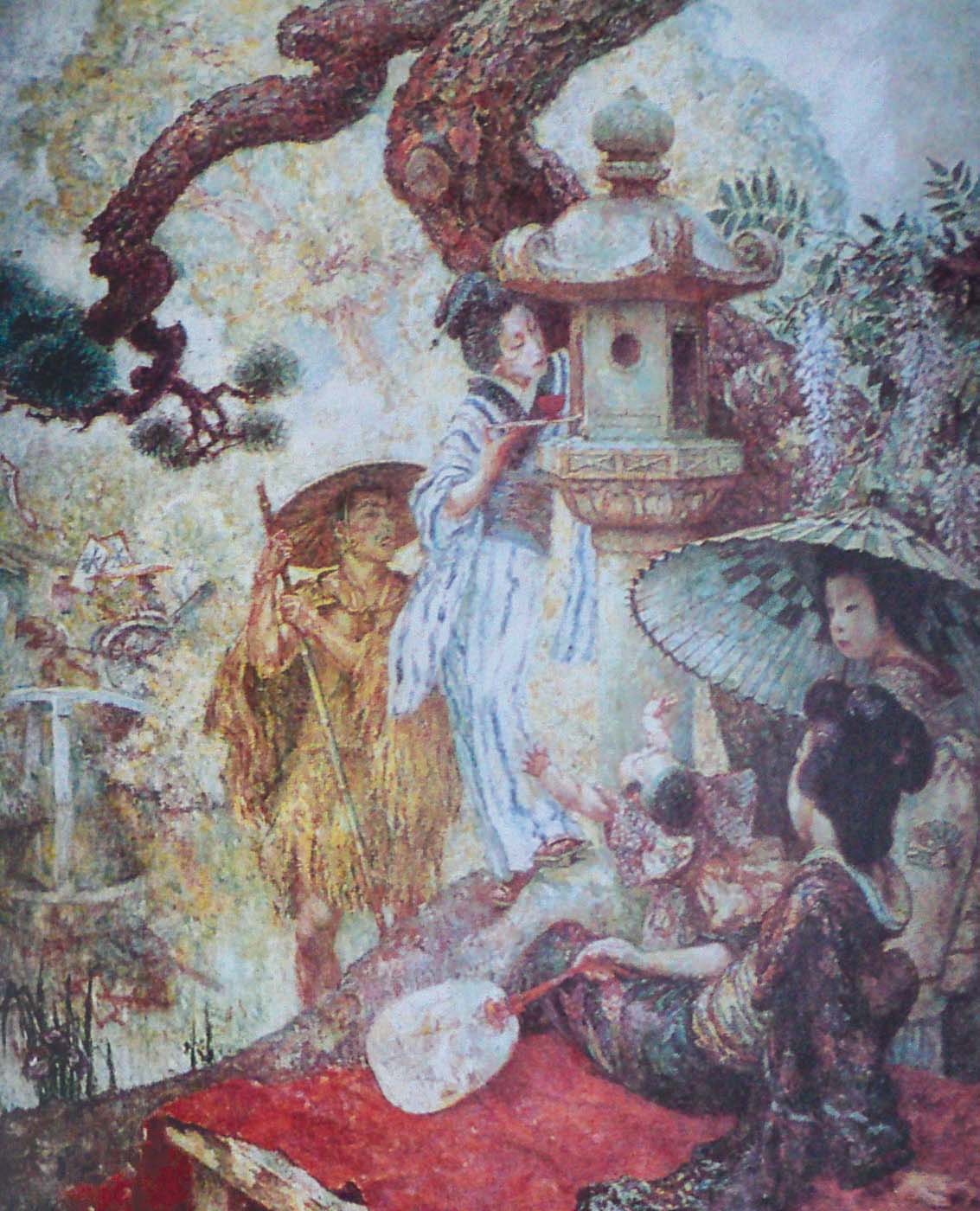
As far as Mützner's work of those years is concerned, it is easy to see the predominance of female representation, of Japanese women in traditional dress, in characteristic occupations or in urban instances. In addition to all this, there is the charming image of geishas, works of particular sensuality in the painter's work. Surprised in typical interiors, or in sumptuous Japanese gardens, the Geisha probably receives the most significant pictorial notations, and is certainly the most interesting apparition in the eyes of a European.
Samuel Mützner's artistic output during this period is significant, with certainly over 100 works, as revealed by his first exhibition in 1916 in Bucharest. It should also be noted that some of the artist's compositions in Japan were of significant size, having been completed over a period of two years, as can be seen from signatures and dates. This is also the case of the great composition "Courtesans at Shimabara", which bears two years - 1912-1913 - in the date given by the artist.
The main development punctuated by the three-year stay in the Far East was to take shape in the manner of painting and style. Driven by the search for sources of light, by an exuberant chromatic palette, Mützner not only finds himself in the oriental stay, but also modifies his manner, going beyond the pointillism typical of the Giverny period. One of the most obvious developments that we find in the present landscape is the total elimination of the neo-impressionist rigour of the aforementioned technique, to the detriment of a freedom of expression both in the choice of the brushwork and the chromatic harmony. Favourite colours in the landscape, as seen here, are harmonised in pastels and warm tones. Pink, lilac, sunshine yellow and navy blue have managed to eliminate strong contrasts, affectively shaping an atmosphere of muted transparency that reverberates over the formal.
The charm of the new visual sources did not suffocate the canvases of the Romanian who deftly discovered in each print the custom, the typical, the simple man and the sacred communion between him and the native place. Among the physiognomies, landscapes, costumes and attitudes we always find the typical corners, gardens, pagodas and temples that were the streets and the composition of a unique culture. "Buddhist Temple of Kyon-Mizu (Kyoto)", "Les érables du Temple d'Eikando" or "L'escalier et la Pagode de Kurodani" along with portrait studies, landscapes with cherry blossoms or character compositions, make up a unique universe in the artist's creation, as well as in the whole of modern Romanian art.
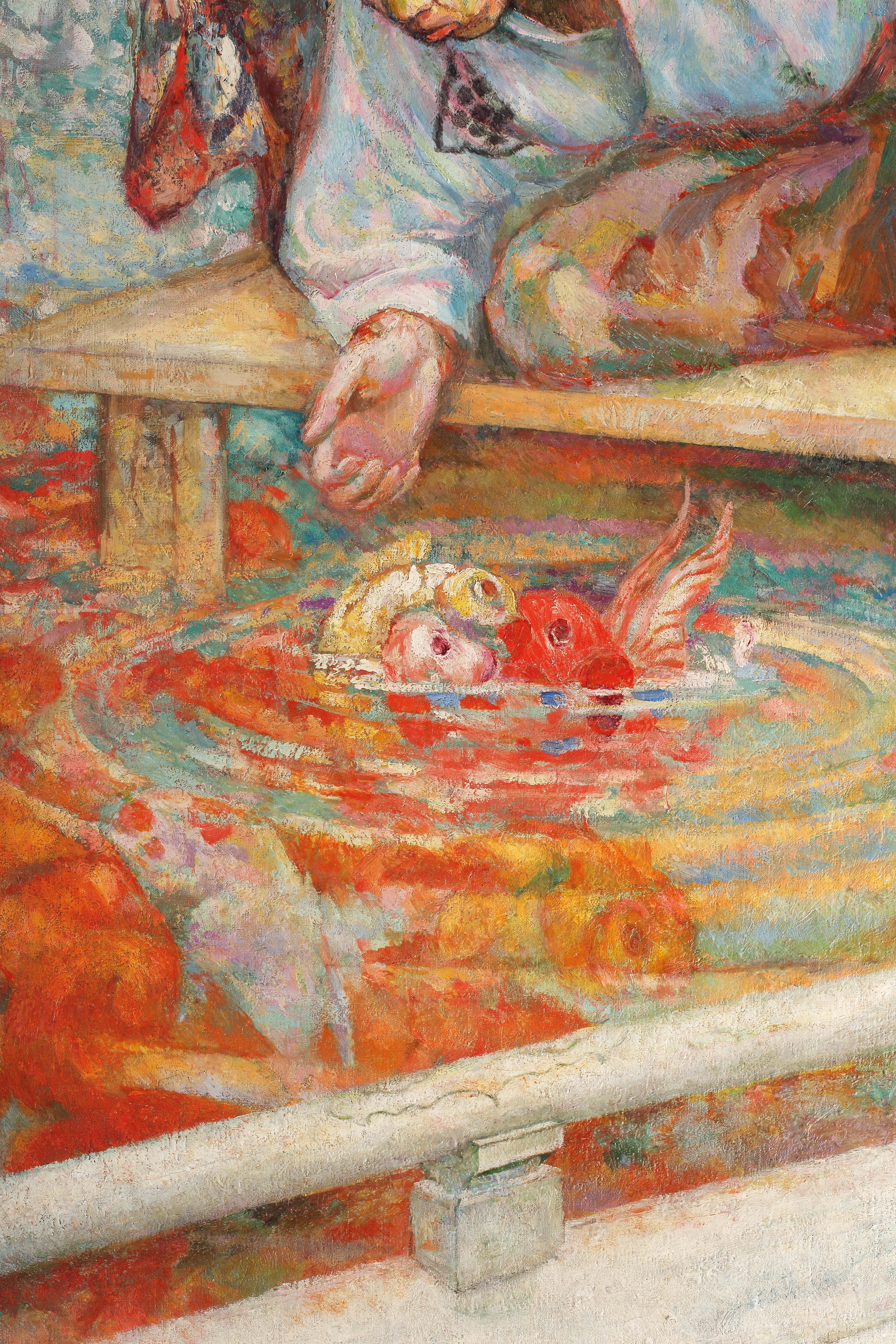
As for the present work - "Courtesans at Shimabara" - Mützner succeeded in creating a masterpiece of the cycle, individualizing it both in size and subject matter. Originally titled "Tayou-San dans un jardin de Shimabara", the painter introduces us to the intimate and alluring world of courtesans. Tayu (Tayou) is the name given to the most important courtesans (forerunners of the famous Oiran), those uniquely graceful, beautiful and charming women.
An exotic apparition from the world of arts and geishas, Mützner's Teyou-San is accompanied by the classic entourage - young girls as apprentices, a Geiko (the typical Kyoto geisha) and a male character, most likely responsible for helping her walk. Absurdly high footwear made it impossible to move easily through the city processions, footwear specially highlighted by Mützner at the edge of the pier.
In addition to the typical retinue, carefully and meticulously punctuated by the painter - see the attention to detail in the clothing of each individual character - Mützner also highlights his pictorial interests of the period. The cherry blossomed in a pastel but sensuously painted manner or the red fish pond become the main chromatic interest and also the occasion for exceptional light studies.
The artwork was to represent a milestone in Japanese creation, being noted and described in the artist's diary-book of the period. Completed most probably in September 1913 (according to the notes in no. 100 of the notebook), Mützner recalled the work and trials involved in making this monumental oil painting but declared himself more than satisfied and happy with the new style he was establishing for this masterpiece. (see Viorica Andreescu, The painter Samuel Mutzner in Japan and America, p. 73)
For clarifications regarding the bidding procedure, hammer price costs, guarantee, payment, and collection terms for the winning lot, we recommend carefully reading/re-reading the Bidding Regulations.
For additional information regarding the lot and the auction, please contact the Art Consultants Department.