The photos of the lot are informative and indicative, and cannot provide a highly detailed view of the object from all angles. We recommend a careful physical inspection of the lot before bidding.
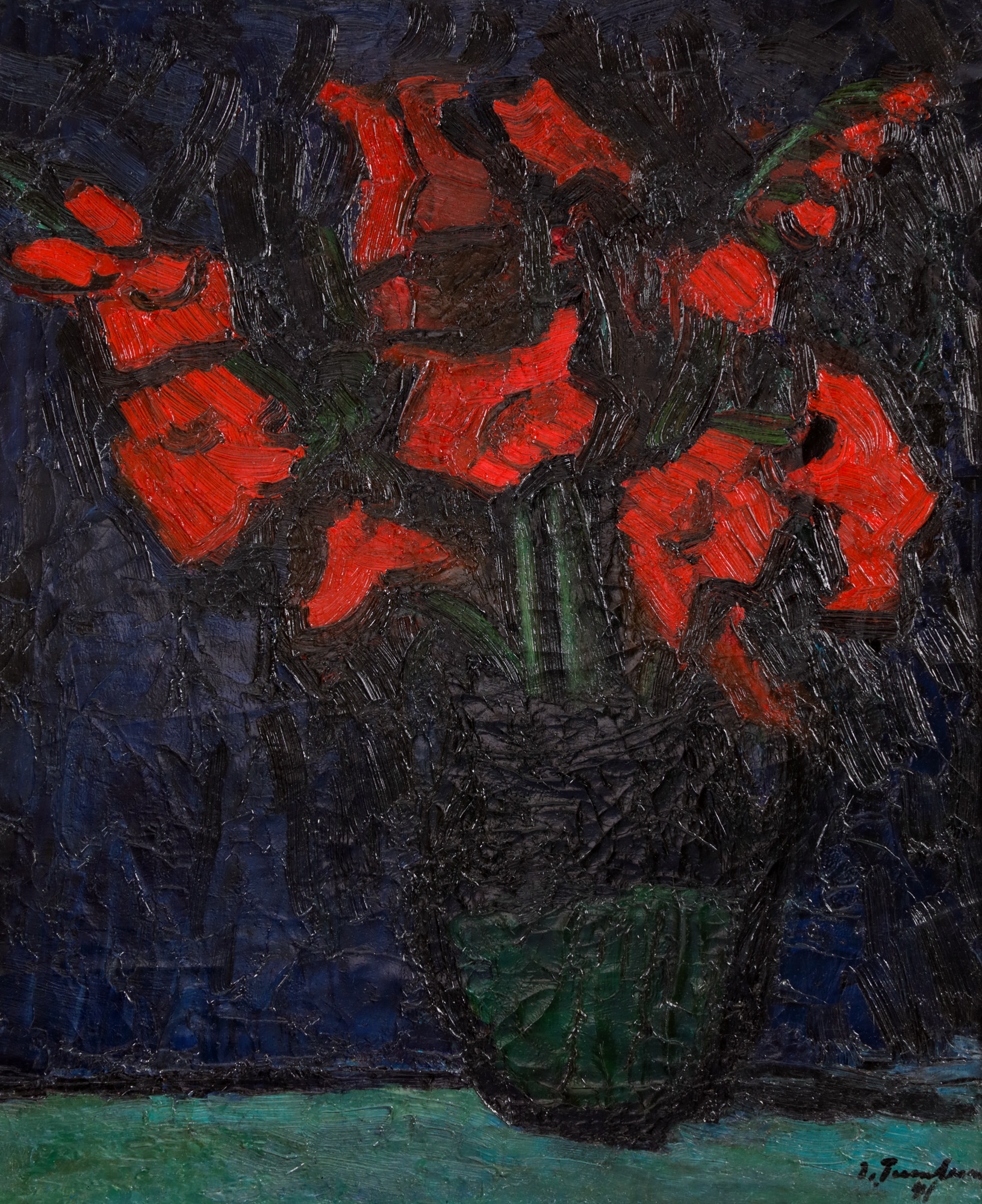
Holding a dual vocation that extends from the mesmerizing universe of art to the fascinating realms of natural sciences, Ion Țuculescu will carve his way through the distinct notes of symbolism, post-impressionism or expressionism, and up to the folkloric or totemic stages to which he entrusted his creation. Research and the constant need to experiment will constitute the key to combining all his activities. From his exhibition debut, he will be warmly greeted by one of the most representative critics of the time, George Oprescu. With a significantly reduced weight in his creative economy, still lifes represent an ideal opportunity for plastic experimentation. From works with fruits and vegetables made in the '20s, to fascinating floral elegies created around the' 40s, where the inner turmoil emerges through a specific color, the technical and stylistic evolution of the artist is remarkable. Ion Țuculescu will stand out, therefore, as an interpreter of nature from the debut period. This will allow him to familiarize himself with the basics of painting and the assimilation and refinement of the technique. From "Apricot Flowers" dating from 1924, rendered under academic-impressionist influence to the overbrimming chromatics typical of the '40s, we will notice the specificity of the central motif of the works being constituted of predominantly vegetal motifs. The subject will now merge with the background and will contribute to the mutual enhancement of the creative force. "Before being certain flowers they have to be a painting", noted the artist. But Țuculescu's flowers transposed in oil were preceded by a series of works made in gouache or pastel on paper. Revealing the particular attention of the scholar, the artist will no longer be concerned with the faithful rendering of reality, but will rather bet on the emotion imprinted on the subject. We find in the dedicated pastel series, true panoplies composed of chrysanthemums, lilies, roses or snapdragons. Arranged on the surface of the table or elevated on a pedestal, the blue, brown or violet vases reveal to us, triumphant, their pure content. The year 1938 coincides both with Țuculescu's departure to do military service, and with organizing his first solo exhibition at the Romanian Athenaeum (his passionate and loving wife will be the one who takes care of renting the hall and other organizational details). With the outbreak of the war, the artist's palette will take on much darker attributes and will mold to the sensitivity of the painter focused as a military doctor. Stylistic permutations can, therefore, be correlated with social-political events that Țuculescu will be forced to take part in, and the period of the world conflict will be pictorially transposed into the so-called "black period". The Fauvist color scheme will be exemplified especially after 1938, showing the tireless infiltrations of black on the entire canvas surface. The present work reveals Țuculescu's color preferences through the use of sanguine red, violet or shades of green. The thick paste, energetically arranged, the geometry and concrete delimitation of plans and the strong accents of red superimposed on the dark background invite us to penetrate into the creative universe of the artist now concerned with materializing the form in his own way. The still nature becomes a state under whose seal Ion Țuculescu reveals his creative self in exuberant choreography.
References
DAVIDESCU, Cătălin, "Țuculescu", Scrisul Românesc Publishing House, Craiova, 1988.
Exhibition catalogue "Țuculescu Centenary", ArtSociety Cultural Centre, Bucharest, 2010.
Dimensions
width 49.5 cm, height 62 cm
Description
oil on cardboard, signed and dated bottom right, in black, "I. Ţuculescu, (1)941"
Dating
1941
ADDITIONAL INFORMATION
For clarifications regarding the bidding procedure, hammer price costs, guarantee, payment, and collection terms for the winning lot, we recommend carefully reading/re-reading the Bidding Regulations.
For additional information regarding the lot and the auction, please contact the Art Consultants Department.

Detalii
Holding a dual vocation that extends from the mesmerizing universe of art to the fascinating realms of natural sciences, Ion Țuculescu will carve his way through the distinct notes of symbolism, post-impressionism or expressionism, and up to the folkloric or totemic stages to which he entrusted his creation. Research and the constant need to experiment will constitute the key to combining all his activities. From his exhibition debut, he will be warmly greeted by one of the most representative critics of the time, George Oprescu. With a significantly reduced weight in his creative economy, still lifes represent an ideal opportunity for plastic experimentation. From works with fruits and vegetables made in the '20s, to fascinating floral elegies created around the' 40s, where the inner turmoil emerges through a specific color, the technical and stylistic evolution of the artist is remarkable. Ion Țuculescu will stand out, therefore, as an interpreter of nature from the debut period. This will allow him to familiarize himself with the basics of painting and the assimilation and refinement of the technique. From "Apricot Flowers" dating from 1924, rendered under academic-impressionist influence to the overbrimming chromatics typical of the '40s, we will notice the specificity of the central motif of the works being constituted of predominantly vegetal motifs. The subject will now merge with the background and will contribute to the mutual enhancement of the creative force. "Before being certain flowers they have to be a painting", noted the artist. But Țuculescu's flowers transposed in oil were preceded by a series of works made in gouache or pastel on paper. Revealing the particular attention of the scholar, the artist will no longer be concerned with the faithful rendering of reality, but will rather bet on the emotion imprinted on the subject. We find in the dedicated pastel series, true panoplies composed of chrysanthemums, lilies, roses or snapdragons. Arranged on the surface of the table or elevated on a pedestal, the blue, brown or violet vases reveal to us, triumphant, their pure content. The year 1938 coincides both with Țuculescu's departure to do military service, and with organizing his first solo exhibition at the Romanian Athenaeum (his passionate and loving wife will be the one who takes care of renting the hall and other organizational details). With the outbreak of the war, the artist's palette will take on much darker attributes and will mold to the sensitivity of the painter focused as a military doctor. Stylistic permutations can, therefore, be correlated with social-political events that Țuculescu will be forced to take part in, and the period of the world conflict will be pictorially transposed into the so-called "black period". The Fauvist color scheme will be exemplified especially after 1938, showing the tireless infiltrations of black on the entire canvas surface. The present work reveals Țuculescu's color preferences through the use of sanguine red, violet or shades of green. The thick paste, energetically arranged, the geometry and concrete delimitation of plans and the strong accents of red superimposed on the dark background invite us to penetrate into the creative universe of the artist now concerned with materializing the form in his own way. The still nature becomes a state under whose seal Ion Țuculescu reveals his creative self in exuberant choreography.
ADDITIONAL INFORMATION
For clarifications regarding the bidding procedure, hammer price costs, guarantee, payment, and collection terms for the winning lot, we recommend carefully reading/re-reading the Bidding Regulations.
For additional information regarding the lot and the auction, please contact the Art Consultants Department.

References
DAVIDESCU, Cătălin, "Țuculescu", Scrisul Românesc Publishing House, Craiova, 1988.
Exhibition catalogue "Țuculescu Centenary", ArtSociety Cultural Centre, Bucharest, 2010.
Dimensions
width 49.5 cm, height 62 cm
Description
oil on cardboard, signed and dated bottom right, in black, "I. Ţuculescu, (1)941"