

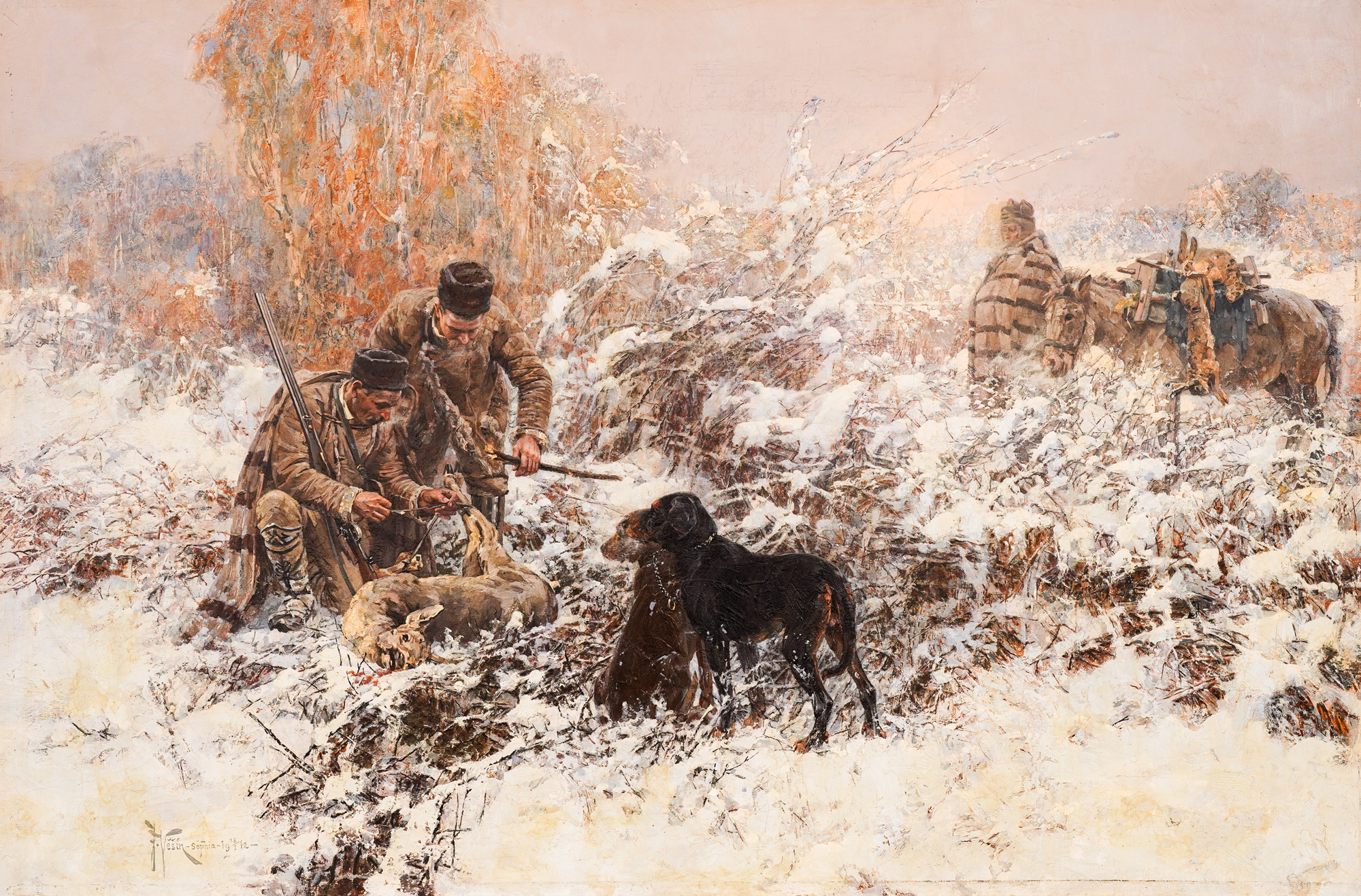
51C. Deer Hunting near Sofia [1912]
The photos of the lot are informative and indicative, and cannot provide a highly detailed view of the object from all angles. We recommend a careful physical inspection of the lot before bidding.
51C. Deer Hunting near Sofia [1912]
1860, Vraný, Austrian Empire - 1915, Sofia
Estimate:
EUR 30.000 - 50.000
Sold
EUR 65.000
References
Tsoncheva, Mara (1955). Yaroslav Veshin, Life and Work. Sofia: Pub. Bulgarian Artist.
oil paints on canvas, 60.5 x 90.5 cm, 60,5 Ã 90,5 cm, Signed, dated and located at the bottom left, in gray, "J. Veshin, Sophia, 18.I.1912"
Research information
The artwork meets the requirements for cultural value, according to an expert conclusion for identification.
Before arriving in Bulgaria, the Czech artist Yaroslav Veshin had already established himself as a true master of the winter landscape. As Mara Tsoncheva writes in her 1955 monograph about the Czech artist: “The cold is a cold, expressed in the characteristics of the earth, the sky, the trees and shrubs. Snow is fluffy and cold, people and animals engulfed in it.” A good example of this can be found in his oil compositions of sleighs, where one can sense the low temperatures by the expressions and bodies of the people, or the steam that comes from the horses’ mouths.
The subject that the artist prefers and devotes the most care and attention to in his late years in Bulgaria is hunting, especially in winter conditions. In these works, Veshin not only demonstrates his skills as a remarkable winter landscape artist, but also reveals his attitude towards nature and human interaction with it. The harmony between light and dark, warm and cold colours, as well as the noble silver palette, make these oil paintings some of his most captivating creations.
A wonderful example of this is the oil work from 1912 titled "Hunting for deer near Sofia". Early in the morning, a group of hunters has successfully shot a deer. On the cold morning, the breath of the two men can be seen steaming from their mouths as they tie up the just-caught game. The frost and snow can be seen on their legs and clothes. Patiently and disciplined, their hunting dogs wait near them, half-sunk in the snow and shrubs, with which they just had to deal while chasing the game. In the right background of the painting, the figure of an elderly man who observes the occasion with his horse, on which the hunters' previous catch is already thrown, can be seen.
All the figures in this composition are fully logically placed in it and convincingly inhabit the natural, forest terrain during winter, which complicates the hunting process. The interactions between man, animal and nature are masterfully highlighted by the Czech artist, demonstrating the harsh life of the Bulgarian peasant in winter through the action of hunting. As represented by the figure next to the horse in the background, man merges with nature. The Bulgarian hunter relies on the forest to provide his food, as well as on his animals - the dogs and the horse in this painting are as notably presented as the people themselves.
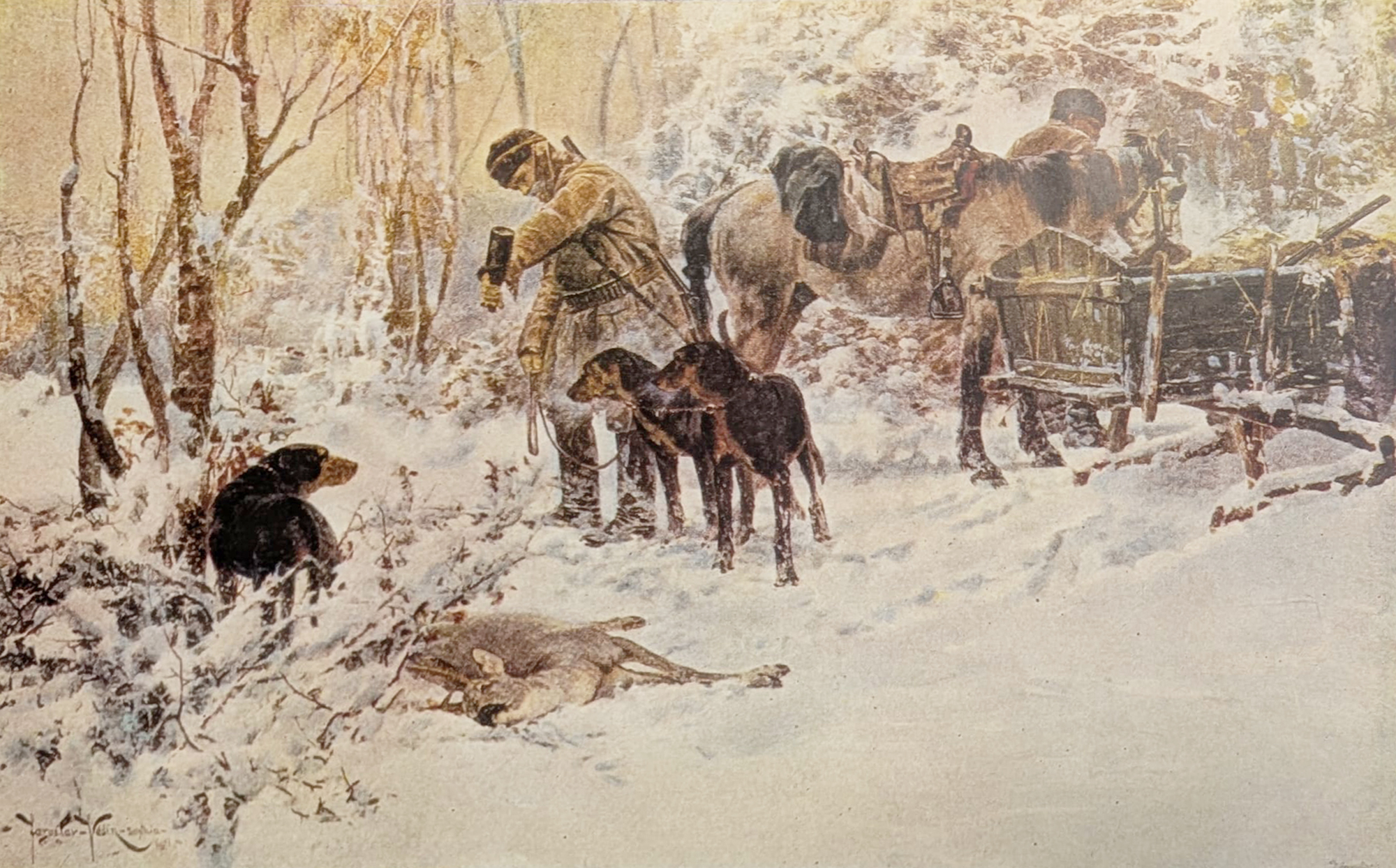
Another similar and highly important painting from this period of the artist is the work "After deer hunting" from 1911. Despite the fact that the plot and composition between the two paintings are almost identical, here Yaroslav Veshin visually enhances the idea of the hardships the Bulgarian peasant and hunter must go through in the harsh winter conditions. The main figure in the painting tilts his water jug, showing that there is not a drop left for him to quench his thirst after the exhausting hunt. Calmly, the dogs next to him look at their owner, intensifying the drama of this moment. Behind them, figures of a man and a horse have stopped next to a cart, in which is placed a shotgun on top of the lifeless body of another game. The sled's traces can be seen in the accumulated snow, further emphasising the hard and torturous life of the hunters in winter.
The intimate and emotional character of these paintings turns Yaroslav Veshin's late period into one of his most emotional. In "Hunting for deer near Sofia", however, the tense life of the Bulgarian hunter takes a back seat to the beauty of the winter forest, the connection between man and forest, and the heroic image of the animals accompanying the hunters. The figures in the painting here are not just visitors, artificially introduced into the snowy landscape, but its natural inhabitants, intertwined with its very essence. (M.Z.)
For clarifications regarding the bidding procedure, hammer price costs, guarantee, payment, and collection terms for the winning lot, we recommend carefully reading/re-reading the Bidding Regulations.
For additional information regarding the lot and the auction, please contact the Art Consultants Department.
SESSION
Brought to you by