
25. Two weddings [1970]
The photos of the lot are informative and indicative, and cannot provide a highly detailed view of the object from all angles. We recommend a careful physical inspection of the lot before bidding.
25. Two weddings [1970]
1903, Brezovo - 1976, Plovdiv
Estimate:
EUR 20.000 - 35.000
Sold
EUR 280.000
oil on canvas, 130 x 165 cm, 130 × 165 cm, signed and dated lower right, in blue, "Златю Бояджиев, 1970"
PROVENANCE
1970-1994, Collection of the University of Salford, Manchester, UK. Purchased directly from the artist in 1970 through Professor William James Orville-Thomas, a British physical chemist and professor of physical chemistry who served as a visiting professor at Sofia University. Throughout his career he maintained close ties with Bulgaria and was recognised for his contributions with an honorary doctorate from Sofia University, the St. Kliment Ohridski gold medal and the Marin Drinov gold medal from the Bulgarian Academy of Sciences. 1994-2009, In the personal collection of Prof. William James Orville-Thomas. Purchased by him in 1994 from the University of Salford; remained in his collection until his death in 2009. 2009-present, Collection of the heirs of Prof. William James Orville-Thomas.
Some of the most famous and impressive paintings from the second half of Zlatyu Boyadzhiev’s creative career (after the stroke he suffered in 1951) are the large-format oil works from the 1970s. Toward the end of his career, Boyadzhiev created expansive worlds filled with exquisite attention to detail, masterful brushwork, rich color, and a sense of constant movement and life. These masterpieces most often depict the bustling and romanticized provincial life of people in villages as well as in Bulgaria’s large historic towns such as Plovdiv and Smolyan. A key subject in these monumental canvases is the wedding, which either forms the main action or serves as the central motif around which the composition of the work is built.
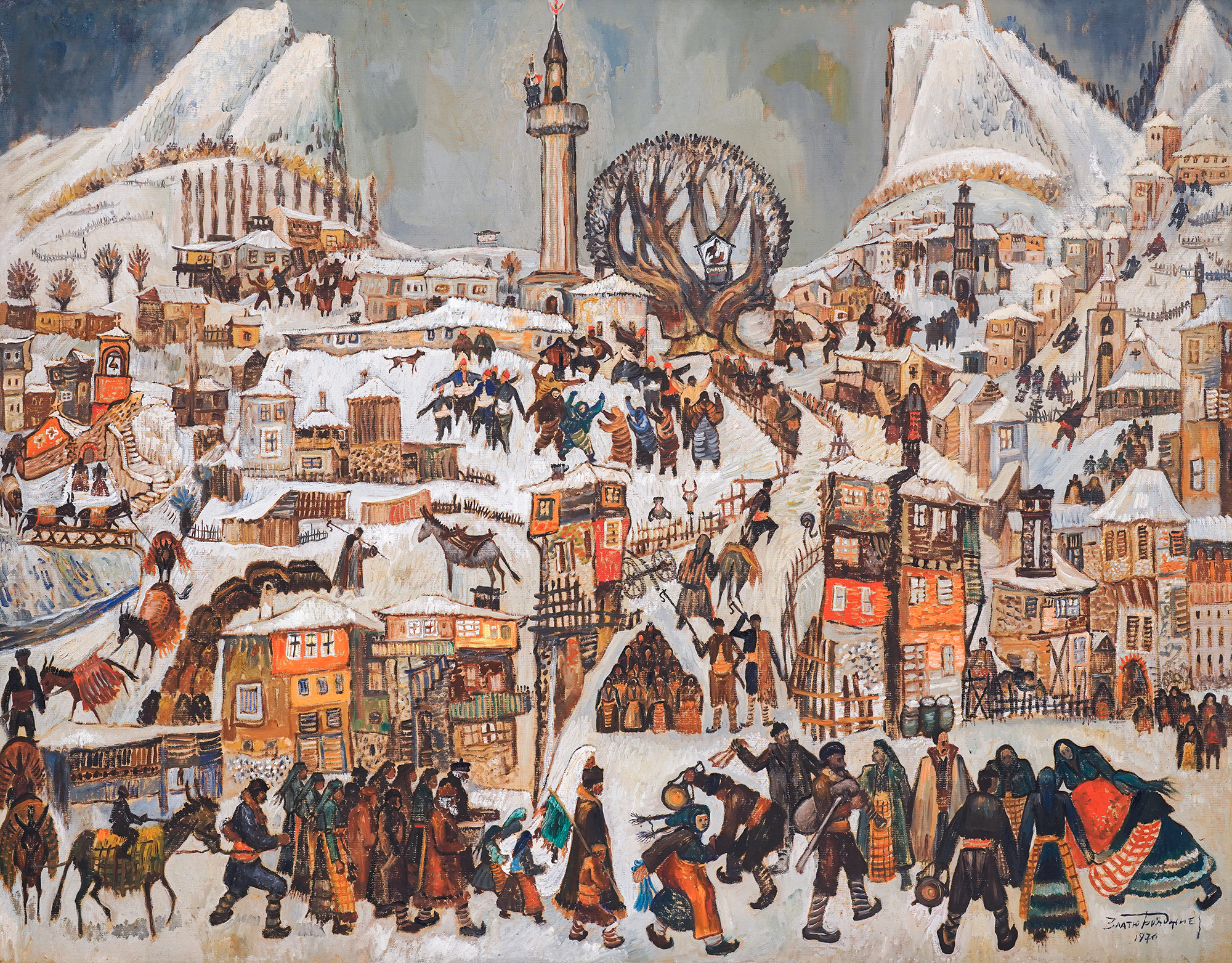
The painting “Two Weddings” (1970) is a pinnacle not only among the works with this theme, but also within the artist’s entire late period. The large, multi-figure composition reveals a winter domestic scene in Smolyan. Through virtuoso and impressionistic brushstrokes in white, blue, and gray, the artist covers the entire scene with snow, spreading across the roofs, streets, and hills of the Rhodope town. The composition is organized in several “bands”: the wedding processions in the foreground; the town square, the gathering of people, and everyday scenes in the center; and the snow-covered Rhodope Mountains and the mosque’s minaret in the upper part of the canvas.
The main wedding scene unfolds in the lower part of the painting: an impressive procession moves from the left edge of the picture toward the central foreground, consisting of donkeys, guests carrying wedding gifts, and finally (in the center foreground) the bride, who is heading toward the festive circle dance while the girls hold up her traditional costume.
The other wedding procession (in a much smaller scale) can be seen in the upper central part of the painting and depicts guests heading toward the church in the upper right. Both weddings are surrounded on the left and right sides of the canvas by scenes of everyday winter life in Smolyan: shepherds gathering their flocks, children sledding down the hill, a man ringing the church bell, and crowds dancing the horo and singing. In each of these small “episodes,” one can observe the artist’s masterful brushwork and attention to detail and color, creating striking and detailed micro-scenes which, like threads, weave together the overall compositional framework.
At the upper center of the painting stands a huge, leafy tree, almost like a symbol or axis of the painted world. Above it rises the minaret, where a figure can be seen with arms outstretched toward the heavens. Surrounded by the tall Rhodope Mountains, this symbolic grouping of the tree and the tower is presented as the culmination of this lively, dense, and colorful universe in which Zlatyu Boyadzhiev places his figures—festive, bustling, rich in spirit and cultural heritage. The artist presents winter Smolyan not as a documentary scene, but as a generalized image of folk life—dense, noisy, vibrant, and almost mythologized.
Other Variants
Besides the presented work, there are two other versions of this subject from the artist’s late period.
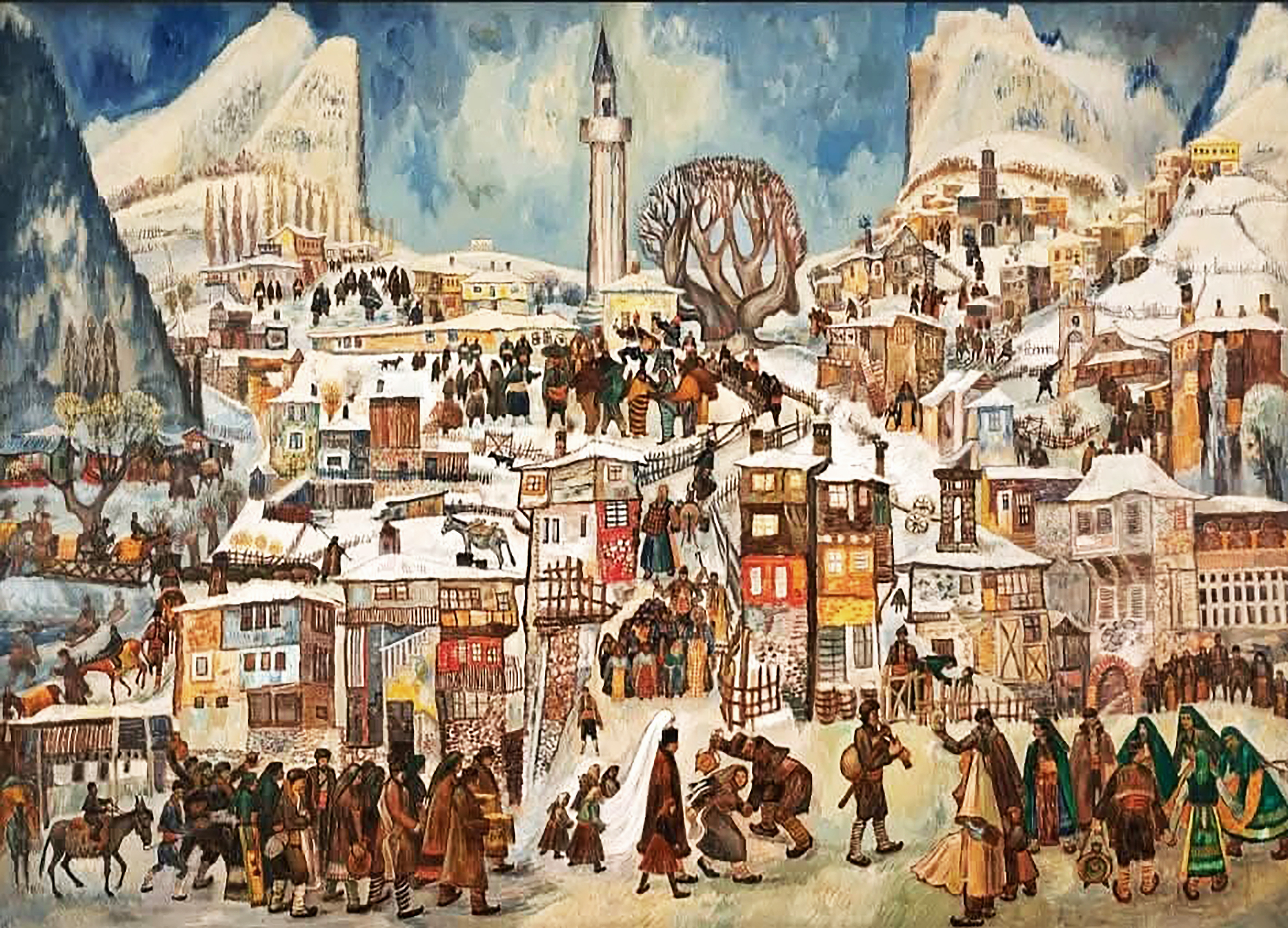
One version is located in the Zlatyu Boyadzhiev House Museum in Plovdiv, measuring 210 × 310 cm. The main difference noticeable here is the presence of another mountain hill on the left side of the canvas. The figures are centralized in the middle of the painting and do not appear as prominently in the periphery of the composition. The sign “Smolyan” is not present on the trunk of the tree, and the figure at the top of the minaret is absent.
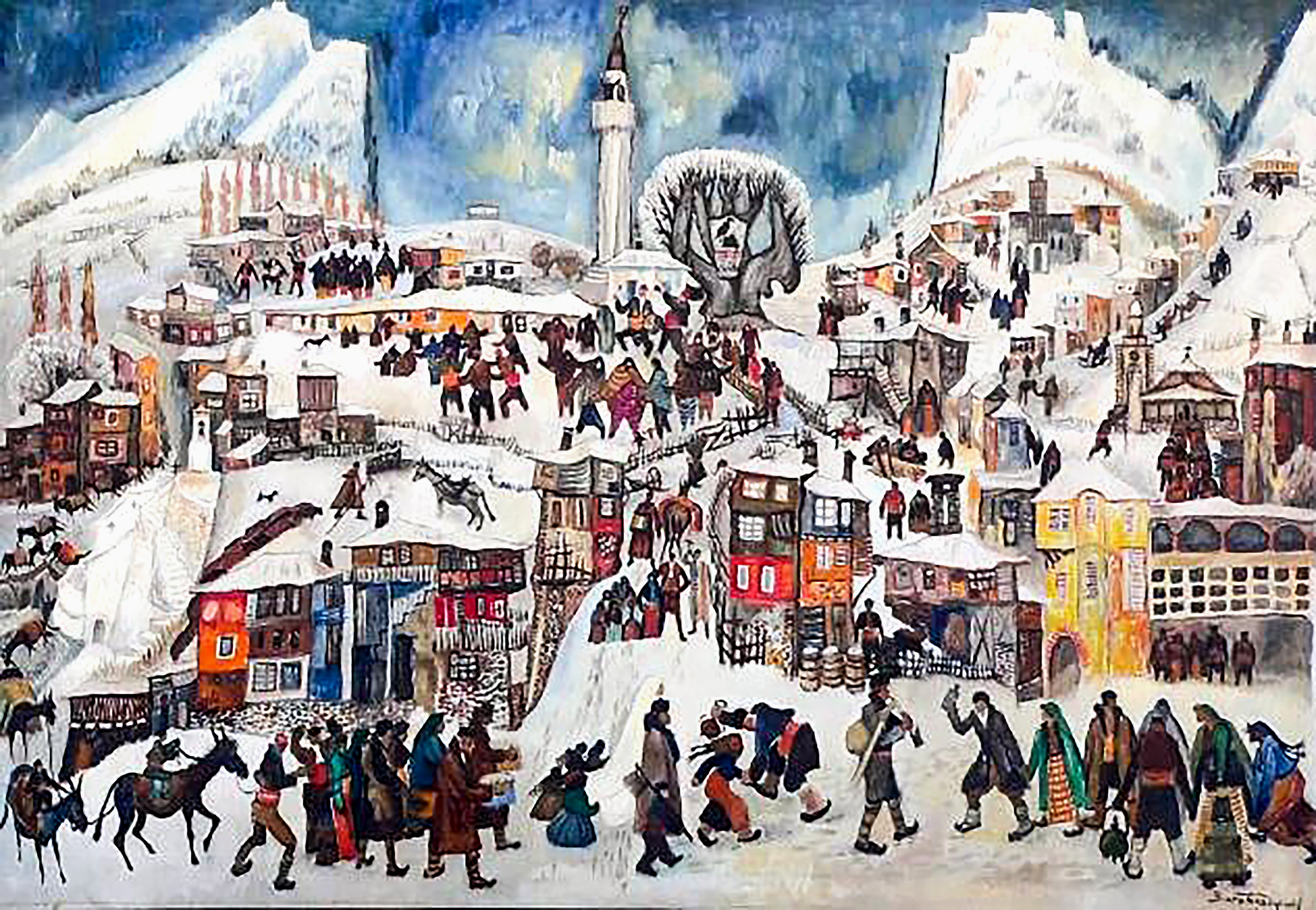
The other version is compositionally (as well as in size) much closer to the presented painting than the one in the Zlatyu Boyadzhiev House Museum. It is located in the meeting hall of the Bulgarian Embassy in Paris, France, measuring 138 × 200 cm. Like the painting presented here, the Paris version also features a more open composition with actions dispersed throughout the entire canvas. The left side of the painting is not closed off by a rising hill, and everyday scenes of shepherding, sledding, and dancing horo can also be seen in the periphery. The inscription “Smolyan” and the man on the tower are also present in this version.
Unlike the painting in the Zlatyu Boyadzhiev House Museum, the work presented in the auction is signed and dated in the lower right corner: “Zlatyu Boyadzhiev, 1970.”
Provenance
While serving as a visiting professor at Sofia University “St. Kliment Ohridski” in 1970, the English professor of physical chemistry William James Orville-Thomas (1921–2009) visited an exhibition of Zlatyu Boyadzhiev, where he befriended the artist and fell in love with his art. During the exhibition, Prof. Orville-Thomas purchased the painting “Smolyan” measuring 57 × 47 cm (lot 73 in the auction) and received a drawing with the same title as a gift (lot 1 in the auction).
He was greatly impressed by the painting “Two Weddings,” and when he returned to the United Kingdom later that year, he persuaded the art department at Salford University—where he himself worked—to purchase the painting for their collection. It remained in their possession until 1994, when Prof. Orville-Thomas asked the university to sell the painting to him on the occasion of his retirement. Thus, from 1994 until his death in 2009, the painting “Two Weddings” was part of his personal collection.
Prof. William James Orville-Thomas was one of the major British patrons of fine art in the United Kingdom during the 1970s and 1980s. He helped enrich the collection of Salford University with masterpieces from around the world, as well as collections of institutions around the Manchester region. He was also a close friend of major British modernists Harold Riley and L. S. Lowry, whose paintings frequently appeared in his collection.
In his professional career, Prof. Orville-Thomas was one of the leading figures in physical chemistry, particularly in the field of spectroscopy, where he made key discoveries and experiments. For his achievements he received honorary doctorates from many universities around the world. Throughout his life he maintained a special affinity for Bulgaria, where he formed many valuable friendships. He was awarded an honorary doctorate from Sofia University “St. Kliment Ohridski,” the Golden Medal “St. Kliment Ohridski,” and the Golden Medal “Marin Drinov” from the Bulgarian Academy of Sciences. (M.Z.)
For clarifications regarding the bidding procedure, hammer price costs, guarantee, payment, and collection terms for the winning lot, we recommend carefully reading/re-reading the Bidding Regulations.
For additional information regarding the lot and the auction, please contact the Art Consultants Department.
SESSION
Brought to you by
Similar lots