The photos of the lot are informative and indicative, and cannot provide a highly detailed view of the object from all angles. We recommend a careful physical inspection of the lot before bidding.
The photos of the lot are informative and indicative, and cannot provide a highly detailed view of the object from all angles. We recommend a careful physical inspection of the lot before bidding.
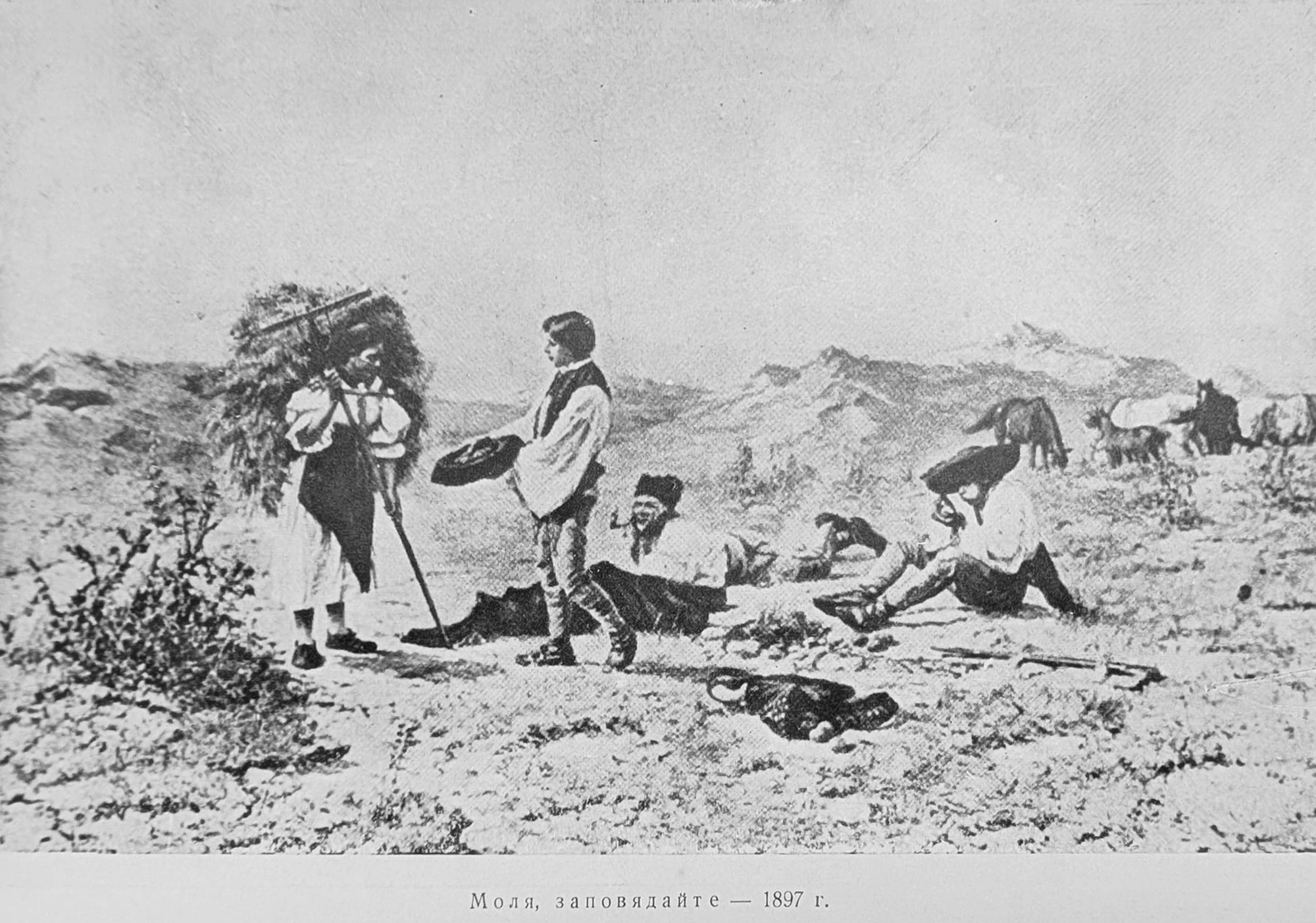
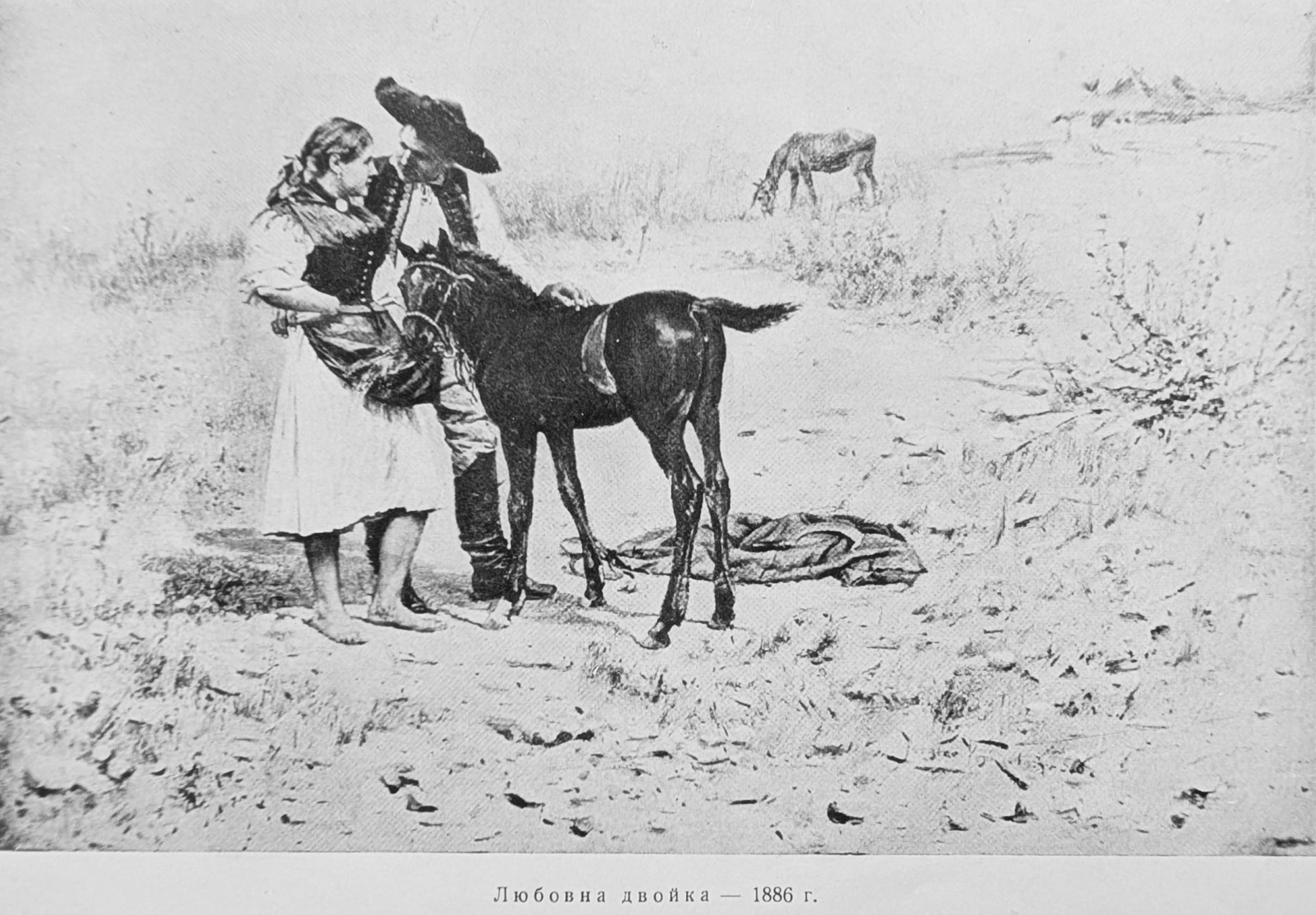
Before his departure for Bulgaria in 1897, the Czech artist Jaroslav Věšín examined in depth the theme of everyday and provincial life in his work, especially during the final years of his stay in Munich. This period of Věšín’s art is often associated with his snowy compositions featuring sleighs and carts, but another genre also plays a key role in his oeuvre — love scenes. These works were strongly influenced by Slovak rural life and culture, a region Věšín frequently visited during the 1880s. Among the most well-known works from this period are “Please, Come In” (1897) and “Love Couple” (1886), known from reproductions in Mara Tsancheva’s 1955 monograph. In these paintings, Věšín consistently seeks to affirm the rural person within genre painting, portraying them in their emotional beauty and dignity. In this series, he not only celebrates young rural love but also highlights the purity and innocence of the couples, often reinforced by the surrounding landscape, which harmonizes with their simple and joyful affection.
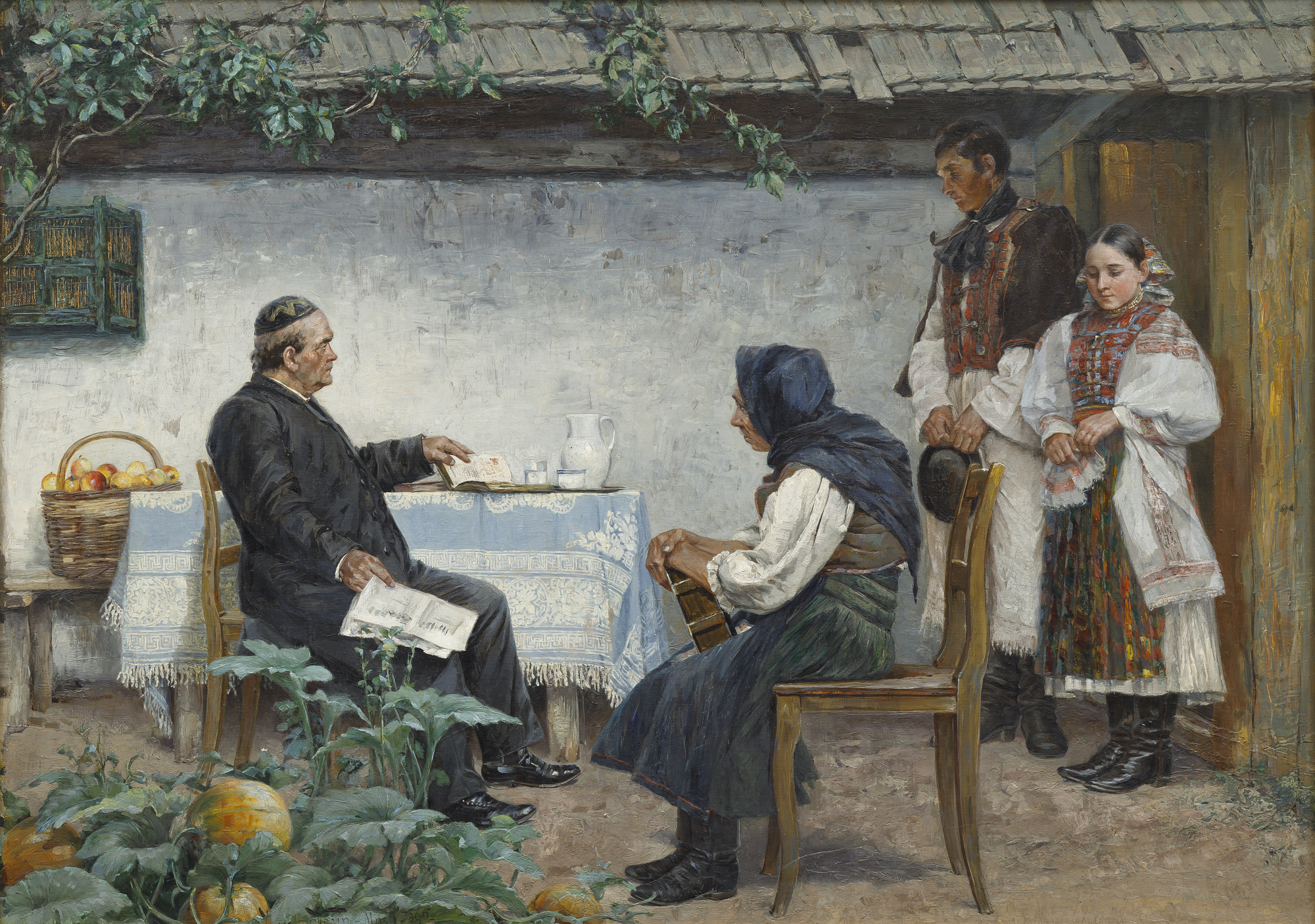
Within this same genre belongs another reproduced painting from Tsancheva’s monograph — the oil painting “Before the Wedding” (1896). Like “Please, Come In,” it belongs to the same Munich period, but it differs compositionally in several key aspects. While in “Please, Come In” and “Love Couple” the young figures are left alone to express their feelings within an idyllic rural landscape, in “Before the Wedding” Věšín shifts the focus to family relations, the domestic courtyard, and generational continuity.
The action takes place not in an open pastoral landscape but in the courtyard of a family home. At the center of the composition sit the parents around a table, interrupted by the entrance of a young couple from the right side of the painting. The father lifts his gaze from his ledger and looks toward the young man who has just entered with the girl, likely about to ask for her hand in marriage. The young woman looks down in embarrassment, while the mother has not yet turned toward the couple, possibly also in emotional hesitation, aware that her daughter will soon leave the family home. Their clean white garments, decorated with folk embroidery, contrast with the dark, worn clothing of the parents.
The artist also uses linear perspective to emphasize how the “white” young love rises above the seated parents, yet still places the father’s figure at the compositional center — the person on whom the future of the young family depends. Věšín further employs iconography in a subtle way: ivy climbing the house, onions in a basket, and ripe pumpkins in the foreground not only indicate late summer and early autumn, but also symbolize the maturity of love, ready for “harvest” or consummation.
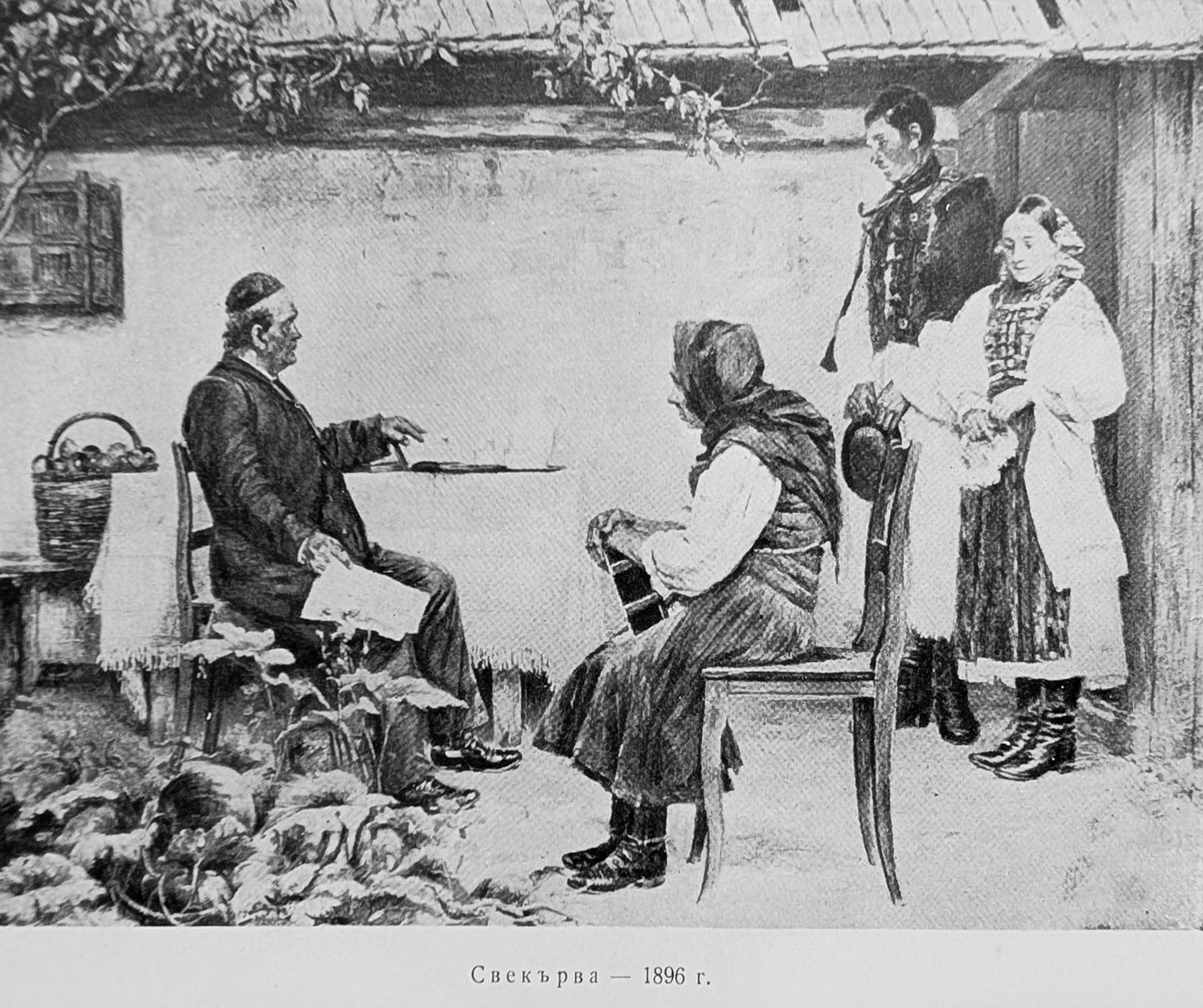
With these references, the artist also hints at another possible reading — the ripe pumpkin in the left foreground, diagonally opposite the young girl, suggests that she may be pregnant. This may explain the couple’s nervousness and the urgency of the marriage request, implying that they are confronted with a fait accompli. The mother’s refusal to turn toward them may also suggest prior awareness of the situation. In Tsancheva’s monograph, the painting is even titled “The Mother-in-Law.”
With this work, Jaroslav Věšín presents one of the most complex and theatrical compositions of his love cycle from the Munich period of 1896–1897, strongly influenced by Slovak rural life and culture. “Before the Wedding” stands as a central work within this thematic cycle developed just before his arrival in Bulgaria at the end of 1897. (M.Z.)
Dimensions
width 90 cm, height 65 cm, custom 65 × 90 cm
Description
oil on canvas, signed bottom left, in brown, "Jaroslav Vesin, Much, (1)896"
Research information
The work is reproduced in Tsoncheva, Mara, "Yaroslav Veshin, Life and Creativity", 1955, Sofia, Bulgarian Artist Publishing House, no. 18, under the title "Mother-in-law"
Dating
1896
ADDITIONAL INFORMATION
For clarifications regarding the bidding procedure, hammer price costs, guarantee, payment, and collection terms for the winning lot, we recommend carefully reading/re-reading the Bidding Regulations.
For additional information regarding the lot and the auction, please contact the Art Consultants Department.
Detalii
Before his departure for Bulgaria in 1897, the Czech artist Jaroslav Věšín examined in depth the theme of everyday and provincial life in his work, especially during the final years of his stay in Munich. This period of Věšín’s art is often associated with his snowy compositions featuring sleighs and carts, but another genre also plays a key role in his oeuvre — love scenes. These works were strongly influenced by Slovak rural life and culture, a region Věšín frequently visited during the 1880s. Among the most well-known works from this period are “Please, Come In” (1897) and “Love Couple” (1886), known from reproductions in Mara Tsancheva’s 1955 monograph. In these paintings, Věšín consistently seeks to affirm the rural person within genre painting, portraying them in their emotional beauty and dignity. In this series, he not only celebrates young rural love but also highlights the purity and innocence of the couples, often reinforced by the surrounding landscape, which harmonizes with their simple and joyful affection.
Within this same genre belongs another reproduced painting from Tsancheva’s monograph — the oil painting “Before the Wedding” (1896). Like “Please, Come In,” it belongs to the same Munich period, but it differs compositionally in several key aspects. While in “Please, Come In” and “Love Couple” the young figures are left alone to express their feelings within an idyllic rural landscape, in “Before the Wedding” Věšín shifts the focus to family relations, the domestic courtyard, and generational continuity.
The action takes place not in an open pastoral landscape but in the courtyard of a family home. At the center of the composition sit the parents around a table, interrupted by the entrance of a young couple from the right side of the painting. The father lifts his gaze from his ledger and looks toward the young man who has just entered with the girl, likely about to ask for her hand in marriage. The young woman looks down in embarrassment, while the mother has not yet turned toward the couple, possibly also in emotional hesitation, aware that her daughter will soon leave the family home. Their clean white garments, decorated with folk embroidery, contrast with the dark, worn clothing of the parents.
The artist also uses linear perspective to emphasize how the “white” young love rises above the seated parents, yet still places the father’s figure at the compositional center — the person on whom the future of the young family depends. Věšín further employs iconography in a subtle way: ivy climbing the house, onions in a basket, and ripe pumpkins in the foreground not only indicate late summer and early autumn, but also symbolize the maturity of love, ready for “harvest” or consummation.
With these references, the artist also hints at another possible reading — the ripe pumpkin in the left foreground, diagonally opposite the young girl, suggests that she may be pregnant. This may explain the couple’s nervousness and the urgency of the marriage request, implying that they are confronted with a fait accompli. The mother’s refusal to turn toward them may also suggest prior awareness of the situation. In Tsancheva’s monograph, the painting is even titled “The Mother-in-Law.”
With this work, Jaroslav Věšín presents one of the most complex and theatrical compositions of his love cycle from the Munich period of 1896–1897, strongly influenced by Slovak rural life and culture. “Before the Wedding” stands as a central work within this thematic cycle developed just before his arrival in Bulgaria at the end of 1897. (M.Z.)
ADDITIONAL INFORMATION
For clarifications regarding the bidding procedure, hammer price costs, guarantee, payment, and collection terms for the winning lot, we recommend carefully reading/re-reading the Bidding Regulations.
For additional information regarding the lot and the auction, please contact the Art Consultants Department.
Dimensions
width 90 cm, height 65 cm, custom 65 × 90 cm
Description
oil on canvas, signed bottom left, in brown, "Jaroslav Vesin, Much, (1)896"
Research information
The work is reproduced in Tsoncheva, Mara, "Yaroslav Veshin, Life and Creativity", 1955, Sofia, Bulgarian Artist Publishing House, no. 18, under the title "Mother-in-law"