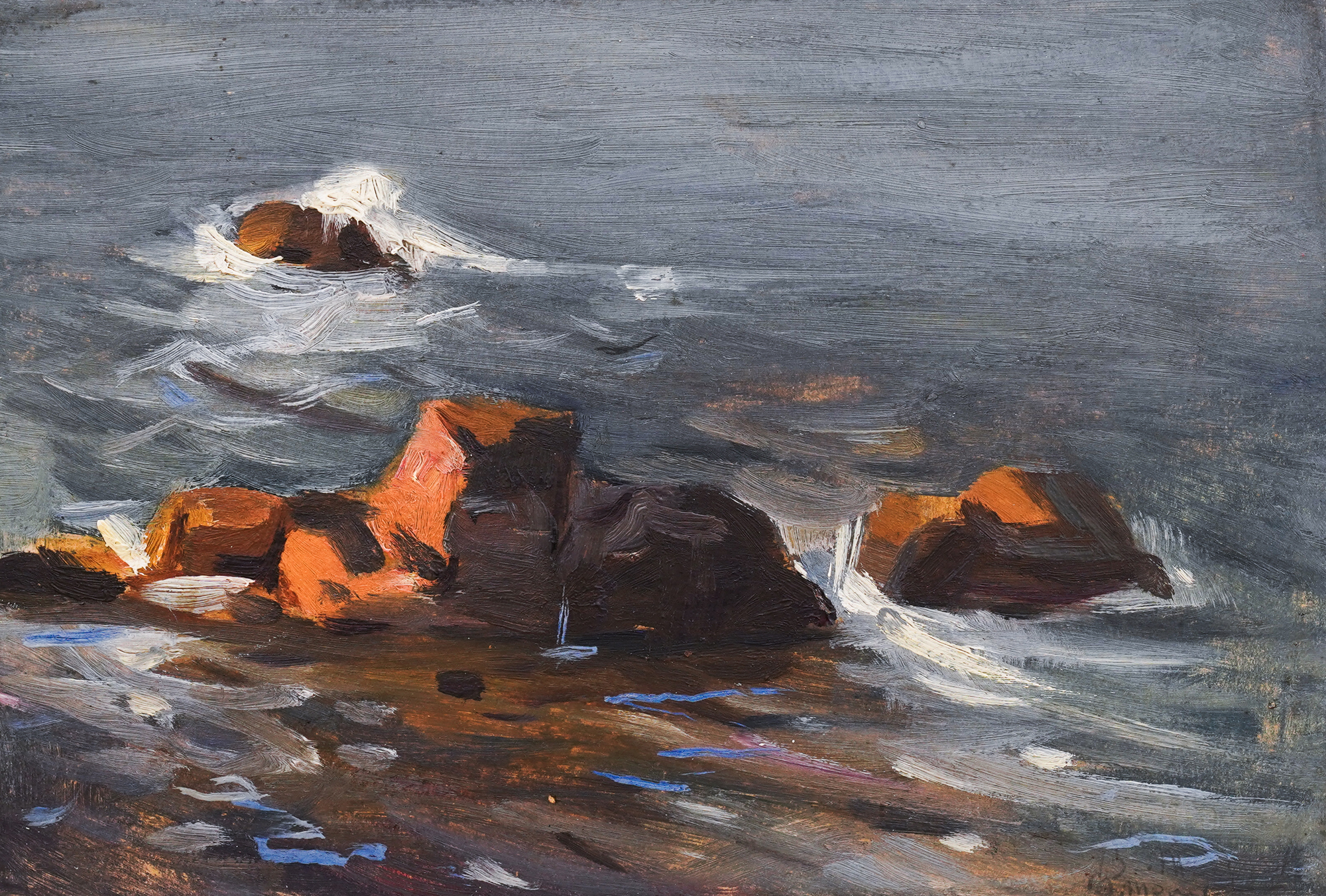
The photos of the lot are informative and indicative, and cannot provide a highly detailed view of the object from all angles. We recommend a careful physical inspection of the lot before bidding.
The photos of the lot are informative and indicative, and cannot provide a highly detailed view of the object from all angles. We recommend a careful physical inspection of the lot before bidding.
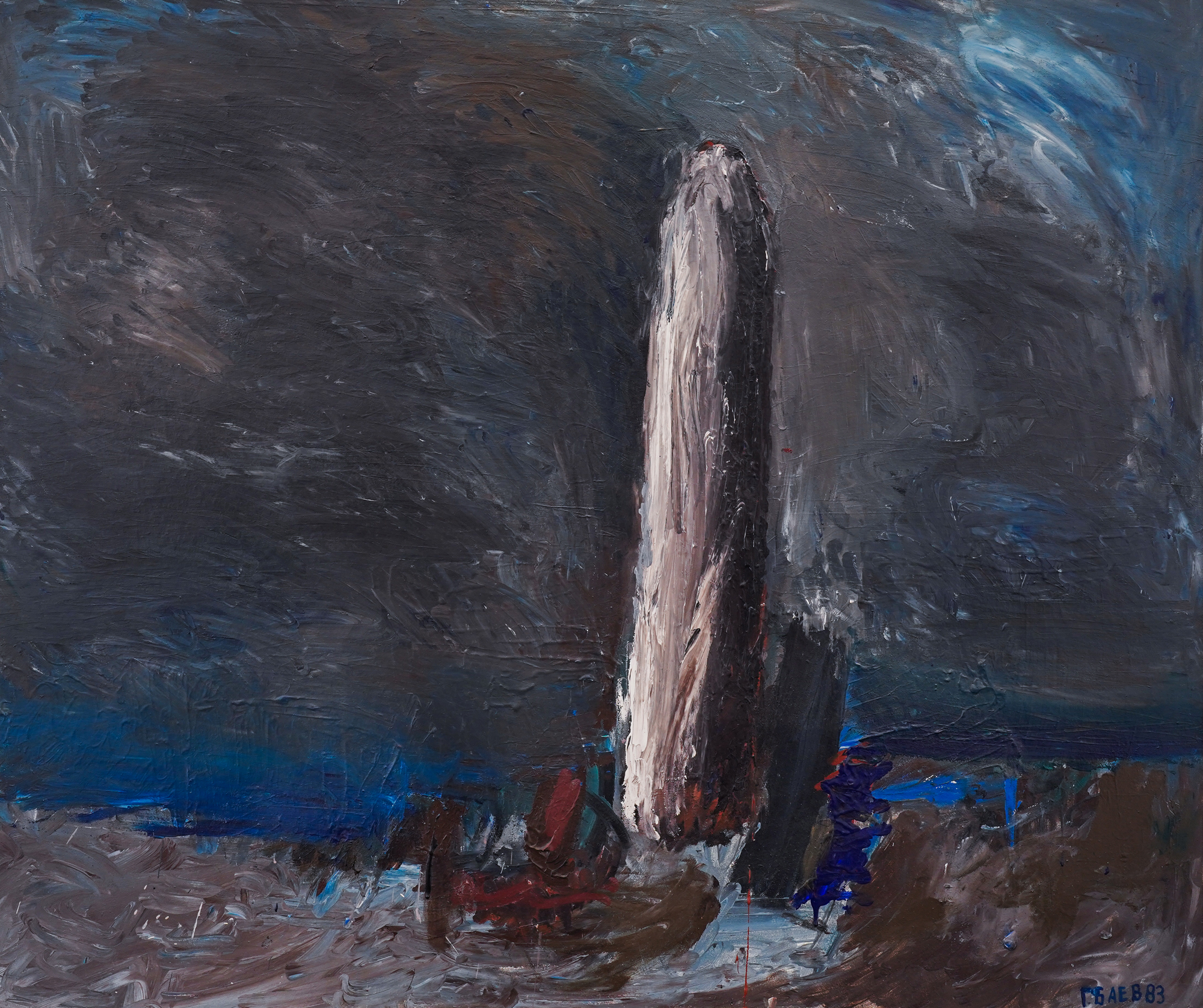
In his painting practice, Georgi Baev often explored closely related types of subjects through which he addressed diverse plastic and compositional problems — in the tonal construction of the painting, in the organization of space and composition, and in achieving emotional and psychological depth. He employed certain “iconographic schemes” through which he arrived at a wide variety of visual solutions. A representative example in this regard is the painting “Memory I,” created in 1983.
During the early period of his career in the 1960s, Georgi Baev painted a series of seascapes characterized by restrained and synthetic painterly language. In the 1980s, he worked primarily on the themes “Memory,” “The Most Beautiful Drowned Man,” and “Refugees.” In this mature phase, his painting became increasingly expressive and gradually approached abstraction.
After graduating from the Academy of Fine Arts, Georgi Baev worked in the fields of graphic art and stage design. The creative imprint of his theatrical work remained visible in his instinctive tendency to construct compositions as stage spaces, with the horizon line almost always positioned low. This type of compositional structure is also employed in “Memory I.” The subject is placed in the central part of the canvas, while above the horizon stretches an atmospheric space saturated with tonal nuances. The compositional framework of the painting would later be multiplied across dozens of subsequent canvases.
Alongside its theatrical quality, the “Memories” cycle — on which the artist worked repeatedly throughout the 1980s — possesses a strong graphic character. These canvases convey a minimalist and graphic impact not only because of their monochromatic palettes, but also through their overall aesthetic presence. They depict a stylized human figure set against a low horizon in varying tonalities, with minimal compositional changes, creating an emotional atmosphere of timelessness and stillness. Although the formats are more intimate in scale, their impact remains monumental.
Georgi Baev was an exceptional psychologist, director, and scenographer within his painting. The sea is the central protagonist of his works — the sea as a symbol of eternity, infinity, life, and creative origin. Such an understanding excludes any depiction of the sea as mere attraction, landscape, or scenery. In his paintings, it is not an azure reflection of sunlight, as traditionally represented in Bulgarian painting, but rather a dense mass that defines the horizon line, the sense of distance, the emotional register, and ultimately gives meaning to the entire canvas. It fills the work with content and renders unnecessary all details and illustrative elements.
The canvas “Memory I” also reveals another characteristic feature of the artist’s overall oeuvre: in the construction of the composition, there is not even the slightest trace of hesitation. (S.N.)
References
Karanfilova, Suzana. Landscape in Blue. Georgi Baev (1924-2007). 2013. National Gallery, Sofia. ISBN 978-954-9473-23-0, pp. 10-12.
Dimensions
width 130 cm, height 109 cm, custom 109 × 130 cm
Description
oil on hardboard, signed and dated bottom right, in blue, "Г. Баев, (19)83"
Lot.notes
signed and titled on the back, in red, "Г. Баев, Спомен I"
Dating
1983
ADDITIONAL INFORMATION
For clarifications regarding the bidding procedure, hammer price costs, guarantee, payment, and collection terms for the winning lot, we recommend carefully reading/re-reading the Bidding Regulations.
For additional information regarding the lot and the auction, please contact the Art Consultants Department.
Detalii
In his painting practice, Georgi Baev often explored closely related types of subjects through which he addressed diverse plastic and compositional problems — in the tonal construction of the painting, in the organization of space and composition, and in achieving emotional and psychological depth. He employed certain “iconographic schemes” through which he arrived at a wide variety of visual solutions. A representative example in this regard is the painting “Memory I,” created in 1983.
During the early period of his career in the 1960s, Georgi Baev painted a series of seascapes characterized by restrained and synthetic painterly language. In the 1980s, he worked primarily on the themes “Memory,” “The Most Beautiful Drowned Man,” and “Refugees.” In this mature phase, his painting became increasingly expressive and gradually approached abstraction.
After graduating from the Academy of Fine Arts, Georgi Baev worked in the fields of graphic art and stage design. The creative imprint of his theatrical work remained visible in his instinctive tendency to construct compositions as stage spaces, with the horizon line almost always positioned low. This type of compositional structure is also employed in “Memory I.” The subject is placed in the central part of the canvas, while above the horizon stretches an atmospheric space saturated with tonal nuances. The compositional framework of the painting would later be multiplied across dozens of subsequent canvases.
Alongside its theatrical quality, the “Memories” cycle — on which the artist worked repeatedly throughout the 1980s — possesses a strong graphic character. These canvases convey a minimalist and graphic impact not only because of their monochromatic palettes, but also through their overall aesthetic presence. They depict a stylized human figure set against a low horizon in varying tonalities, with minimal compositional changes, creating an emotional atmosphere of timelessness and stillness. Although the formats are more intimate in scale, their impact remains monumental.
Georgi Baev was an exceptional psychologist, director, and scenographer within his painting. The sea is the central protagonist of his works — the sea as a symbol of eternity, infinity, life, and creative origin. Such an understanding excludes any depiction of the sea as mere attraction, landscape, or scenery. In his paintings, it is not an azure reflection of sunlight, as traditionally represented in Bulgarian painting, but rather a dense mass that defines the horizon line, the sense of distance, the emotional register, and ultimately gives meaning to the entire canvas. It fills the work with content and renders unnecessary all details and illustrative elements.
The canvas “Memory I” also reveals another characteristic feature of the artist’s overall oeuvre: in the construction of the composition, there is not even the slightest trace of hesitation. (S.N.)
ADDITIONAL INFORMATION
For clarifications regarding the bidding procedure, hammer price costs, guarantee, payment, and collection terms for the winning lot, we recommend carefully reading/re-reading the Bidding Regulations.
For additional information regarding the lot and the auction, please contact the Art Consultants Department.
References
Karanfilova, Suzana. Landscape in Blue. Georgi Baev (1924-2007). 2013. National Gallery, Sofia. ISBN 978-954-9473-23-0, pp. 10-12.
Dimensions
width 130 cm, height 109 cm, custom 109 × 130 cm
Description
oil on hardboard, signed and dated bottom right, in blue, "Г. Баев, (19)83"
Lot.notes
signed and titled on the back, in red, "Г. Баев, Спомен I"