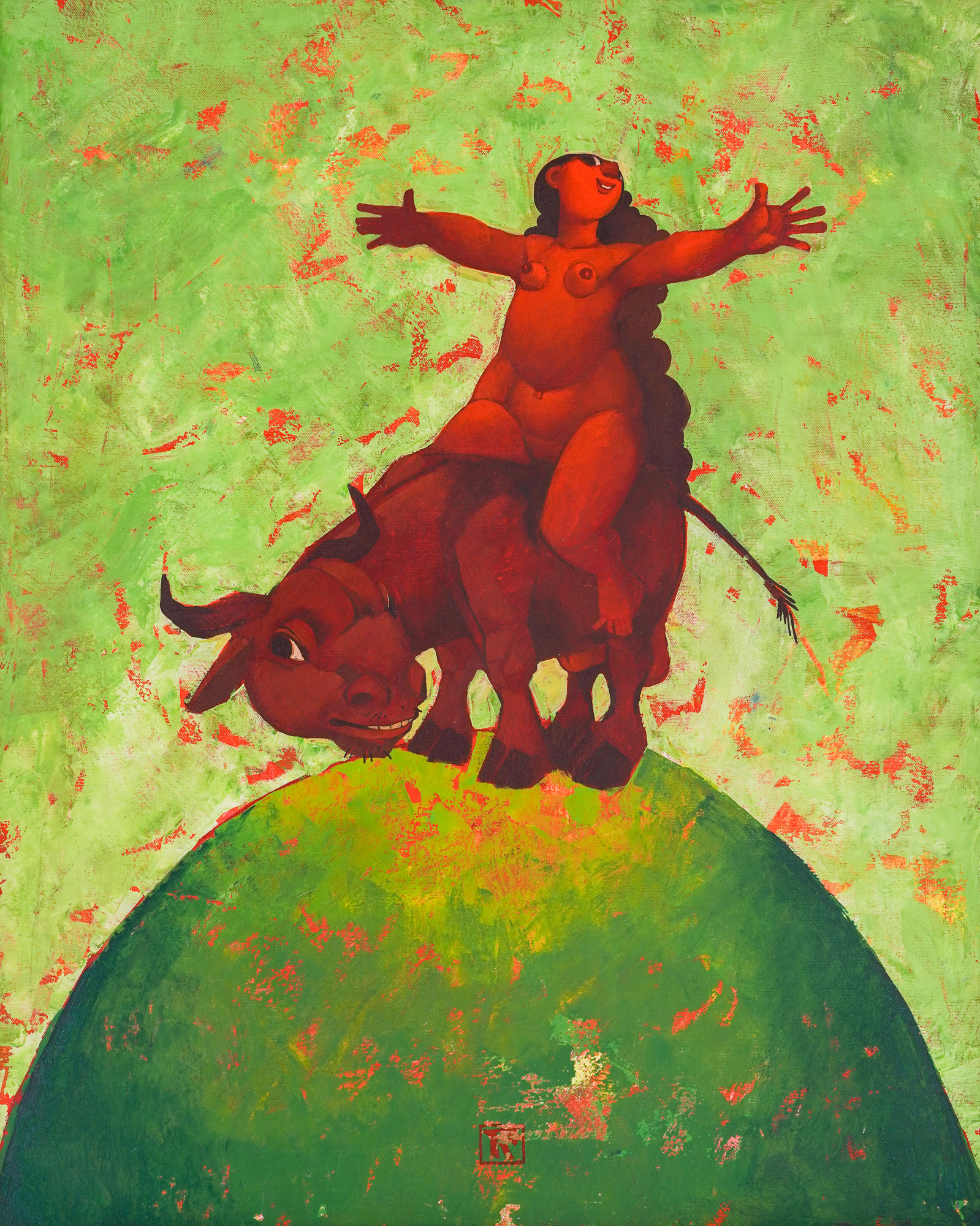
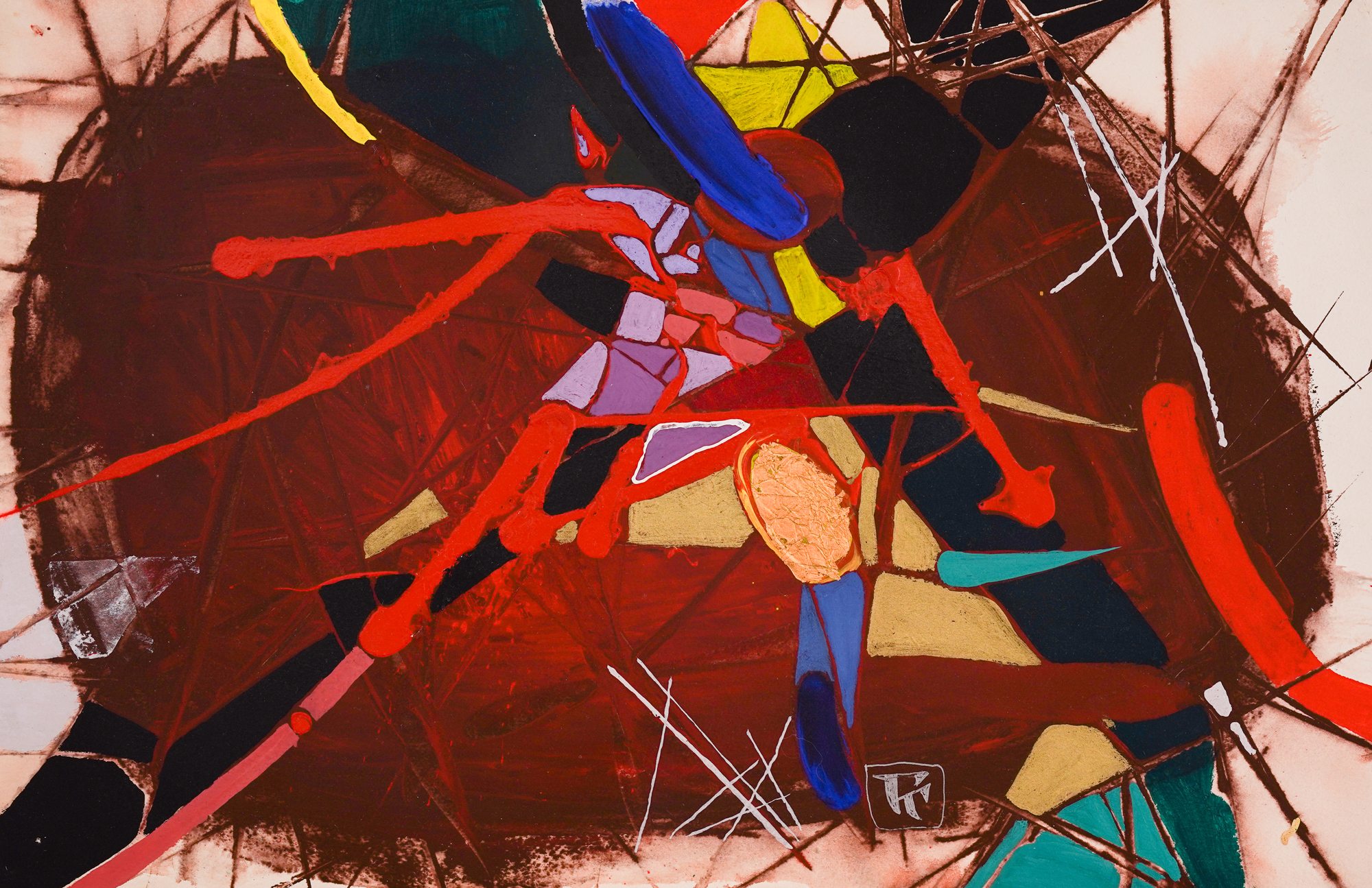
The photos of the lot are informative and indicative, and cannot provide a highly detailed view of the object from all angles. We recommend a careful physical inspection of the lot before bidding.
Avramov, Dimitar (2000). Lika Yanko. Sofia: AY Publishing.
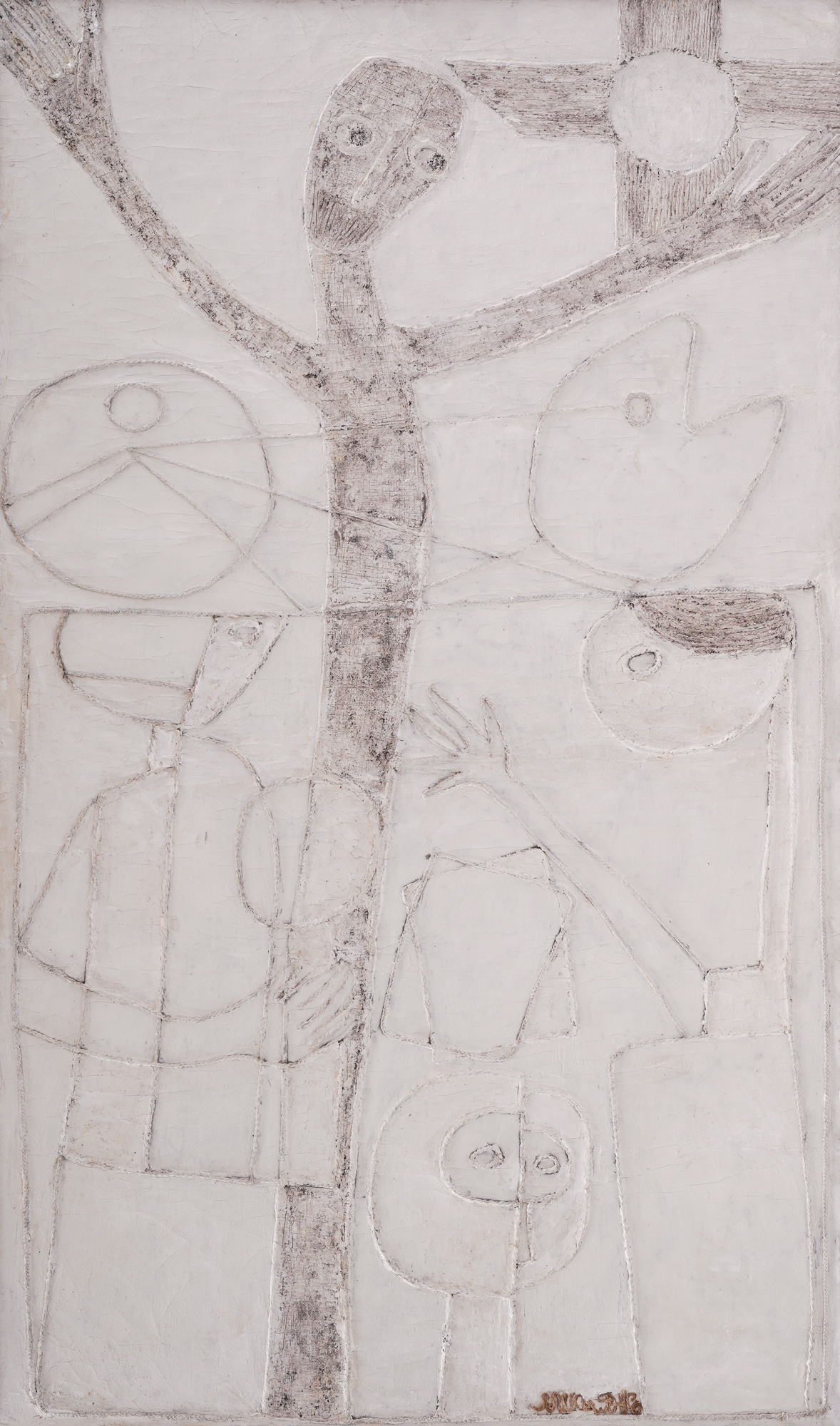
Oil paint and rope on canvas, 125 x 75 cm, Signed lower right, with hemp, "Lika Yanko"
Notes
Signed and named on the back, in brown, "Lika Yanko, 20th century - under the zodiac"
In the history of Bulgarian modern painting from the second half of the 20th century, the name of Lika Yanko inevitably stands out. An artist with an enormous internal charge and inexhaustible, boundless spirit, who reverses the perceptions and norms of the time, and remains true to herself, preserving the childish curiosity, the pure love, and the aspiration for life.
Born to the family of Albanian immigrants Efrosina and Lazar Yanko, Lika was one of three children. She had a brother and a sister, Petar and Danka. The young Lika grew up in a protective and warm family environment. She was close with her sister and mother, who paved the way for the little girl to the world of art.
The art critic Dimitar Avramov testified in the monograph he wrote about the artist in 2000, about her interests as a child: "We had a willow in our yard. I loved to climb on it and from there watch the sky. In the strange, always-changing forms of the clouds, I saw various, incredible creatures. I firmly believed in spirits and thought I saw them around me. I don't know if this was due to my mother's peculiar pedagogy: since I was crying on time, she was constantly scaring me with the devil. When you cry - she said - the devil is laughing. I loved to play dolls. I sewed their dresses myself. My mother used to tell me that when I fell asleep, they went to a ball. I would wake up excited in the middle of the night and stand to see in the semi-darkness if they had gone out… I must have started drawing then. I remember my sister Danka could draw better and so, I just contented myself with colouring what she had done."
This rich imagination and sensuality lead Yanko, after nearly nine years in French college, to apply to the Art Academy. In 1946, she was admitted to painting at the class of Prof. Iliya Petrov and academician Dechko Uzunov.
Lika's interests, who was just 22-23 years old at the time, but already has an enviable idea of the creative path she wants to follow, quickly manifested themselves. While most Bulgarian artists at that time were fascinated by Bulgarian art and followed unwaveringly in the footsteps of their predecessors and professors, the young woman learned primarily from the French art school. Her favourites were Gauguin, Cezanne, Van Gogh, and Paul Klee, whose influence on her work is noticeable.
Lika's work also developed in the field of applied arts, but after the artist Kiril Tsonev advised her to give up the applied activities and focus on the genres of landscape and portrait, Yanko became even more popular and successful. However, the path to artistic freedom was not easy. Her first solo exhibition in 1967 was a turning point in her career as an artist. Just a week after the opening of the exhibition, it was closed. This put the artist in a dilemma about her creative path. Thanks to her colleagues, however, Lika Yanko did not stop painting, and her enthusiasm did not subside.
The painting "The Fisherman and His Soul" is most likely part of her work from the 70's, when she fully committed to the marine theme and her favourite place - Sozopol. She painted more and more coastal landscapes with boats, nets, fishing, and old houses and began to weave strange creatures, mythical symbols and signs into her paintings. Her collage technique became characteristic of her, as well as the white beige colour scheme, as can also be seen in the painting we are observing.
The choice of colour is not accidental, but is inspired also by the spiritual pursuits of the artist. The white colour is associated with the transcendental, the pure, and the divine. The entire semiotic system on which the work of Lika Yanko is based makes her a unique artist and artist, especially for the Bulgarian art scene in the 20th century.
"I love everything that is crazy, strange, unusual. If they reject me it means I have been true to myself. I will remain the same - the path must be followed to the end." (S.Y.)
For clarifications regarding the bidding procedure, hammer price costs, guarantee, payment, and collection terms for the winning lot, we recommend carefully reading/re-reading the Bidding Regulations.
For additional information regarding the lot and the auction, please contact the Art Consultants Department.
By choosing "Accept all cookies" you agree to the use of cookies to help us provide you with a better user experience and to analyse website usage. By clicking "Adjust your preferences" you can choose which cookies to allow. Only the essential cookies are necessary for the proper functioning of our website and cannot be refused
Cookie settings
Our website stores four types of cookies. At any time you can choose which cookies you accept and which you refuse. You can read more about what cookies are and what types of cookies we store in our Confidentiality Policy.
are necessary for technical reasons. Without them, this website may not function properly.
are necessary for specific functionality on the website. Without them, some features may be disabled.
allow us to analyse website use and to improve the visitor's experience.
allow us to personalise your experience and to send you relevant content and offers, on this website and other websites.