

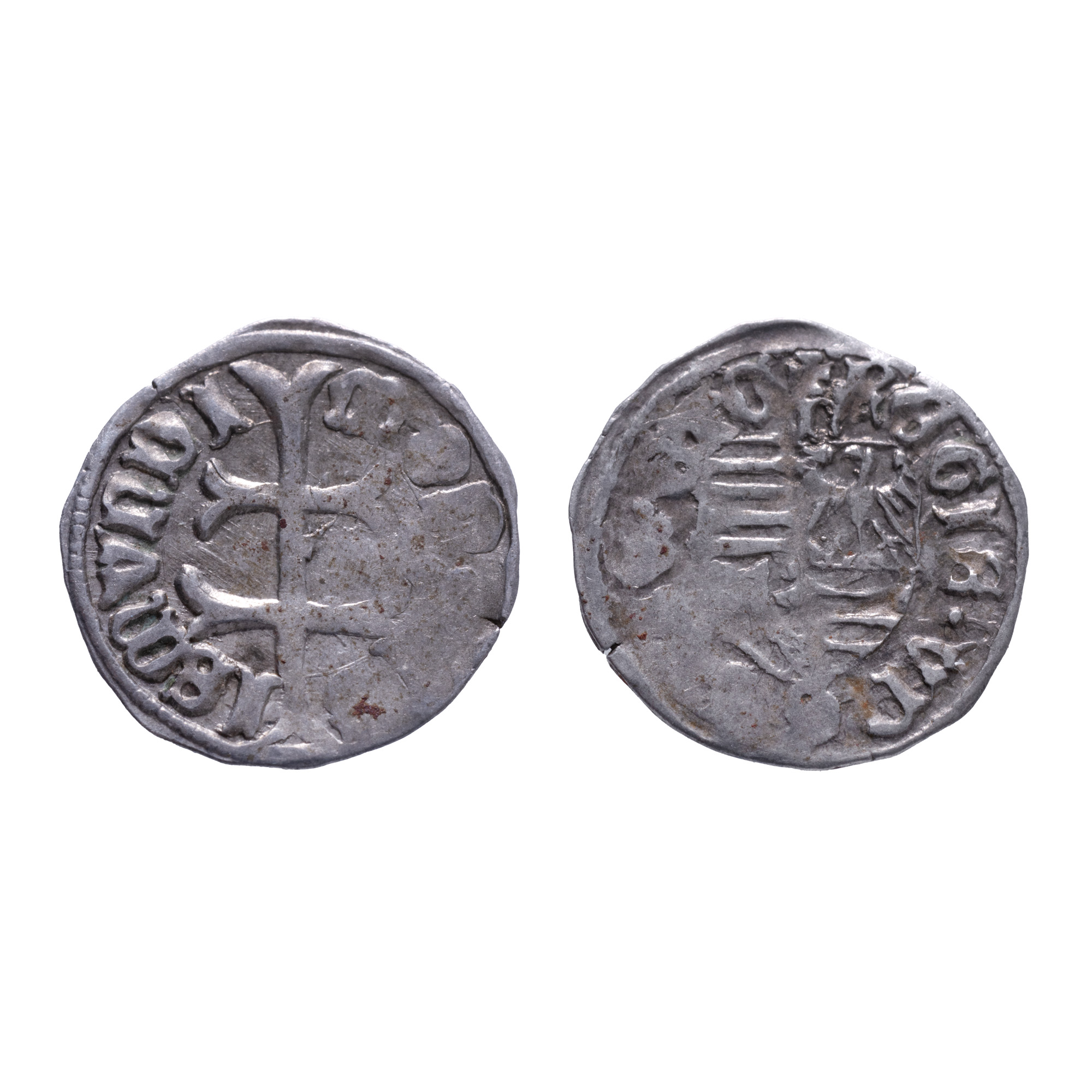
93F. Denar Coin, Sigismund of Luxembourg, Hungary, 1387-1437, Minted in Baia Mare, Silver
The photos of the lot are informative and indicative, and cannot provide a highly detailed view of the object from all angles. We recommend a careful physical inspection of the lot before bidding.
93F. Denar Coin, Sigismund of Luxembourg, Hungary, 1387-1437, Minted in Baia Mare, Silver
Starting price:
EUR 200
Not sold
silver, d=14 mm
Obverse: Double cross. Reverse: Quartered shield with Hungarian bars and Brandenburg eagles. The mint mark above the shield.
King Sigismund of Luxembourg (1368–1437), one of the most influential political figures in Central and Eastern Europe in the fourteenth–fifteenth centuries, played an essential role both in the consolidation of the Kingdom of Hungary and in defining its relations with Romanian countries. As King of Hungary (1387–1437), Emperor of the Holy Roman Empire (from 1433) and King of Germany and Bohemia, Sigismund was an ambitious monarch, who aimed to expand the influence of the House of Luxembourg over a fragmented but increasingly interconnected Europe.
One of his most significant concerns was fighting against the Ottoman threat, which was beginning to seriously threaten southeastern Europe. In this context, the Romanian countries - especially Wallachia and Moldova - became strategic allies or adversaries, depending on the interests of the moment. Sigismund sought to include these states in the defense system of the Hungarian Crown, but also to subjugate them politically.
His relationship with Mircea the Elder, ruler of Wallachia, was intricate. In the face of the Ottoman threat, the two agreed to an anti-Ottoman alliance, exemplified by both participating in the Battle of Nicopolis (1396), one of the largest battles of the late crusades. Although the battle was a failure for the Christians, it demonstrated Sigismund's commitment to create a united front against the Ottoman expansion and the strategic importance of Wallachia in this effort.
However, his policy of subordinating the Romanian voivodeships was not always well received. He tried to impose Hungarian domination over these states, including through military interventions or supporting rulers favorable to the Crown. With Moldova, the relations were tense, especially during the period of Alexandru the Good, who oscillated between alliances with Poland and a cautious attitude towards Hungary.
On a European level, Sigismund distinguished himself by initiating the Council of Constance (1414–1418), which ended the Great Schism in the Catholic Church and tried to reform the clergy. This reinforced his image as a monarch concerned with Christian unity - an ideal also reflected in his vision of a unifying crusade against the Ottomans.
For clarifications regarding the bidding procedure, hammer price costs, guarantee, payment, and collection terms for the winning lot, we recommend carefully reading/re-reading the Bidding Regulations.
For additional information regarding the lot and the auction, please contact the Art Consultants Department.
SESSION
Similar lots
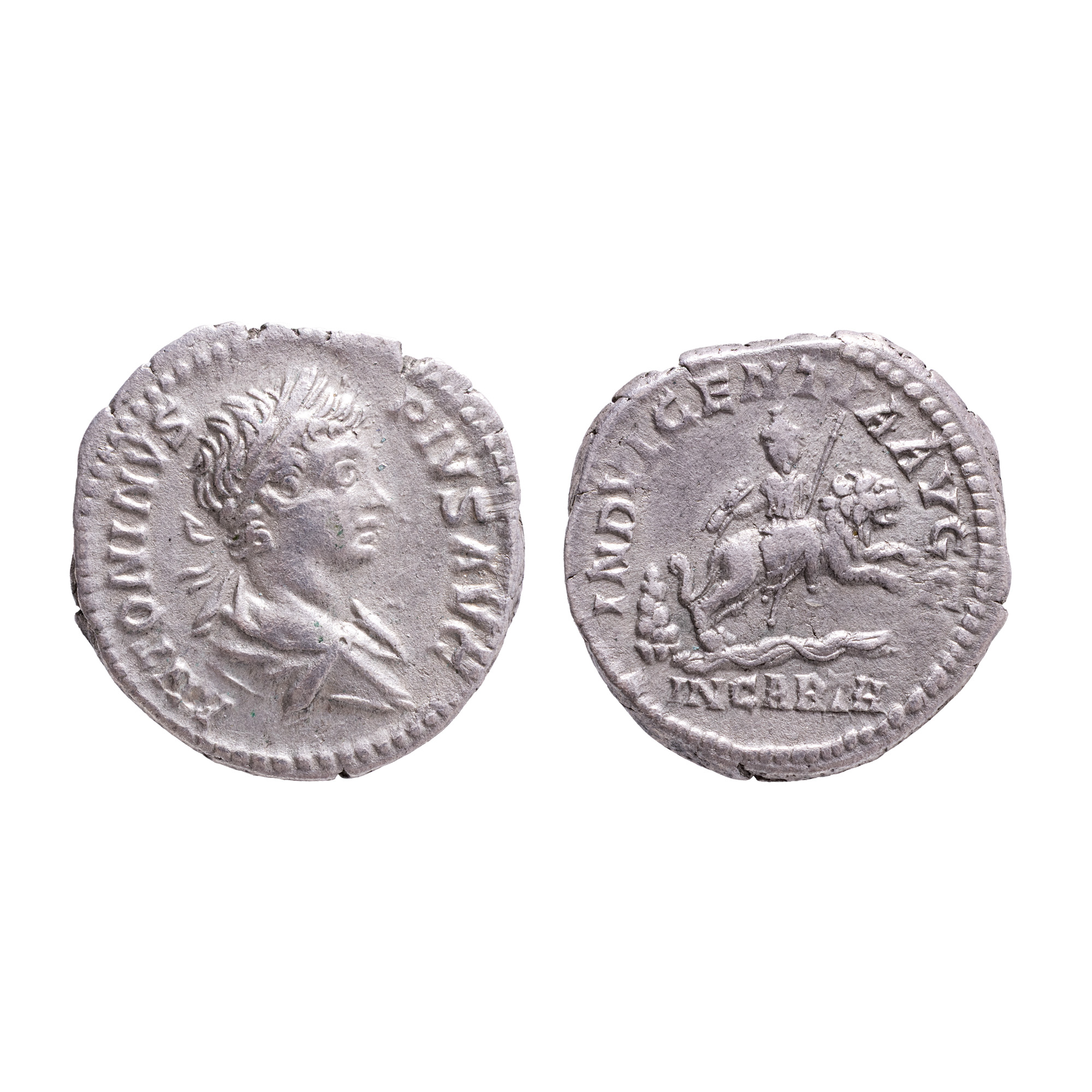
80F. Denarius Coin, Caracalla, Dea Caelestis Type, 198-217 AD, Silver
Starting price:
EUR 200
Not sold