
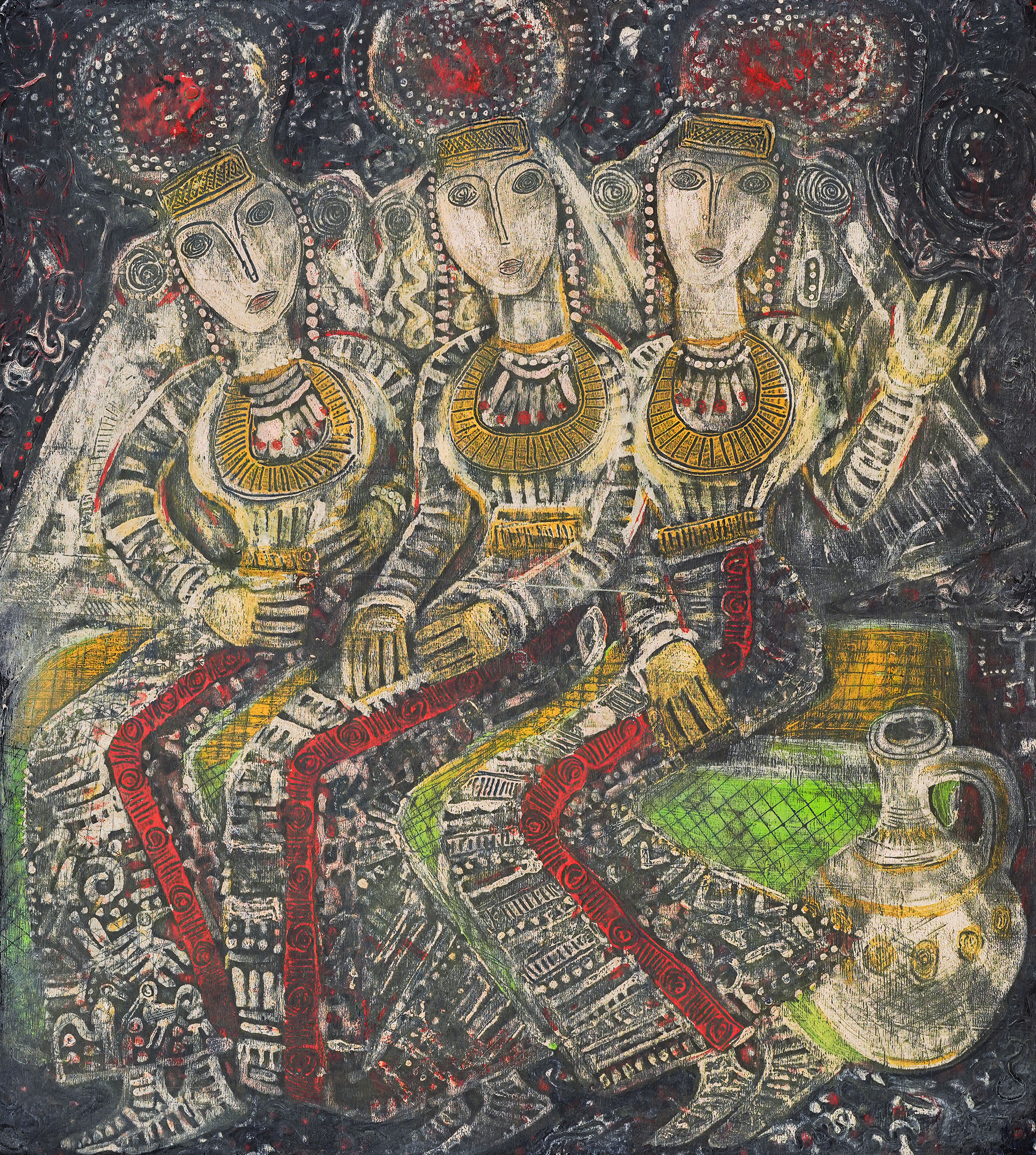
7. Three maidens [1970's]
The photos of the lot are informative and indicative, and cannot provide a highly detailed view of the object from all angles. We recommend a careful physical inspection of the lot before bidding.
7. Three maidens [1970's]
1933, Tsarski Izvor - 1992, Bozhurishte
Estimate:
EUR 5.000 - 8.000
Sold
EUR 9.500
маслени бои върху дърво, 65.5 x 58.5 cm, 65,5 Ã 58,5 cm
PROVENANCE
From the collection of Petar Rusinov (1929â2011) â a composer of childrenâs music, conductor, and close friend of Dimitar Kazakov-Neron.
The work of Dimitar Kazakov attracted great interest from the public and from collectors in Bulgaria and abroad even during his lifetime. His exhibitions were presented in Paris, Tokyo, New York and elsewhere. Even today he is one of the most sought-after and collected artists. Many studies and biographical books have been dedicated to his work — by Corr. Member Aksiniya Dzhurova, Dora Vallier, Georgi Shapkarov, Ruen Ruenov and others.
In state collections the artist is represented mainly by significant works acquired from his solo exhibitions, which outline the real dimensions and scale of his art. Most of them were painted between 1978 and 1980 — the strongest period of the artist, when he presented a number of solo exhibitions.
It is from this period that the painting Three Maidens dates, created in the late 1970s. It possesses all the best qualities of his painting. The theme, the characters, the compositional structure of the work, as well as its painterly and plastic qualities, place it among the most representative works of Dimitar Kazakov – Neron. Close in stylistic terms is the painting At the Fountain from the collection of the National Gallery.
Throughout his life the artist remained deeply connected with the land and with our traditional culture. He created a magical world in which memories from his native village Tsarski Izvor intertwine with myths and legends from national folklore and with projections of ancient cultures and civilizations. Without hiding his affinity for the Orthodox icon-painting tradition, he was inspired by the art of the Etruscans, Mycenae, Persia, Iran… “...The distance from the Kazanlak Tomb to the image of Desislava (in the Boyana Church) is not great. It is this distance, sprinkled with millennia of archaeological layers, that is my idol and my inspiration.” (From a 1979 letter to Aksiniya Dzhurova, The Myth of Dimitar Kazakov - Neron, 2003).
All these components are combined in an abstract-figurative imagery in which conventionally constructed figures float in a weightless, surreal space, immersed in earthy tones. Dimitar Kazakov is not tempted by the three-dimensional modelling of form. Every centimetre of the canvas is populated with characters and symbols — apples, maidens, birds, snakes, fountains — in unusual foreshortenings, viewed from an unusual angle, arranged in an “inverted space,” according to the artist. Woman — mother, creator, muse, forest nymph — is a main character in the paintings. Central place is given to the themes of love, the earth, nature and its wonders. According to the artist, the painting is a universe, a complex world and a continuous source of life.
Dimitar Kazakov created painting, graphics, drawings, ceramics and wooden sculpture. He is one of the artists who shaped the appearance of modern Bulgarian plastic culture and presented it beyond the borders of Bulgaria. Kazakov understood the meaning and value of the act of donation. In 1985, together with his brother Nikola Kazakov, he donated more than 500 works — paintings, graphics, watercolours, wood sculpture and ceramics — to the restored 1836 school of P. R. Slaveykov in Tryavna (Specialized Museum of Woodcarving and Icon Painting). In 1988, Dimitar Kazakov donated 185 graphics and drawings and 95 ceramic panels to the architectural and historical reserve Varosha in Lovech. In 2008 this ceramic collection was presented in the National Gallery.
Dimitar Kazakov was a colourful personality. He called himself “a gladiator with a sharp sword.” His nickname “Neron” came from the following incident: “... It was during the rationing system and we lived in the attic of the Academy with Todor Baltev. I was constantly educating myself in the studios of the Academy. I was also a stoker… That’s when I got the nickname Neron. When we were throwing coal into the furnace, Todor Baltev said to me: ‘You have a fringe like Nero.’ And so it remained…” (Aksiniya Dzhurova, The Myth of Dimitar Kazakov - Neron, 2003).
Dimitar Kazakov was born on 22 June 1933 in the village of Tsarski Izvor, Veliko Tarnovo region. In 1951 he enrolled in the first class of the Secondary School of Fine Arts in Sofia. He graduated from the National Academy of Arts, majoring in Graphics under Prof. Evtim Tomov, in 1965.
From 1965 to 1972 he lived and worked in Pazardzhik, where he was sent by assignment. In 1967 he received the Graphic Arts Award of the Union of Bulgarian Artists. Since 1968 he was a regular member of the Union of Bulgarian Artists. In 1972 he left Pazardzhik and settled with his family in the village of Bozhurishte near Sofia. He worked as a full-time artist at the military unit in Bozhurishte until 1977. From 1978 he worked as a freelance artist. He was often treated in hospitals and sanatoriums because of asthma.
He died on 16 January 1992 in his home in Bozhurishte.
Between 1965 and 1990, Dimitar Kazakov regularly participated with paintings, watercolours and drawings in General Art Exhibitions held in Sofia, Berlin, Sao Paulo, Ankara, Washington, Paris, Dusseldorf, Tokyo, New York, Madrid, Basel, Nimes and others. He presented more than 40 solo exhibitions in Bulgaria and abroad. (S.N.)
For clarifications regarding the bidding procedure, hammer price costs, guarantee, payment, and collection terms for the winning lot, we recommend carefully reading/re-reading the Bidding Regulations.
For additional information regarding the lot and the auction, please contact the Art Consultants Department.
SESSION
Brought to you by
Similar lots