
Снимките на лота са с информативен и илюстративен характер и не могат да предоставят изключително детайлен изглед на обекта от всички ъгли. Препоръчваме внимателен оглед на лота на място, преди да направите наддаване.
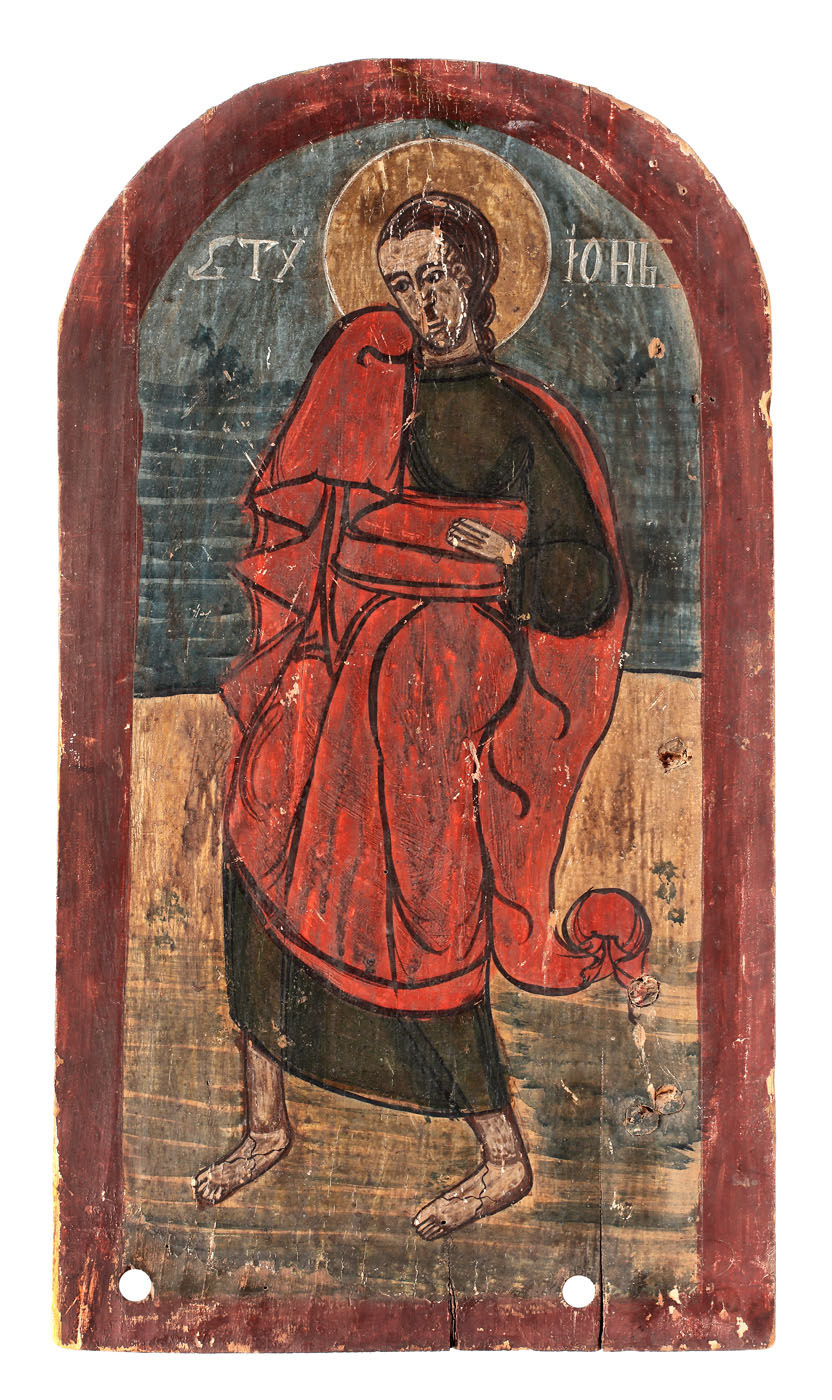
84. Icon on wood, "St. John the Baptist", Oltenian workshop, late 18th century-early 19th century, from the collection of artist Ion Pacea
Начална цена
Pretul de pornire si cel estimat nu sunt preturi de vanzare efective
EUR 350
Продадено
Pretul de pornire si cel estimat nu sunt preturi de vanzare efective
A. Man’s shirt from the Maramureș area, hand-woven flax cloth, traditional cut with the sleeve attached from the shoulder down and made using two widths of cloth (very wide), hand embroidered with white perforated cotton. Dating: second quarter of the 20th century. The item observes the traditional cut and sewing techniques (creases on the shoulders and under the band collar). B. Oltenian girdle made of wool hair and manufactory wool, using the passing technique. Traditional woman’s piece with a decoration arranged into longitudinal strips of geometric motifs. Locally entitled "eyelet waist belt". The chromatic is set on a red background, with black, yellow, olive green and white motifs. C. Lot of 3 Romanian peasant homespun skirts. a. Moldavian (Bucovina) fota skirt, woven with wool with metallic thread, dating back to the second quarter of the 20th century. Classic structure, with chromatically highlighted brick-red edges, a black body and borders (lappet) decorated with stripes. b. Fota skirt embroidered on velvet from the Argeş area, from the third quarter of the 20th century. Industrial cotton velvet, sequins, beads, wool and industrial lace. The piece represents a fashion originating in the rural area after 1950 that uses new materials: velvet, sequins, beads and modern techniques. Embroidery on the classic structure of the traditional fota skirt. The motifs are floral, highlighted with sequins and beads, with industrial lace lining the borders. c. Fota skirt from the Vâlcea area, late 19th century. Materials: woollen fabric weaved with two threads; cotton; metallic thread and sequins. The piece comes into prominence through the "classic" composition type of the traditional fota skirt in the area, being embroidered on wool hair cloth. The type of composition – with three-sided borders, as well as the heavily geometrically stylised motif categories, highlight its age, revealing an ornamental structure with protective functions. The chromatic – brown background and polychromatic motifs in white, red, Nile green, yellow, blue, sequins and silver metallic threads.
Размери
width 34.5 cm, height 64.5 cm
ДОПЪЛНИТЕЛНА ИНФОРМАЦИЯ
За разяснения относно процедурата по наддаване, разходите при спечелване, условията за гаранция, плащане и вземане на спечеления лот, препоръчваме внимателно четене/препрочитане на Правилника за наддаване.
A. Man’s shirt from the Maramureș area, hand-woven flax cloth, traditional cut with the sleeve attached from the shoulder down and made using two widths of cloth (very wide), hand embroidered with white perforated cotton. Dating: second quarter of the 20th century. The item observes the traditional cut and sewing techniques (creases on the shoulders and under the band collar). B. Oltenian girdle made of wool hair and manufactory wool, using the passing technique. Traditional woman’s piece with a decoration arranged into longitudinal strips of geometric motifs. Locally entitled "eyelet waist belt". The chromatic is set on a red background, with black, yellow, olive green and white motifs. C. Lot of 3 Romanian peasant homespun skirts. a. Moldavian (Bucovina) fota skirt, woven with wool with metallic thread, dating back to the second quarter of the 20th century. Classic structure, with chromatically highlighted brick-red edges, a black body and borders (lappet) decorated with stripes. b. Fota skirt embroidered on velvet from the Argeş area, from the third quarter of the 20th century. Industrial cotton velvet, sequins, beads, wool and industrial lace. The piece represents a fashion originating in the rural area after 1950 that uses new materials: velvet, sequins, beads and modern techniques. Embroidery on the classic structure of the traditional fota skirt. The motifs are floral, highlighted with sequins and beads, with industrial lace lining the borders. c. Fota skirt from the Vâlcea area, late 19th century. Materials: woollen fabric weaved with two threads; cotton; metallic thread and sequins. The piece comes into prominence through the "classic" composition type of the traditional fota skirt in the area, being embroidered on wool hair cloth. The type of composition – with three-sided borders, as well as the heavily geometrically stylised motif categories, highlight its age, revealing an ornamental structure with protective functions. The chromatic – brown background and polychromatic motifs in white, red, Nile green, yellow, blue, sequins and silver metallic threads.
ДОПЪЛНИТЕЛНА ИНФОРМАЦИЯ
За разяснения относно процедурата по наддаване, разходите при спечелване, условията за гаранция, плащане и вземане на спечеления лот, препоръчваме внимателно четене/препрочитане на Правилника за наддаване.