Снимките на лота са с информативен и илюстративен характер и не могат да предоставят изключително детайлен изглед на обекта от всички ъгли. Препоръчваме внимателен оглед на лота на място, преди да направите наддаване.
Снимките на лота са с информативен и илюстративен характер и не могат да предоставят изключително детайлен изглед на обекта от всички ъгли. Препоръчваме внимателен оглед на лота на място, преди да направите наддаване.
Arthur Segal was born on July 14, 1875, in Iași, but spent the early part of his childhood in Botoșani. Coming from a wealthy family in Botoșani (his father, Itzhac Segal, was a bank owner; and his grandfather had business connections in Berlin and Leipzig), Arthur Segal would be under the auspices of a future prolific career in banking. Generational conflict and a lack of adaptation to the school program in Botoșani found him misunderstood and immersed in a deep sense of loneliness. The family's favorable financial condition facilitated Segal's enrollment at the Boarding School in Iași and his encounter with Nicolae Grigorescu's painting. At just twelve years old, he was sent to a boarding school in Iași, where he learned German and economics. The young boy with Jewish roots from Botoșani would become an admirer of the work of the master painter from Câmpina, which he glimpsed, often, in the bookstore windows in Iași.
This would be one of the key moments in his later artistic development, as he developed interest in painting and drawing now. Hours spent in front of Grigorescu's works would inspire in him a passion for art. He would subconsciously adopt the themes practiced by his master and recreate with genuine admiration rustic scenes. We also find in Segal dusty streets, country houses, people and churches, or even the problem of light captured in brown shades. Works such as "Bărăția din Câmpulung" could have provided inspiration, with its clear skies and carefully arranged light, similar to the composition at hand.
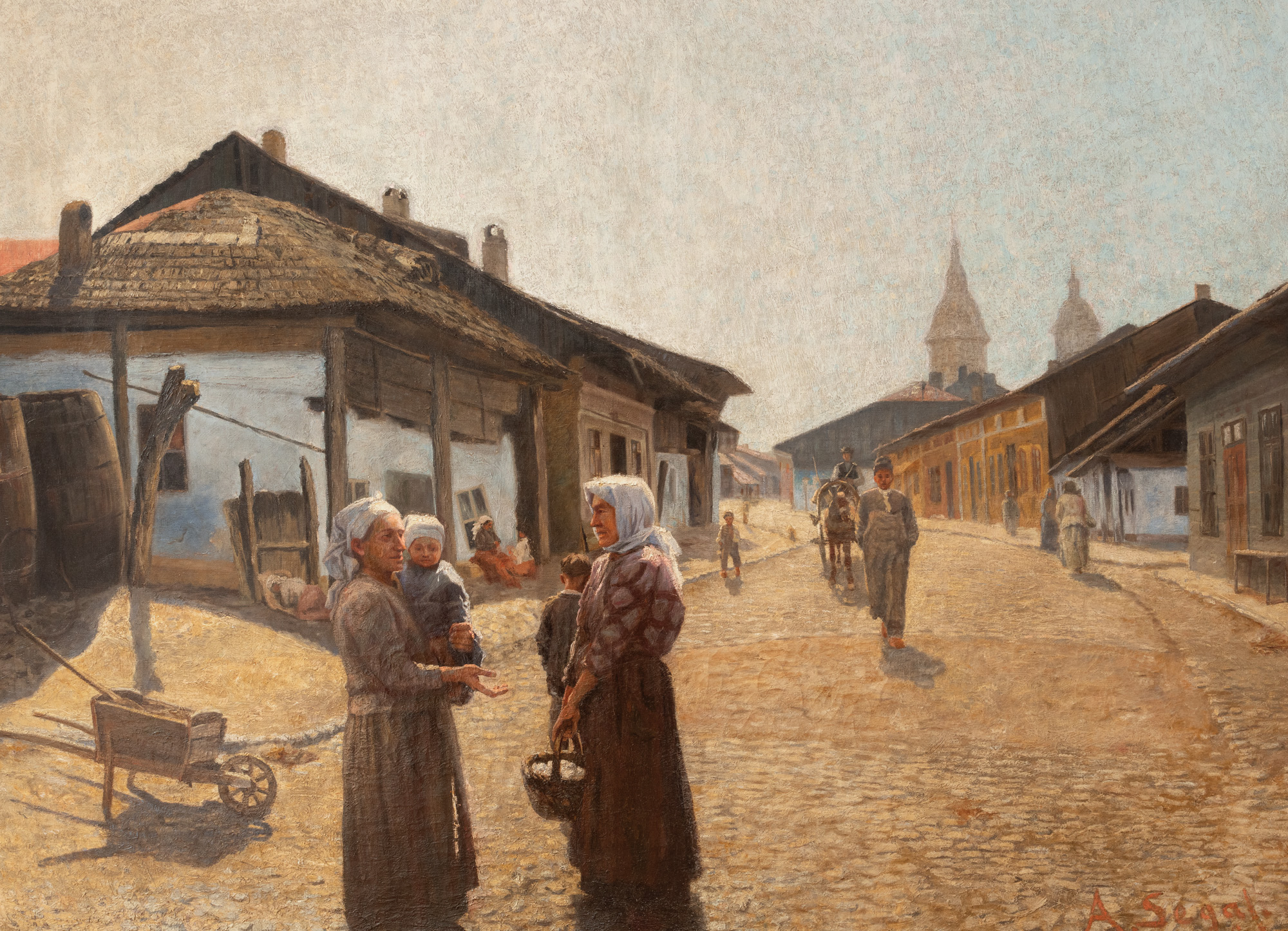
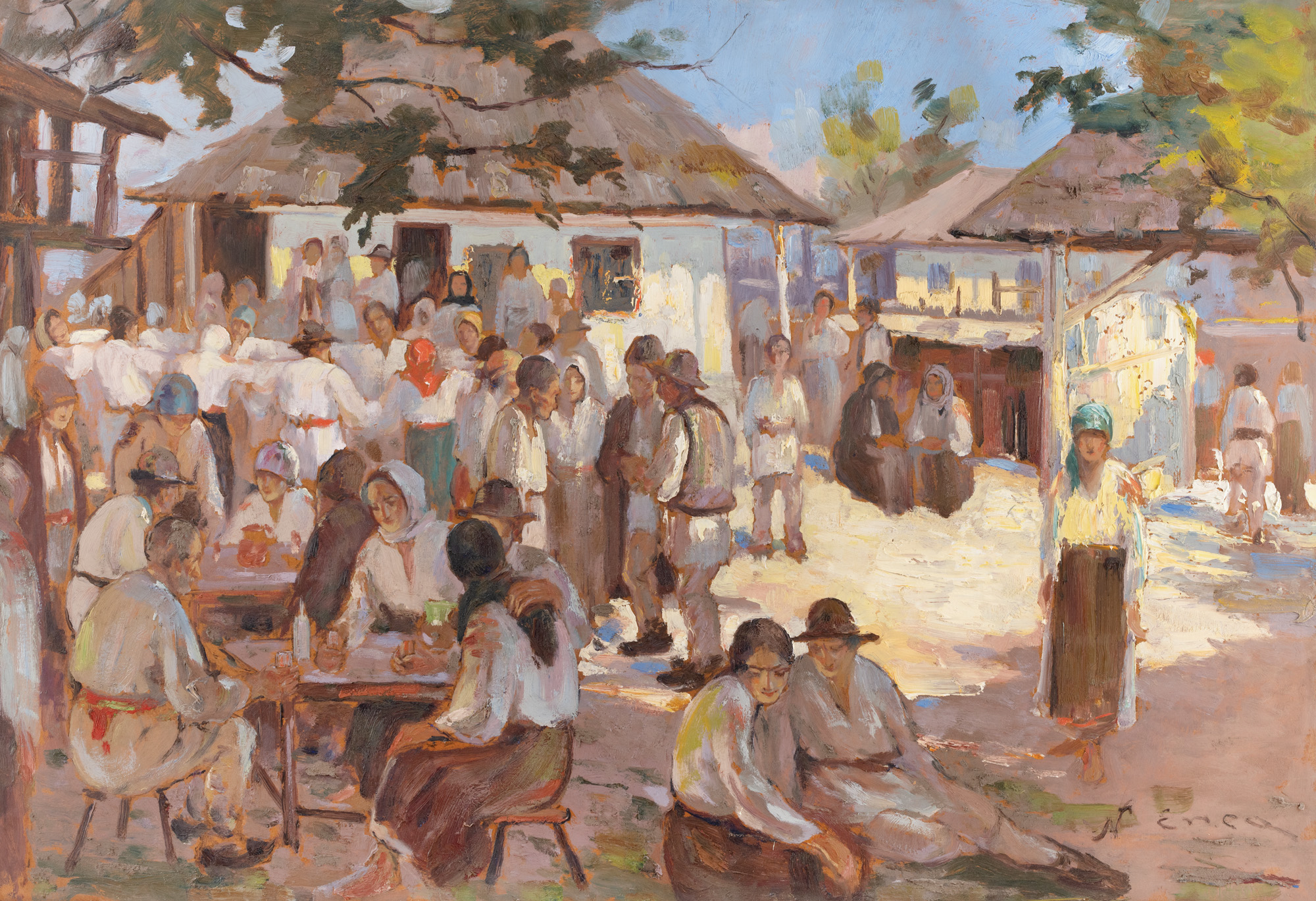
A work of great dimensions (measuring nearly two meters horizontally, and almost a meter and a half vertically), the impressive view of Botoșani at the end of the 19th century, the work highlights the city's frenzy, where old houses are arranged on either side of the road. The foreground is reserved for the protagonists, be they little peasant girls carrying willow baskets, or mothers holding their children in their arms; we also find, in the horizontal unfolding of the subject, the horse-drawn carriage, peasants or barefoot children.
Living in Iași, as mentioned, Arthur Segal would learn German in his grandparents' family and would come into contact with the sociopolitical ideas expressed in magazines such as "Contemporanul". With clear inclinations towards the artistic field, he gave up the idea (instilled by the family) of working in business, although on his return to Botoșani he worked for a while in the bank led by his father (1889). The announcement of his decision to become a painter was met with skepticism by his family, but following a problematic demonstration organized by Segal and his friends on May 1 (a demonstration that affected the family's image in Botoșani), the young man was allowed to go to Berlin to pursue his vocation.
So, he arrived in Berlin in August 1892, freed from his family's expectations and ready to release his creative self. In Berlin, he was a student of Eugen Bracht, from whom he received constant encouragement. He will now conduct an intensive study of nature, taking and processing its image into genuine plastic creations, especially in the last years of the 19th century and the first years of the 20th.
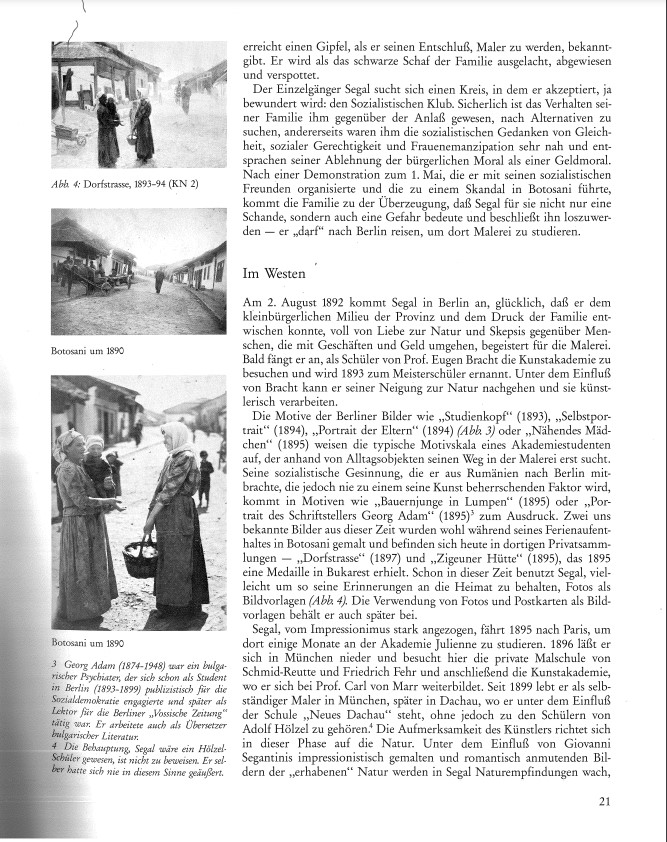
Concerned with illustrating light and shadow, he created a wide series of landscapes dedicated to Botoșani or his family. In Berlin, he experimented a lot with portraiture - various studies, self-portraits or portraits of his parents. The summer holidays spent in Botosani provided him with the ideal context to create under the auspices of the rural theme. The paintings "Dorfstrasse" (the present work) and "Zigeuner Hütte" are mentioned in the context of his participation in an exhibition in 1895 (probably "The Official Exhibition of Living Artists", in Paris), a event where Segal won a medal. Sometimes he worked from photographs or postcards, thus keeping the memory of his native space closer.
Inevitably attracted by impressionism, he traveled to Paris in 1895, where he enrolled at the Julian Academy. He then studied in Munich and will be noticed and appreciated by the Berlin avant-garde, both for his artistic qualities, and as a man. It is said that Segal was an enthusiastic interlocutor and a voluble, charismatic personality. An adherent of modern currents, he will rightly earn his international reputation, so often his image will not be associated, in collective memory, with our native space.
Among his achievements are the co-founding of the "Neue Secession" group in Berlin, where he exhibited alongside Kandinsky, Marc, Macke. He will also be one of the founders of the group. The strain under which he demonstrated his talent found him on the same walls with Marc Chagall, Erlich, Kisling, Lipschitz or Modigliani. As a representative of abstract art, he exhibited alongside artists such as Braque, Kandinsky, Klee, Mondrian or Picasso, in Mannheim.
In Romania, his name is linked to events such as "Exhibition of Living Artists" (1895, 1896, 1899), "Artistic Youth" (1910, 1911), the "Contemporanul" Exhibition in 1924 or the personal exhibition organized in Bucharest in 1910 that amazed and at the same time upset the public opinion of the moment (by exposing modern art works from "the latest phase of Impressionism").
Препратки
PAVEL, Amelia, "Jewish Painters from Romania", Hasefer Publishing House, Bucharest, 2003.
The raisonné Catalog Arthur Segal 1875-1944, Pavel Liska and Wulf Herzogenrath, Argon Verlag, Berlin, 1987.
Размери
width 196 cm, height 144 cm
Описание
oil on canvas, signed lower right, in red, "A. Segal"
Информация от изследване
The artwork participated in the "Exhibition of Living Artists", Bucharest, 1895, an event in which it also obtained a medal. The work is reproduced and inventoried in the catalogue raisonné "Arthur Segal 1875-1944", Pavel Liska and Wulf Herzogenrath, Argon Verlag, Berlin, 1987, on page 21 and cat. No. 2, page 321, under the title "Dorfstrasse (Botosani)".
Запознанства
1893-1894
ПРОИЗХОД
Private collection Vancouver.
Private collection Buenos Aires.
ДОПЪЛНИТЕЛНА ИНФОРМАЦИЯ
За разяснения относно процедурата по наддаване, разходите при спечелване, условията за гаранция, плащане и вземане на спечеления лот, препоръчваме внимателно четене/препрочитане на Правилника за наддаване.
Arthur Segal was born on July 14, 1875, in Iași, but spent the early part of his childhood in Botoșani. Coming from a wealthy family in Botoșani (his father, Itzhac Segal, was a bank owner; and his grandfather had business connections in Berlin and Leipzig), Arthur Segal would be under the auspices of a future prolific career in banking. Generational conflict and a lack of adaptation to the school program in Botoșani found him misunderstood and immersed in a deep sense of loneliness. The family's favorable financial condition facilitated Segal's enrollment at the Boarding School in Iași and his encounter with Nicolae Grigorescu's painting. At just twelve years old, he was sent to a boarding school in Iași, where he learned German and economics. The young boy with Jewish roots from Botoșani would become an admirer of the work of the master painter from Câmpina, which he glimpsed, often, in the bookstore windows in Iași.
This would be one of the key moments in his later artistic development, as he developed interest in painting and drawing now. Hours spent in front of Grigorescu's works would inspire in him a passion for art. He would subconsciously adopt the themes practiced by his master and recreate with genuine admiration rustic scenes. We also find in Segal dusty streets, country houses, people and churches, or even the problem of light captured in brown shades. Works such as "Bărăția din Câmpulung" could have provided inspiration, with its clear skies and carefully arranged light, similar to the composition at hand.
A work of great dimensions (measuring nearly two meters horizontally, and almost a meter and a half vertically), the impressive view of Botoșani at the end of the 19th century, the work highlights the city's frenzy, where old houses are arranged on either side of the road. The foreground is reserved for the protagonists, be they little peasant girls carrying willow baskets, or mothers holding their children in their arms; we also find, in the horizontal unfolding of the subject, the horse-drawn carriage, peasants or barefoot children.
Living in Iași, as mentioned, Arthur Segal would learn German in his grandparents' family and would come into contact with the sociopolitical ideas expressed in magazines such as "Contemporanul". With clear inclinations towards the artistic field, he gave up the idea (instilled by the family) of working in business, although on his return to Botoșani he worked for a while in the bank led by his father (1889). The announcement of his decision to become a painter was met with skepticism by his family, but following a problematic demonstration organized by Segal and his friends on May 1 (a demonstration that affected the family's image in Botoșani), the young man was allowed to go to Berlin to pursue his vocation.
So, he arrived in Berlin in August 1892, freed from his family's expectations and ready to release his creative self. In Berlin, he was a student of Eugen Bracht, from whom he received constant encouragement. He will now conduct an intensive study of nature, taking and processing its image into genuine plastic creations, especially in the last years of the 19th century and the first years of the 20th.
Concerned with illustrating light and shadow, he created a wide series of landscapes dedicated to Botoșani or his family. In Berlin, he experimented a lot with portraiture - various studies, self-portraits or portraits of his parents. The summer holidays spent in Botosani provided him with the ideal context to create under the auspices of the rural theme. The paintings "Dorfstrasse" (the present work) and "Zigeuner Hütte" are mentioned in the context of his participation in an exhibition in 1895 (probably "The Official Exhibition of Living Artists", in Paris), a event where Segal won a medal. Sometimes he worked from photographs or postcards, thus keeping the memory of his native space closer.
Inevitably attracted by impressionism, he traveled to Paris in 1895, where he enrolled at the Julian Academy. He then studied in Munich and will be noticed and appreciated by the Berlin avant-garde, both for his artistic qualities, and as a man. It is said that Segal was an enthusiastic interlocutor and a voluble, charismatic personality. An adherent of modern currents, he will rightly earn his international reputation, so often his image will not be associated, in collective memory, with our native space.
Among his achievements are the co-founding of the "Neue Secession" group in Berlin, where he exhibited alongside Kandinsky, Marc, Macke. He will also be one of the founders of the group. The strain under which he demonstrated his talent found him on the same walls with Marc Chagall, Erlich, Kisling, Lipschitz or Modigliani. As a representative of abstract art, he exhibited alongside artists such as Braque, Kandinsky, Klee, Mondrian or Picasso, in Mannheim.
In Romania, his name is linked to events such as "Exhibition of Living Artists" (1895, 1896, 1899), "Artistic Youth" (1910, 1911), the "Contemporanul" Exhibition in 1924 or the personal exhibition organized in Bucharest in 1910 that amazed and at the same time upset the public opinion of the moment (by exposing modern art works from "the latest phase of Impressionism").
ДОПЪЛНИТЕЛНА ИНФОРМАЦИЯ
За разяснения относно процедурата по наддаване, разходите при спечелване, условията за гаранция, плащане и вземане на спечеления лот, препоръчваме внимателно четене/препрочитане на Правилника за наддаване.
PAVEL, Amelia, "Jewish Painters from Romania", Hasefer Publishing House, Bucharest, 2003.
The raisonné Catalog Arthur Segal 1875-1944, Pavel Liska and Wulf Herzogenrath, Argon Verlag, Berlin, 1987.
Размери
width 196 cm, height 144 cm
Описание
oil on canvas, signed lower right, in red, "A. Segal"
Информация от изследване
The artwork participated in the "Exhibition of Living Artists", Bucharest, 1895, an event in which it also obtained a medal. The work is reproduced and inventoried in the catalogue raisonné "Arthur Segal 1875-1944", Pavel Liska and Wulf Herzogenrath, Argon Verlag, Berlin, 1987, on page 21 and cat. No. 2, page 321, under the title "Dorfstrasse (Botosani)".
Запознанства
1893-1894
ПРОИЗХОД
Private collection Vancouver.
Private collection Buenos Aires.