
Meniu

Продай / Продай
Контакт
Моят профил
Български

Открийте

Арт консултанти

Отдели търгове


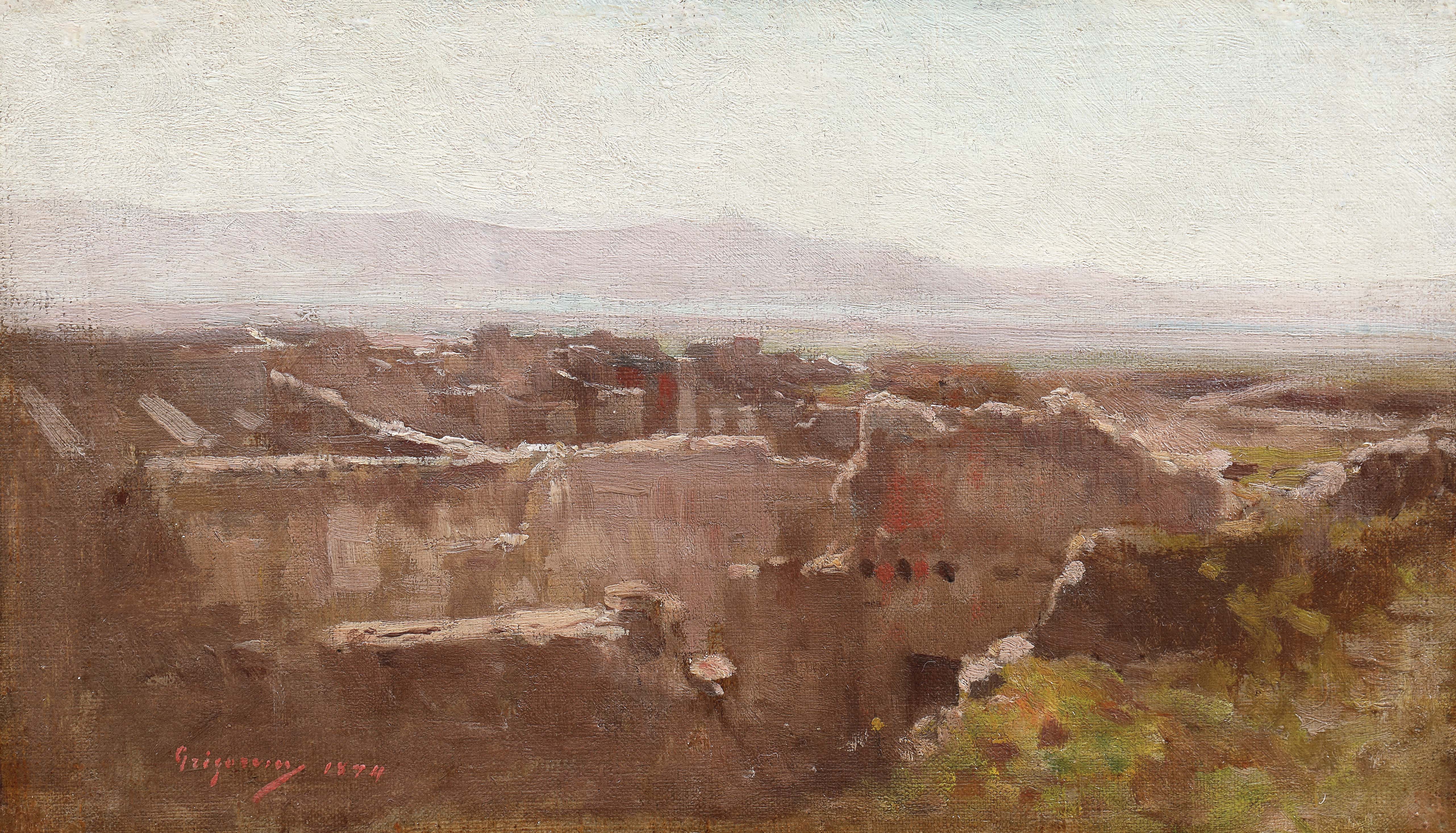
140. The Ruins of Pompeii [1874]

1838, Pitaru, Dâmboviţa - 1907, Câmpina

Оценка

EUR 15.000 - 25.000

Продадено

EUR 20.000

Сесия

Вто, 22 март 2022 19:00

Grigorescu's classical journey to Italy for artistic biographies is in the winter of 1873-1874 (Trieste, Venice, Florence, Rome) and then in the spring when he travelled to Naples and its surroundings. The success (including financial) achieved by the artist in 1873 when more than 140 of his paintings were shown in the great exhibition of the Society of Fine Arts will have contributed to the final decision on this trip. We do not have explicit testimonies of the painter about the short Italian period that followed his French training, the main sources of information remain the works executed during this period (paintings, academic drawings - nude studies, caricatures documenting his presence in the famous art cities of the peninsula). Considering the little-known episode of Grigorescu's frequent visits to Rome, to the studio of the Accademia Libera del Nudo in Via Margutta, where he worked after the model in the company of several European artists and where, of course, he saw at work the Spanish Mariano Fortuny, the famous colourist, we can advance the idea of a double aim of the Romanian painter by visiting Italy. On the one hand, the encounter with the masterpieces "at home" (he knew the Italian schools of painting to a large extent at the Louvre, where he had also painted children), and on the other, the encounter with contemporary art, more specifically with the Resina School, the school of outdoor landscape painting at Posilippo and Portici, near Naples, active in those years. Grigorescu learned about the researches of the Neapolitan landscape painters, in the wake of the French plein air school of the time (we are in 1874, the year of the first exhibition of the Impressionists), about what was happening near Naples, from the Neapolitan painters present in the Fontainebleau forest area, such as Giuseppe Pallizzi (established in Marlotte) and his brothers, all working in the 7th and 8th decades, alternately in Naples and Marlotte. Standing in front of the famous remains of Pompeii - where the archaeologists of the young Italian state, recently unified into a kingdom, were carrying out a vast campaign of excavations and uncovering the ruins - Grigorescu is concerned with the spectacle of light, as a plein air painter. He does not seem moved by the grandeur of Antiquity or does not care to record that feeling. In fact, a similar position is taken before the ruins of the Acropolis (see the work of the same name, MNAR, inv. 3296). What fascinates him when he sees the archaeological site is the direction of the calm, solar light bathing the entire landscape and imposing the materiality of the ruins in the foregrounds to leave the hills on the horizon in a mist of white. A pictorial formula of working in front of the motif that the artist will turn into his own trademark in the country, towards the end of the century, painting in the Subcarpathian area of Câmpina. But the style of small, synthetic, rapid brushstrokes, the palette dominated by ochres and the privileged treatment of light (in cooler tones, however) can be found in many of the artist's works from the 8th decade, especially those at Vitré. In his personal exhibitions from 1880-1890, Grigorescu exhibited several times works titled Pompeii. In the absence of any technical data on the paintings exhibited (the catalogues only indicate titles), we cannot identify the presence of this landscape in the master's exhibitions. The small horizontally elongated rectangle of the canvas, reproduced by Grigorescu in very similar dimensions in several images painted in Italy (Naples, 18 x 34, MNAR, inv. 3145; Shepherd on donkey, 26 x 17, MNAR, col. K.H. Zambaccian), is reminiscent of a format adapted to outdoor painting that Western artists used in the last decades of the 19th century. (IB)

Препратки

Costina Anghel, Mariana Vida, Repertoriul picturii românești moderne, secolul al XIX-lea (The repertoire of modern Romanian painting, 19th century), Vol. II, Letters F-H, The National Museum of Art of Romania, 2016. Ioana Beldiman, Grigorescu in Rome in Via Margutta, in Secolul 21, No. 7-12/2014. Marion Lagrange, Les Peintres italiens en quete d’identité Paris 1855 -1909, CTHS-INHA, Paris, 2010. Remus Niculescu, Nicolae Grigorescu Exhibition, The R.P.R. Art Museum, Bucharest, 1957. G.Oprescu [-R.Niculescu], N.Grigorescu, Meridiane, Bucharest, 1963.

Размери

width 27.5 cm, height 16 cm

Описание

oil on canvas, signed and dated bottom left, with red, "Grigorescu, 1874"

Информация от изследване

The artwork was painted in April 1874, when Nicolae Grigorescu was visiting the ruins of Pompeii on his itinerary between Rome and Naples.

Запознанства

1874

ДОПЪЛНИТЕЛНА ИНФОРМАЦИЯ

За разяснения относно процедурата по наддаване, разходите при спечелване, условията за гаранция, плащане и вземане на спечеления лот, препоръчваме внимателно четене/препрочитане на Правилника за наддаване.

За допълнителна информация относно лота и търга, моля свържете се с Отдела на арт консултантите.

Алтернативни лотове

The Green Hat

31. The Green Hat [1908-1909]

Iosif Iser

    Оценка EUR 4.000 - 7.000
    Продадено EUR 9.750
Cișmigiu

126. Cișmigiu

Micaela Eleutheriade

    Оценка EUR 800 - 1.500
    Продадено EUR 800
Hanging Garden

127. Hanging Garden [1971]

Ion Alin Gheorghiu

    Оценка EUR 1.000 - 1.800
    Продадено EUR 1.000
Street in Rome

76. Street in Rome

Francisc Gall

    Оценка EUR 2.000 - 3.000
    Продадено EUR 2.250