Снимките на лота са с информативен и илюстративен характер и не могат да предоставят изключително детайлен изглед на обекта от всички ъгли. Препоръчваме внимателен оглед на лота на място, преди да направите наддаване.
Снимките на лота са с информативен и илюстративен характер и не могат да предоставят изключително детайлен изглед на обекта от всички ъгли. Препоръчваме внимателен оглед на лота на място, преди да направите наддаване.
Although the painting style of the era was primarily religious in nature, with a decorative role in places of worship or boyar households, this type of Byzantine art was approached much more frugally by the young artist who was schooled abroad. Constantin Lecca focused on portraiture, clearly demonstrating the influence of the Viennese school. He perfected his artistic training in Buda, Vienna, Rome and Berlin, learning the craft of copyists in Rome by reproducing famous paintings. These show evidence of his studies abroad, and Constantin Lecca was among the first Romanian artists doing such works. After returning to the country, he opened his own printing press in Craiova, near the central school (having concluded a financing agreement with the educational unit). Magazines (of which "Mozaicul" remains among the most known), various Christian or moral publications, plays or dictionaries were printed here. He would then take the position of drawing and calligraphy teacher at the Craiova school and would also be the first drawing teacher of Theodor Aman and Petre Alexandrescu. Chronicles of the time describe him as an influential painter who created monumental canvases dedicated to rulers like Michael the Brave, Radu Negru-Basarab, Dragos Voda, Dimitrie Cantemir, or Stephen the Great, which were later exhibited in schools in Bucharest to serve as historical sources and objects of admiration for the students. He skillfully tackled historical topics such as the signing of peace treaties, the unfolding of battles or dismounts; but he remained essentially a romantic painter. He founded a so-called "triumvirate" in his time, alongside painters Mișu Popp and Barbu Stancescu. Together they would take on various commissions, from painting the country's crest on the army banners to painting churches. But Constantin Lecca had a particular fondness for revealing human characters in portraits. He captured the faces of wealthy nobles, doctors or priests; but also painted his wife, children, cousins, or other family members. These portraits are tangible historical documents, detailing the painstakingly rendered dress, hairstyles, laces, and ornaments. He essentially created a whole gallery of portraits dedicated to Romanian boyars, but often also portrayed himself. He created a thematic cycle of self-portraits: still under the influence of Viennese romanticism, but in Italy, he sketched a first youthful self-portrait, preserved today at the Romanian Academy.
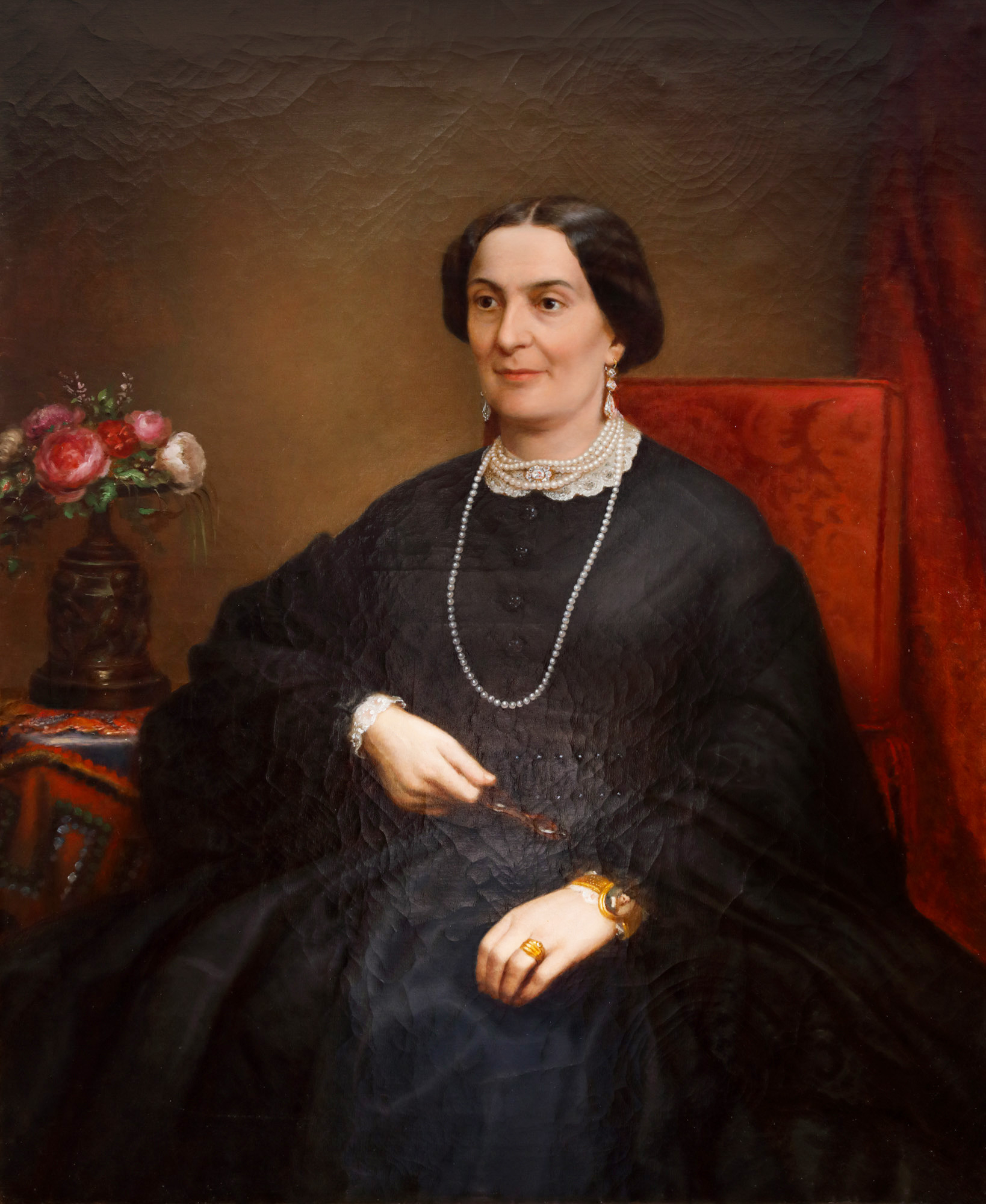
Most likely made in the mid-nineteenth century, this work offers us, through the specific clothing and hairstyle, vestiges of an entire epoch. The sober but elegant dress, the hair done according to the time's fashion, the gold jewelry, the pearls, and the precious stones reveal important clues regarding the social status and the noble rank of the protagonist. Pearls, with significant value but not so easily procurable, were seen as a symbol whose nuances can be deciphered in the famous Latin expression "vanitas vanitatum". Therefore, the fateful existence is crowned by the spiritual journey towards reaching perfection, and the pearl becomes a symbol of light and femininity. Pearls also represented power and status but could also suggest references to divinity. With emblematic valences, mostly found in the collections of kings and nobles, pearls made their appearance in the works of artists such as Botticelli, Titian or Vermeer. With the skill of a miniaturist, Constantin Lecca focused on details of clothing such as the ethereal lace with transparent iridescence that subtly revealed the skin color underneath. We also notice the painstakingly modeled string of pearls, the special attention the artist paid to the folds formed by the buttoning of the dress, the gilded jewelry decorating the ring finger, and the bracelet where we discern, with the same attention to detail, the portrait of a nobleman. Around the collarbone, a seductive play of elegance is highlighted, reflected both through the use of precious materials as well as diaphanous ones. The face respects the physiognomic proportions and retains more of a neutral expression that verges on the outline of an imperceptible smile. Regarding the hairstyle, we note the carefully gathered hair, a pattern also used by other painters of the time (J.H. Neuman in the portrait "Johanna Maria Constantia Vreede", Émile Auguste Hublin in "Portrait of a Woman" or Francesco Hayez in "Ritratto di Giuseppina Negroni Prati Morosini"). The posture also falls among the poses favored by the nobility of the time. Posing for a portrait took on the valuances of a veritable ritual with roots stretching back several centuries. We can mention, therefore, the dignified posture, with the straight back and raised head, and the chin placed in a slight ascent. The gaze is fixed on an external focal point; the protagonist is concentrating her attention somewhere in the outer left side of the work. The positioning of the hands seems to have been thoroughly studied, these being carefully placed on the body. In the right hand, we can discern the details of a fan, held between the middle fingers, the fingers tightly yet delicately clasping the object. The left hand is much less contracted, the fingers are close together, slightly bent, allowing glimpses of the jewelry worn by the protagonist. If the left arm lightly slides along the body, the right arm appears to be propped on the table next to the character. By resting the body weight on the chair seat and that of the right arm on the table surface, the protagonist can remarkably endure the hours spent in the statue-like pose in front of the artist's canvas.
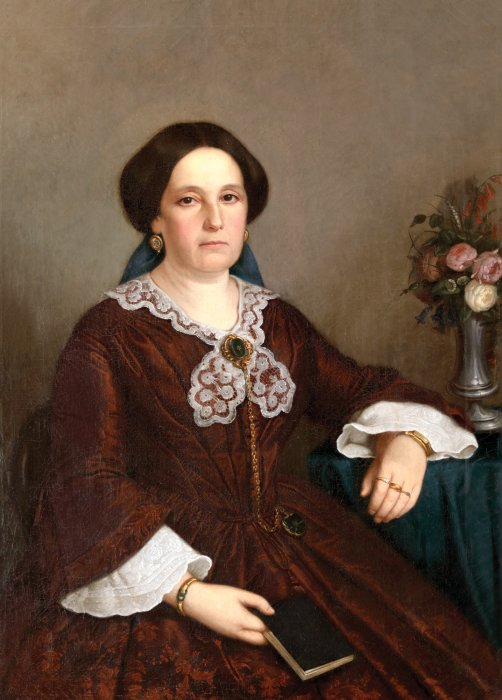
We notice that the artist also paid careful attention to the depiction of the flower vase. Carved in relief, most likely in bronze, the mug rendered in shades of brown presents larger volumes at the bottom from which small moving bodies emerge, while the upper part narrows and supports the delicate stems of the flowers. At a closer look, we notice the recurring use of peonies in the works of Constantin Lecca. They particularly appear in female portraits, either meticulously placed in baroque vases or carefully arranged in the hands of the protagonists. From the portraits of Eufrosina Lecca to the large gallery of portraits of noble wives and the current work, the peonies surprise us with their blooming petals, their green leaves, and their vibrant vitality. With origins in Asian art from the Joseon Dynasty period, the peony, considered the "king of flowers" in Chinese culture, became a leitmotif in many works of art. Artists adopted and perpetuated them in their works, thus transferring them from the sphere of an auxilliary element, meant to enhance the composition value, to the role of protagonist, towards the foreground of the canvas. From Manet's peonies to the sumptuous bouquets rich in symbols that we find in the Dutch Golden Age, peonies have delighted both artists and spectators with their blooming stems, leaves, and petals. Alluding to royalty, nobility or prosperity, the colorful bouquets were generally set against darkly colored backgrounds, the painters thus appealing to a contrast meant to intensify meanings. Constantin Lecca subscribed to this flower cult which maintains the accuracy of nature while also enhancing it. With their large petals and splendid range of colors, peonies have often been noticed in works of art associated with royalty. However, in this work, the symbolism of the blooming peonies contrasts with the ephemerality embedded in the texture of pearls and the fine embroidery of laces. Set against a decor with a simple, yet carefully studied scenography, where red accents dominate (in the imposing armchair, in the rendition of the flowers or the cloth covering the table), the model in this work successfully fits in the previously mentioned portrait gallery, in creating which Constantin Lecca was concerned with demonstrating his artistic prowess and affirming his standing in high society equally. Conserving the pre-established canons, the artist focused his attention on faithfully depicting the character traits. With an exceptional ability for synthesis, the painter employed techniques specific to neoclassicism and romanticism. He aimed for truthful rendition, renounced non-essential artifices and highlighted the intellectual element by depicting the state of the characters (he usually embedded the traits of famous people with high ranks, members of royal families or nobility of the time). Constantin Lecca intervened less on the background, opting for a sober, yet simple, palette that emphasizes the richness of the details in rendering the protagonists. He also relied on the effect of chiaroscuro for highlighting the three-dimensionality of the elements in his compositions and for bringing out certain states. The artist would, therefore, sculpt the volumes of subjects with the help of light and shadow effects.
Препратки
THEODORESCU, Barbu, "Constantin Lecca", Official Monitor, Bucharest, 1938.
Размери
width 88 cm, height 108.5 cm
Описание
oil on canvas
ДОПЪЛНИТЕЛНА ИНФОРМАЦИЯ
За разяснения относно процедурата по наддаване, разходите при спечелване, условията за гаранция, плащане и вземане на спечеления лот, препоръчваме внимателно четене/препрочитане на Правилника за наддаване.
Although the painting style of the era was primarily religious in nature, with a decorative role in places of worship or boyar households, this type of Byzantine art was approached much more frugally by the young artist who was schooled abroad. Constantin Lecca focused on portraiture, clearly demonstrating the influence of the Viennese school. He perfected his artistic training in Buda, Vienna, Rome and Berlin, learning the craft of copyists in Rome by reproducing famous paintings. These show evidence of his studies abroad, and Constantin Lecca was among the first Romanian artists doing such works. After returning to the country, he opened his own printing press in Craiova, near the central school (having concluded a financing agreement with the educational unit). Magazines (of which "Mozaicul" remains among the most known), various Christian or moral publications, plays or dictionaries were printed here. He would then take the position of drawing and calligraphy teacher at the Craiova school and would also be the first drawing teacher of Theodor Aman and Petre Alexandrescu. Chronicles of the time describe him as an influential painter who created monumental canvases dedicated to rulers like Michael the Brave, Radu Negru-Basarab, Dragos Voda, Dimitrie Cantemir, or Stephen the Great, which were later exhibited in schools in Bucharest to serve as historical sources and objects of admiration for the students. He skillfully tackled historical topics such as the signing of peace treaties, the unfolding of battles or dismounts; but he remained essentially a romantic painter. He founded a so-called "triumvirate" in his time, alongside painters Mișu Popp and Barbu Stancescu. Together they would take on various commissions, from painting the country's crest on the army banners to painting churches. But Constantin Lecca had a particular fondness for revealing human characters in portraits. He captured the faces of wealthy nobles, doctors or priests; but also painted his wife, children, cousins, or other family members. These portraits are tangible historical documents, detailing the painstakingly rendered dress, hairstyles, laces, and ornaments. He essentially created a whole gallery of portraits dedicated to Romanian boyars, but often also portrayed himself. He created a thematic cycle of self-portraits: still under the influence of Viennese romanticism, but in Italy, he sketched a first youthful self-portrait, preserved today at the Romanian Academy.
Most likely made in the mid-nineteenth century, this work offers us, through the specific clothing and hairstyle, vestiges of an entire epoch. The sober but elegant dress, the hair done according to the time's fashion, the gold jewelry, the pearls, and the precious stones reveal important clues regarding the social status and the noble rank of the protagonist. Pearls, with significant value but not so easily procurable, were seen as a symbol whose nuances can be deciphered in the famous Latin expression "vanitas vanitatum". Therefore, the fateful existence is crowned by the spiritual journey towards reaching perfection, and the pearl becomes a symbol of light and femininity. Pearls also represented power and status but could also suggest references to divinity. With emblematic valences, mostly found in the collections of kings and nobles, pearls made their appearance in the works of artists such as Botticelli, Titian or Vermeer. With the skill of a miniaturist, Constantin Lecca focused on details of clothing such as the ethereal lace with transparent iridescence that subtly revealed the skin color underneath. We also notice the painstakingly modeled string of pearls, the special attention the artist paid to the folds formed by the buttoning of the dress, the gilded jewelry decorating the ring finger, and the bracelet where we discern, with the same attention to detail, the portrait of a nobleman. Around the collarbone, a seductive play of elegance is highlighted, reflected both through the use of precious materials as well as diaphanous ones. The face respects the physiognomic proportions and retains more of a neutral expression that verges on the outline of an imperceptible smile. Regarding the hairstyle, we note the carefully gathered hair, a pattern also used by other painters of the time (J.H. Neuman in the portrait "Johanna Maria Constantia Vreede", Émile Auguste Hublin in "Portrait of a Woman" or Francesco Hayez in "Ritratto di Giuseppina Negroni Prati Morosini"). The posture also falls among the poses favored by the nobility of the time. Posing for a portrait took on the valuances of a veritable ritual with roots stretching back several centuries. We can mention, therefore, the dignified posture, with the straight back and raised head, and the chin placed in a slight ascent. The gaze is fixed on an external focal point; the protagonist is concentrating her attention somewhere in the outer left side of the work. The positioning of the hands seems to have been thoroughly studied, these being carefully placed on the body. In the right hand, we can discern the details of a fan, held between the middle fingers, the fingers tightly yet delicately clasping the object. The left hand is much less contracted, the fingers are close together, slightly bent, allowing glimpses of the jewelry worn by the protagonist. If the left arm lightly slides along the body, the right arm appears to be propped on the table next to the character. By resting the body weight on the chair seat and that of the right arm on the table surface, the protagonist can remarkably endure the hours spent in the statue-like pose in front of the artist's canvas.
We notice that the artist also paid careful attention to the depiction of the flower vase. Carved in relief, most likely in bronze, the mug rendered in shades of brown presents larger volumes at the bottom from which small moving bodies emerge, while the upper part narrows and supports the delicate stems of the flowers. At a closer look, we notice the recurring use of peonies in the works of Constantin Lecca. They particularly appear in female portraits, either meticulously placed in baroque vases or carefully arranged in the hands of the protagonists. From the portraits of Eufrosina Lecca to the large gallery of portraits of noble wives and the current work, the peonies surprise us with their blooming petals, their green leaves, and their vibrant vitality. With origins in Asian art from the Joseon Dynasty period, the peony, considered the "king of flowers" in Chinese culture, became a leitmotif in many works of art. Artists adopted and perpetuated them in their works, thus transferring them from the sphere of an auxilliary element, meant to enhance the composition value, to the role of protagonist, towards the foreground of the canvas. From Manet's peonies to the sumptuous bouquets rich in symbols that we find in the Dutch Golden Age, peonies have delighted both artists and spectators with their blooming stems, leaves, and petals. Alluding to royalty, nobility or prosperity, the colorful bouquets were generally set against darkly colored backgrounds, the painters thus appealing to a contrast meant to intensify meanings. Constantin Lecca subscribed to this flower cult which maintains the accuracy of nature while also enhancing it. With their large petals and splendid range of colors, peonies have often been noticed in works of art associated with royalty. However, in this work, the symbolism of the blooming peonies contrasts with the ephemerality embedded in the texture of pearls and the fine embroidery of laces. Set against a decor with a simple, yet carefully studied scenography, where red accents dominate (in the imposing armchair, in the rendition of the flowers or the cloth covering the table), the model in this work successfully fits in the previously mentioned portrait gallery, in creating which Constantin Lecca was concerned with demonstrating his artistic prowess and affirming his standing in high society equally. Conserving the pre-established canons, the artist focused his attention on faithfully depicting the character traits. With an exceptional ability for synthesis, the painter employed techniques specific to neoclassicism and romanticism. He aimed for truthful rendition, renounced non-essential artifices and highlighted the intellectual element by depicting the state of the characters (he usually embedded the traits of famous people with high ranks, members of royal families or nobility of the time). Constantin Lecca intervened less on the background, opting for a sober, yet simple, palette that emphasizes the richness of the details in rendering the protagonists. He also relied on the effect of chiaroscuro for highlighting the three-dimensionality of the elements in his compositions and for bringing out certain states. The artist would, therefore, sculpt the volumes of subjects with the help of light and shadow effects.
ДОПЪЛНИТЕЛНА ИНФОРМАЦИЯ
За разяснения относно процедурата по наддаване, разходите при спечелване, условията за гаранция, плащане и вземане на спечеления лот, препоръчваме внимателно четене/препрочитане на Правилника за наддаване.