

88. The guardian [1920's]
The photos of the lot are informative and indicative, and cannot provide a highly detailed view of the object from all angles. We recommend a careful physical inspection of the lot before bidding.
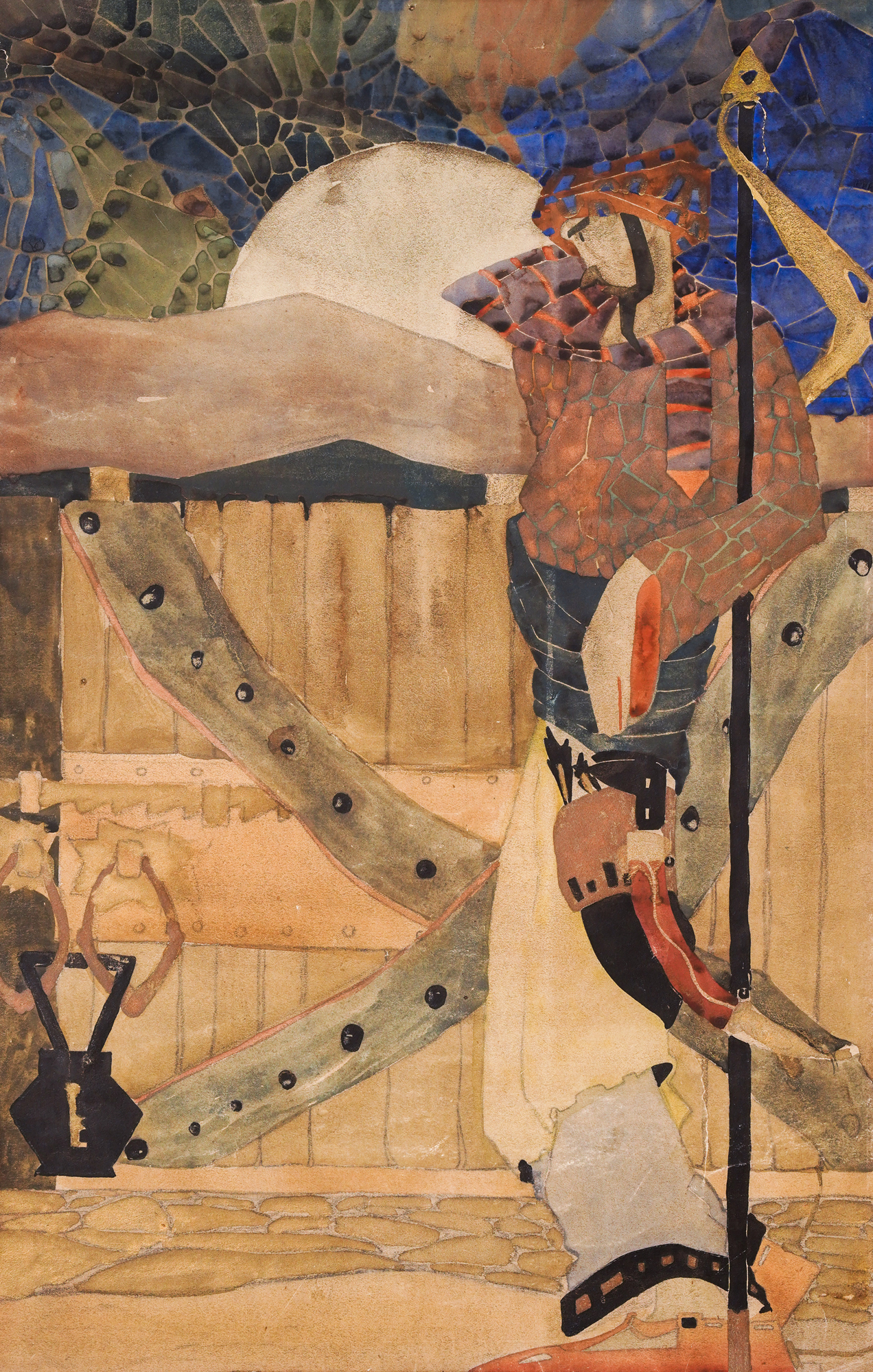
88. The guardian [1920's]
1897, Kazanlak - 1927, Sofia
Estimate:
EUR 4.000 - 6.000
Sold
EUR 85.000
watercolor, ink and gold paint on paper, 44.5 x 28.5 cm, 44,5 × 28,5 cm
PROVENANCE
Collection of Slavka Floreva, the sister of the artist's wife, passed down through her descendants to the current owners.
Ivan Milev is among the most beloved Bulgarian artists. His works are extremely rare, as most of them belong to state collections. He died young but left a lasting mark on Bulgarian art.
Ivan Milev is one of the masters of Secession combined with national tradition. His work forms part of the modernization of Bulgarian art during the first half of the 20th century. He represents the late wave of Secession after the First World War in the early 1920s. In the spring of 1926 he was accepted into the art society “Native Art” (Rodno Izkustvo).
Already well known for his young age, Ivan Milev worked for some of the most prominent publishing houses, newspapers, and magazines of the time. He also worked for the National Theatre, created murals, and produced an unrealized project for the monument on Shipka Peak.
The work “The Guard” represents a composition typical of Ivan Milev’s artistic style, executed in watercolor, tempera, and gold paint. The secessionist stylized forms construct the image of a man dressed in fairy-tale-like Eastern attire. The figure is arranged in an S-shaped pose in the right part of the pictorial field, shown in profile facing left in an outdoor setting. In the middle ground behind the guard is depicted a large wooden gate with metal fittings and a stylized black lock. The fairy-tale character of the composition is enhanced by the night sky illuminated by a large white moon.
The image of the Eastern guard is characterized by exotic details such as the colorful turban with a decorative geometric pattern in the Secession style, reminiscent of motifs often seen in the paintings of Gustav Klimt. The warrior’s shirt is rendered in a similar palette of brick-red and dark ochres, structured into elongated panels by thin grey-turquoise lines. The impression of oriental stylization is further reinforced by the dark Eastern beard and eyebrows, as well as by the distinctive weapons—a spear with a golden banner and a yataghan attached to a black belt.
The creation of such an exotic image was likely influenced by his work as a scenographer at the National Theatre, where he designed stage sets and costumes.
The painting “The Guard” is among the most characteristic works of the artist, and parallels can be drawn with some of his most emblematic works such as “A Gypsy Abducting a White Girl” (1923), “The Morphine Smoker,” “Shepherd” (1924) and others.
The work possesses exceptional qualities: a high degree of completion, a richly nuanced color palette, a fairy-tale narrative, theatricality in the decor and costume, and a relatively large format for Ivan Milev. Previously unknown, this work ranks among the significant pieces by this artist who died prematurely.
Ivan Milev was born on 19 February 1897 into the family of Milyu Lalev in the village of Shipka. He studied at the Kazanlak Pedagogical School but did not graduate. In the autumn of 1916 he was mobilized and assigned to the headquarters of the Aviation Unit as a military artist. In 1917 he served as a soldier on the Romanian front. On 18 November of the same year, while on leave, he opened a two-day solo exhibition in Kazanlak. In 1918 he graduated from high school in his hometown.
In 1919 and 1920 he worked as a teacher in the village of Korucheshme, in the Haskovo region. In 1920 he enrolled in the Academy of Fine Arts in Sofia. During his studies he held three solo exhibitions. In 1922 he illustrated book covers for “Death” by Vladimir Polyanov, “The Blue Chrysanthemum” by Svetoslav Minkov, “Fantasies” by Edgar Allan Poe, and “The Horror” by Hanns Heinz Ewers. He also designed the cover and illustrated the poetry collection “Arena” by Lamar.
In the summer of 1923 he traveled to Constantinople (Istanbul), Athens, Corfu, Naples, Rome, Florence, and Venice. In January 1924, together with Ivan Penkov, he created the stage design for “He Who Gets Slapped” by Leonid Andreyev at the National Theatre. On 29 June 1925 he received a certificate of completion with highest distinction from the Academy of Fine Arts, specializing in Decorative Arts.
In 1925 he received the State Prize for Art for his work “Krali Marko.” Together with Vasil Vichev, he participated in the 1925 competition for a monument at Shipka Peak, where their project placed second.
In the spring of 1926 he was accepted into the Rodno Izkustvo (Native Art) Society, and in April–May he participated in its exhibition with the works “Holy Mother of God” and “A Legend from Mount Athos.”
On 19 July 1925 he married the opera singer Katya Naumova, and on 18 May 1926 their daughter Maria Mileva was born. (S.N.)
For clarifications regarding the bidding procedure, hammer price costs, guarantee, payment, and collection terms for the winning lot, we recommend carefully reading/re-reading the Bidding Regulations.
For additional information regarding the lot and the auction, please contact the Art Consultants Department.
SESSION
Brought to you by
Similar lots