


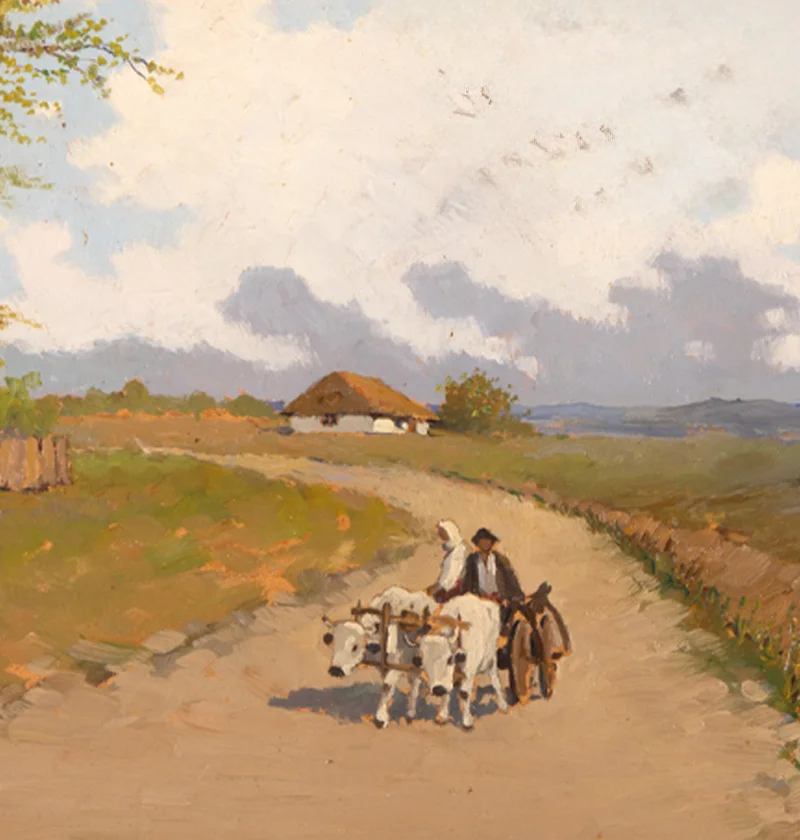

Снимките на лота са с информативен и илюстративен характер и не могат да предоставят изключително детайлен изглед на обекта от всички ъгли. Препоръчваме внимателен оглед на лота на място, преди да направите наддаване.
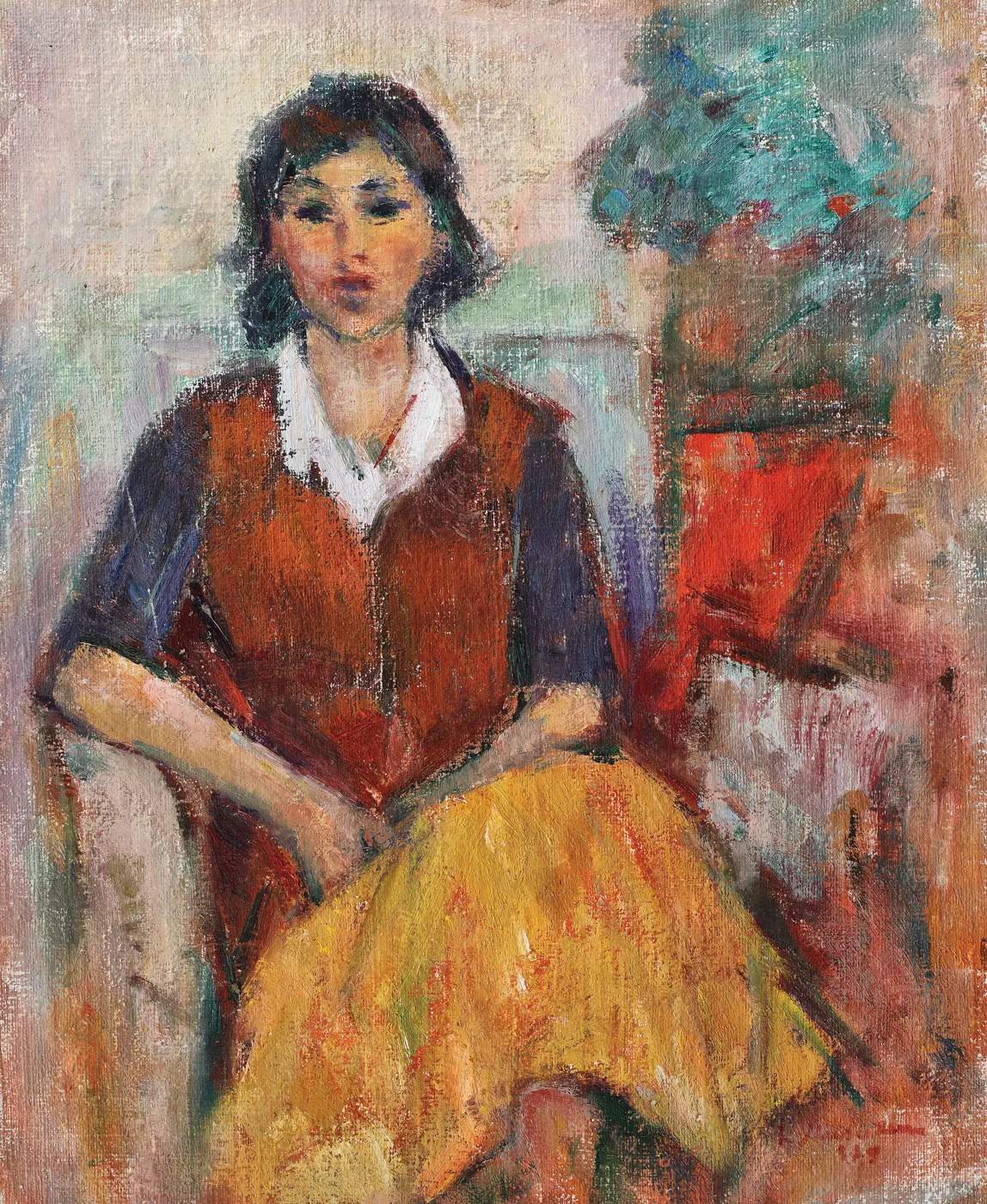
Eustațiu Stoenescu is distinguished in Romanian painting and more as one of the most important portrait painters, claiming the attention of three continents. At the same time, beyond the truth of physiognomy, Stoenescu, colourist and observer, achieved the complete display of inner unrest. Whether in politicians, intellectuals, industrialists, elegant or simple women, he knew how to find the chief personality traits and highlight them for the public. A key moment in his development as an artist is the year 1900, the year of his departure for Paris. The 16-year-old youth, under significant Grigorescu influence, is welcomed in the studio of Jean Paul Laurens, painter specialised in historical compositions and a distinguished professor, where he studied alongside Steriadi, Ressu, Dărăscu, Mutzner and others. Thanks to the close relationship with his mentor, the painter from Craiova would get to meet Rodin and Bourdelle at the studio in Dépôt de Marbres. His debut occurred in 1905, in Paris and Craiova. Being a great admirer of Velasquez, Stoenescu was already showing special regard for portraits, and his painting was still pervading in several directions. His breakthrough in the history of art is his resounding success from the spring of 1930, when he managed to exhibit his work in New York, at the famous Duran Ruel Gallery. America was so impressed by Stoenescu that he is met with receptions, the most grandiose being at the Colony Club, also attended by F.D. Roosevelt. The 1930’s were divided between Paris, Bucharest and Craiova. He spent his summers painting the St. George Church. In Bucharest, he organised a new individual exhibition at the Automobil Club. 1931 marked the creation of the famous portrait of lawyer Alexandrescu, exhibited one year later. After two exhibitions at the Official Salon in Paris, Stoenescu became more present in the Romanian artistic life, started consolidating his relations and position within the capital modern society. The demand for portraits was ever increasing and people are genuinely moved by his evocative power. At one point, Stoenescu also confines a few colour specks, an existence seemingly more authentic than the real one. His portraits, marked by the motion of shades of grey, dark red and cream white, manifesting a special care for light effects, in order to suggest depth or relief by tone gradients, appear as a fairly controversial art form at the time, but also an appealing art form for the very same reason. The portrait of the “girl in red” is one of the works created along with the celebrity status newly found by Stoenescu in 1931. By contrast to numerous representations, even satirical at times, of certain influential characters in Bucharest, this work is marked by innocence and gentleness. The same extraordinary shades of grey make up the background of the painting, the same melancholic red enriches the young girl’s dress, but what is truly striking about this composition, brimming with expressivity, is her face. The girl appears to be looking in the distance, at something that she cannot reach. It represents eloquent proof of the fact that Stoenescu managed the most complex introduction of the psychological element into a portrait. His portraits, like the one in question, seem to ask for their stories to be revealed. In technical terms, the soft and faded light, evenly distributed, contributes to the calm, yet uneasy atmosphere, directly stemming from the character’s soul. (S.T.)
Размери
width 65.5 cm, height 100 cm
Описание
oil on canvas, signed and dated lower right, in black, "Stoenescu, 1931"
Lot.material_carats
ulei pe pânză
ДОПЪЛНИТЕЛНА ИНФОРМАЦИЯ
За разяснения относно процедурата по наддаване, разходите при спечелване, условията за гаранция, плащане и вземане на спечеления лот, препоръчваме внимателно четене/препрочитане на Правилника за наддаване.
Eustațiu Stoenescu is distinguished in Romanian painting and more as one of the most important portrait painters, claiming the attention of three continents. At the same time, beyond the truth of physiognomy, Stoenescu, colourist and observer, achieved the complete display of inner unrest. Whether in politicians, intellectuals, industrialists, elegant or simple women, he knew how to find the chief personality traits and highlight them for the public. A key moment in his development as an artist is the year 1900, the year of his departure for Paris. The 16-year-old youth, under significant Grigorescu influence, is welcomed in the studio of Jean Paul Laurens, painter specialised in historical compositions and a distinguished professor, where he studied alongside Steriadi, Ressu, Dărăscu, Mutzner and others. Thanks to the close relationship with his mentor, the painter from Craiova would get to meet Rodin and Bourdelle at the studio in Dépôt de Marbres. His debut occurred in 1905, in Paris and Craiova. Being a great admirer of Velasquez, Stoenescu was already showing special regard for portraits, and his painting was still pervading in several directions. His breakthrough in the history of art is his resounding success from the spring of 1930, when he managed to exhibit his work in New York, at the famous Duran Ruel Gallery. America was so impressed by Stoenescu that he is met with receptions, the most grandiose being at the Colony Club, also attended by F.D. Roosevelt. The 1930’s were divided between Paris, Bucharest and Craiova. He spent his summers painting the St. George Church. In Bucharest, he organised a new individual exhibition at the Automobil Club. 1931 marked the creation of the famous portrait of lawyer Alexandrescu, exhibited one year later. After two exhibitions at the Official Salon in Paris, Stoenescu became more present in the Romanian artistic life, started consolidating his relations and position within the capital modern society. The demand for portraits was ever increasing and people are genuinely moved by his evocative power. At one point, Stoenescu also confines a few colour specks, an existence seemingly more authentic than the real one. His portraits, marked by the motion of shades of grey, dark red and cream white, manifesting a special care for light effects, in order to suggest depth or relief by tone gradients, appear as a fairly controversial art form at the time, but also an appealing art form for the very same reason. The portrait of the “girl in red” is one of the works created along with the celebrity status newly found by Stoenescu in 1931. By contrast to numerous representations, even satirical at times, of certain influential characters in Bucharest, this work is marked by innocence and gentleness. The same extraordinary shades of grey make up the background of the painting, the same melancholic red enriches the young girl’s dress, but what is truly striking about this composition, brimming with expressivity, is her face. The girl appears to be looking in the distance, at something that she cannot reach. It represents eloquent proof of the fact that Stoenescu managed the most complex introduction of the psychological element into a portrait. His portraits, like the one in question, seem to ask for their stories to be revealed. In technical terms, the soft and faded light, evenly distributed, contributes to the calm, yet uneasy atmosphere, directly stemming from the character’s soul. (S.T.)
ДОПЪЛНИТЕЛНА ИНФОРМАЦИЯ
За разяснения относно процедурата по наддаване, разходите при спечелване, условията за гаранция, плащане и вземане на спечеления лот, препоръчваме внимателно четене/препрочитане на Правилника за наддаване.