


Meniu

Продай / Продай
Контакт
Моят профил
Български

Открийте

Арт консултанти

Отдели търгове


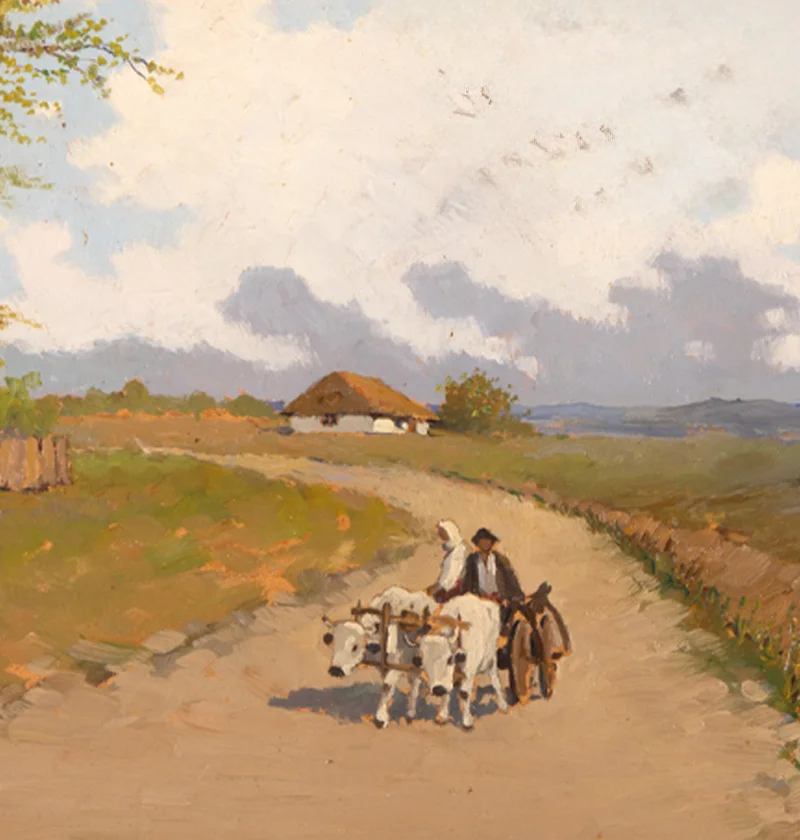
98. The Bridge from Alcántara (Toledo) [1929]

1872, Tecuci, Galați - 1949, Bucureşti

Продажна цена

EUR 14.472

Сесия

Вто, 21 октомври 2025 17:30

During his studies, Gheorghe Petrașcu was noticed by renowned artists such as Nicolae Grigorescu and G.D. Mirea, and he gathered enough pictorial qualities to consecrate him both on the stands of major exhibitions and in the history of Romanian art. The refinement of his art, in which he endeavors with confidence, follows his spontaneous intuitions from the beginning. He will never shy away from the enthusiasm foreshadowed by experiments and study exercises, and the courses taken in Paris will open up the Romanian painter's appetite for travel. He will discover Venice, which he will transcribe into exceptional pictorial frescoes, making panoramas of the canals, bridges or monumental architectural constructions. He will also visit Egypt, but one of his significant encounters will take place in Spain, especially in Toledo, where he discovers the grand construction of Alcántara, which, despite its nearly 2000-year-old, remains intact. The impressive stone bridge was built by order of the Roman Emperor Trajan, between 104-106. Today, it is included on the list of cultural interest monuments. The Spanish landscapes appear in Petrașcu's work particularly around 1929. The Iberian journey was thus transformed into pictorial motifs. The artist here familiarizes himself with the works of El Greco, Goya or Velázquez and develops a preference for the arid and unusual landscape. The Castilian sun will cast over the palette of the Romanian painter who will prefer buildings and stone constructions at the expense of the vegetal motif. "The Sun Gate", "The Bridge of San Marin" or "The Bridge of Alcántara" become recurring motifs that will quickly integrate into the houses of Romanian collectors. From Doctor Iosif Dona to lawyer Aurel Vladimir Diaconu, the famous Iberian bridges will crown the collections of connoisseurs, avid of art and lovers of landscapes. The artist respects the real pretext from which he starts in structuring the composition and does not deviate too much from the prerogatives adjacent to the subject. The Spanish motif will evolve throughout a stand-alone thematic cycle, in which the wide plans prevail, attesting the remarkable plastic value of the artist. If Iosif Iser brought back from the Iberian lands the sun-burnt faces and female bodies with characteristic garments, Petrașcu was more interested in transposing an original topos into his canvases. In Spain, Petrașcu will deepen the expressiveness of light and shadow play, the deep feeling of colors and the reflections of encounters between water and celestial planes.

Препратки

OPRESCU, George, "Gheorghe Petrașcu", Meridiane Publishing House, Bucharest, 1963. FLOREA, Vasile, "Gheorghe Petrașcu", Meridiane Publishing House, Bucharest, 1989.

Размери

width 18.5 cm, height 24 cm

Описание

ulei pe pânză lipită pe carton, signed bottom right, in black, "G. Petrașcu"

Информация от изследване

The work is reproduced in the album "Petrașcu", by Aurel Vladimir Diaconu, "Royal Foundation for Literature and Art", Bucharest, 1946, p. 25 (dimensions shown incorrectly, perhaps including the mat). The work is reproduced in the monograph "Gheorghe Petrașcu", by Vasile Florea, Meridiane Publishing, Bucharest, 1989, cat. 93 (dimensions shown incorrectly, possibly including the mat). The work is reproduced in the "Art" magazine, no. 8-9, 1972, on page 15.

Запознанства

1929

ПРОИЗХОД

Av. Vladimir Diaconu's collection

ДОПЪЛНИТЕЛНА ИНФОРМАЦИЯ

За разяснения относно процедурата по наддаване, разходите при спечелване, условията за гаранция, плащане и вземане на спечеления лот, препоръчваме внимателно четене/препрочитане на Правилника за наддаване.

За допълнителна информация относно лота и търга, моля свържете се с Отдела на арт консултантите.

Алтернативни лотове