


Meniu

Продай / Продай
Контакт
Моят профил
Български

Открийте

Арт консултанти

Отдели търгове


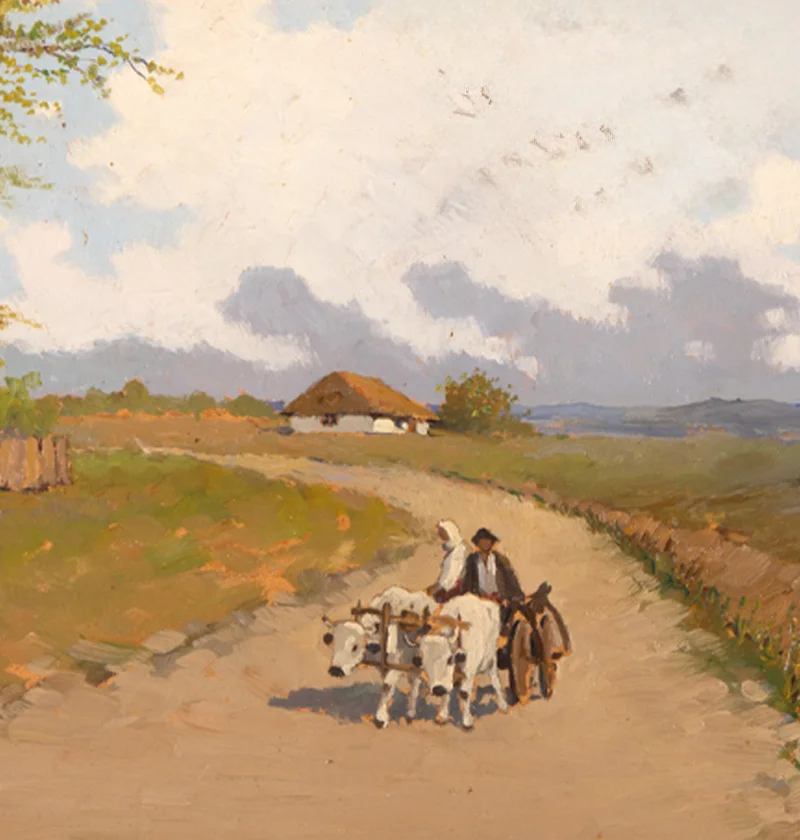
52. The Church in Câmpulung [1867]

1838, Pitaru, Dâmboviţa - 1907, Câmpina

Оценка

EUR 50.000 - 100.000

Продадено

EUR 120.000

Сесия

Вто, 19 декември 2017 19:30

In May 1867, Nicolae Grigorescu, a Romanian scholarship recipient in Paris and an artist integrated in the Barbizon School, returned to Romania for several months to find specific subjects in our country, landscapes, figure typologies, etc. What Grigorescu aimed to do was that through his own creation, the Romanian motifs would enter the repertoire of modern European art, correlating with its tendencies: "our homeland represents enough subjects worthy of studing, enough original and artistic beauties to be able to have its own dignified place in the gallery of any museum in the Western world "(apud Barbu Brezianu, 1959, p. 87). Grigorescu returned to the country and requested the extension of the scholarship for another two years. He was more than halfway through his training, he had just made his debut in the international artistic life, showing seven paintings at the Fine Arts Salon of the Universal Exhibition opened in Paris in April 1867. Arriving in the country, he travelled to Căldăruşani, Târgovişte, Câmpulung, Rucăr, at least two of these places being considered in that century of nations and prospecting the past, the true home of the nation. In Câmpulung and Târgovişte, the first capitals of Wallachia, emblematic monuments for the Romanian Middle Ages were still preserved. In Câmpulung Grigorescu finds both past and present, and the medieval vestige of Bărăţia, as well as the contemporary fair, full of bustle, bearing the mark of rural life. In this painting, both aspects are correlated, the silhouette of the old architecture (the belfry tower on the right side of the image), as well as the alley bathed in light and shade. The lighted and shaded areas intertwine, showing the moment of a summer afternoon. Painted in translucent ochres that still preserve their earthiness, the shadow areas cover much of the left side of the work. They come in contrast with the powerful light source springing out of the sky with white clouds, as if cut, arched over this piece of scenery. A few characters, tiny silhouettes, a peasant woman, a rider, animate with discretion the scenery bathed in the warmth of the midday. Obviously painted in plein air, the work carries in the dynamic and unpredictable style of the brushstrokes the vitality and non-finite appearance of the sketch, the rhythm and the emotion of the execution on the spot. The palette is restricted to the nature's chromatics according to Barbizon artists’ preference for neutral tones: earthy colors, intense ochres, various types of concentration and brightness, coloured whites, blue for strips of the sky. We know of three paintings by Grigorescu, depicting the Bărăţia alley in Câmpulung. These are variants and not replicas of a single work, each time the artist being placed in another spot of the landscape, overlooking the Church Tower. Perhaps one of the three paintings, the one entitled Câmpulungu, was featured in the great exhibition of the Society of the Friends of the Fine Arts Society, designed by Alexandru Odobescu and opened at the Herdan Hotel in Bucharest in 1873 (cat. 216, p. 9). The eponymous work in the patrimony of the National Museum of Art of Romania (National Gallery, item 1231), made in concentrated spots of pictorial matter, with dramatic areas of contrast between light and shadow, with close-knit elements of the composition, is perhaps the result of a resumed dialogue with the motif, so possibly painted later than the one we are talking about. The third painting (Vlahuţă, il. p. 50, the collection of Eng. Dan Capriel in 1984) may belong to a later period, because the construction and luminosity of the image, and the tiny signature remind of the 90s in the artist's creation. Therefore, belonging to the moment 1867 (the signature also corresponds to this dating), our work may be the earliest of the mentioned group of versions. It may have had a significance in Grigorescu's preferences, because the artist presented it in 1889 with the title Vue de Câmpu-Lung at the Universal Exhibition in Paris (Beaux-Arts Salon, Romania's Pavilion). For his entire participation (18 oil paintings), Grigorescu was awarded a silver medal. This work remains a testimony of how Grigorescu worked "sur le motif", close to the Impressionists' target of capturing variations in light at various times of the day. At the same time, the history of the work, along with the series of prestigious collections it has belonged to (Gheorghe Gr. Cantacuzino "The Nabob", 1832-1912, Grigore Bălăceanu, 1876-1967, Dr. Anton Buşulenga), gives it a privileged status. (I.B.)

Препратки

Ioana Beldiman, Gheorghe Cosma], Nicolae Grigorescu, pictură-grafică, Muzeul de Artă al RSR, 1984-1985
Georges Bibesco Prince, 1889 Exposition universelle. La Roumanie, avant-pendant-après, Imprimerie typographique J.Kugelmann, Paris, 1890
Barbu Brezianu, Nicolae Grigorescu, Ed.Tineretului, Bucureşti, 1959
Virgil Cioflec, Grigorescu, Bucureşti, Cultura Naţională, 1925
Ionel Jianu, V. Beneş, Mărturii despre N.Grigorescu, antologie critică, Editura de stat pentru literatură şi artă, Bucureşti, 1957
Francisc Şirato, Grigoresco, Editions de la connaissance, Bruxelles, 1938
Mariana Vida, Monica Enache, Grigorescu, pictor al naturii (1838-1907) / Grigorescu peintre de la nature, Muzeul Naţional de Artă al României, Bucureşti [2007].
A.Vlahuţă, Pictorul N.I.Grigorescu. Vieaţa şi opera lui, ediţia Casei Şcoalelor, Bucureşti, 1910

Размери

width 59 cm, height 45 cm

Описание

oil on cardboard, signed lower left, in brown, "Grigorescu"

Информация от изследване

Opera a fost pictată de Nicolae Grigorescu în vara anului 1867, când, întors în țară din Franța, unde participase la Expoziția Universală de la Paris, călătorea și lucra în zona Argeșului, la Căldărușani, Câmpulung și Rucăr. „Bărăția din Câmpulung” cunoaște alte două variante, una în colecția Muzeului Național de Artă al României, inv. 1231, 34 x 71 cm și una în colecția istorică Ioan G. Manu, 54 x 65 cm. Este foarte probabil ca opera să fi participat la Expoziția Societății Amicilor Bellelor Arte, București, Hotel Herdan, 1 ianuarie - 22 februarie 1873. La categoria 216 din catalogul expoziției este menționată opera „Câmpulungu”. Opera a participat la "Exposition Universelle Internationale de 1889 a Paris", 5 mai - 31 octombrie 1889 și este inventariată în Catalogul General Oficial al Expoziției, vol I, la pag. 261, cat. 15, sub titlul "Vue de Câmpu-Lung". Opera este reprodusă în catalogul "Exposition Universelle Internationale de Paris 1889. Section Roumaine". Opera a participat la expoziția retrospectivă Nicolae Grigorescu, Muzeul de Artă al R.P.R., București, 1957 și este menționată în catalogul de expoziție la cat. nr. 50, pag. 32, sub titlul "Bărăția din Cîmpulung". Opera este reprodusă și inventariată în monografia "N.Grigorescu", vol. I, acad. G. Oprescu, Ed. Meridiane, București, 1962 la cat. 101, pag. 271.

Запознанства

1867

ПРОИЗХОД

historic collection of Gheorghe Grigore "The Nabob" Cantacuzino (1832-1913); historic collection of Grigore Bălăceanu (1876-1967); historic collection of Dr. Anton Bușulenga.

ДОПЪЛНИТЕЛНА ИНФОРМАЦИЯ

За разяснения относно процедурата по наддаване, разходите при спечелване, условията за гаранция, плащане и вземане на спечеления лот, препоръчваме внимателно четене/препрочитане на Правилника за наддаване.

За допълнителна информация относно лота и търга, моля свържете се с Отдела на арт консултантите.

Алтернативни лотове

Sinaia Monastery

42. Sinaia Monastery

Ludovic Bassarab

    Оценка EUR 1.000 - 1.800
    Продадено EUR 2.000
Roses

222. Roses

Traian Cornescu

    Оценка EUR 800 - 1.200
Jug with Snapdragon

135. Jug with Snapdragon

Constantin Artachino

    Оценка EUR 700 - 1.000
    Продадено EUR 1.400
Nymph and Faun

3. Nymph and Faun

Constantin Baraschi

    Оценка EUR 1.000 - 1.800
    Продадено EUR 1.400